

On this page
In chemistry exams, the hardest marks to secure are often the short "give reason" questions. When asked why a reaction speeds up or why one molecule is more basic than another, students frequently write down a true statement and assume it is the correct answer.
In a 2021 study published in Chemistry Education Research and Practice, researchers analysed how 170 undergraduate students justified acid-base equilibria. They found that the majority relied on "relational reasoning"—restating rules or observable properties—rather than explaining the underlying chemical mechanism.
This gap between stating a fact and proving a mechanism is why students often lose marks on what seems like a simple question. Understanding the difference is the first step to writing complete answers.
Why do students lose marks on "give reason" questions?
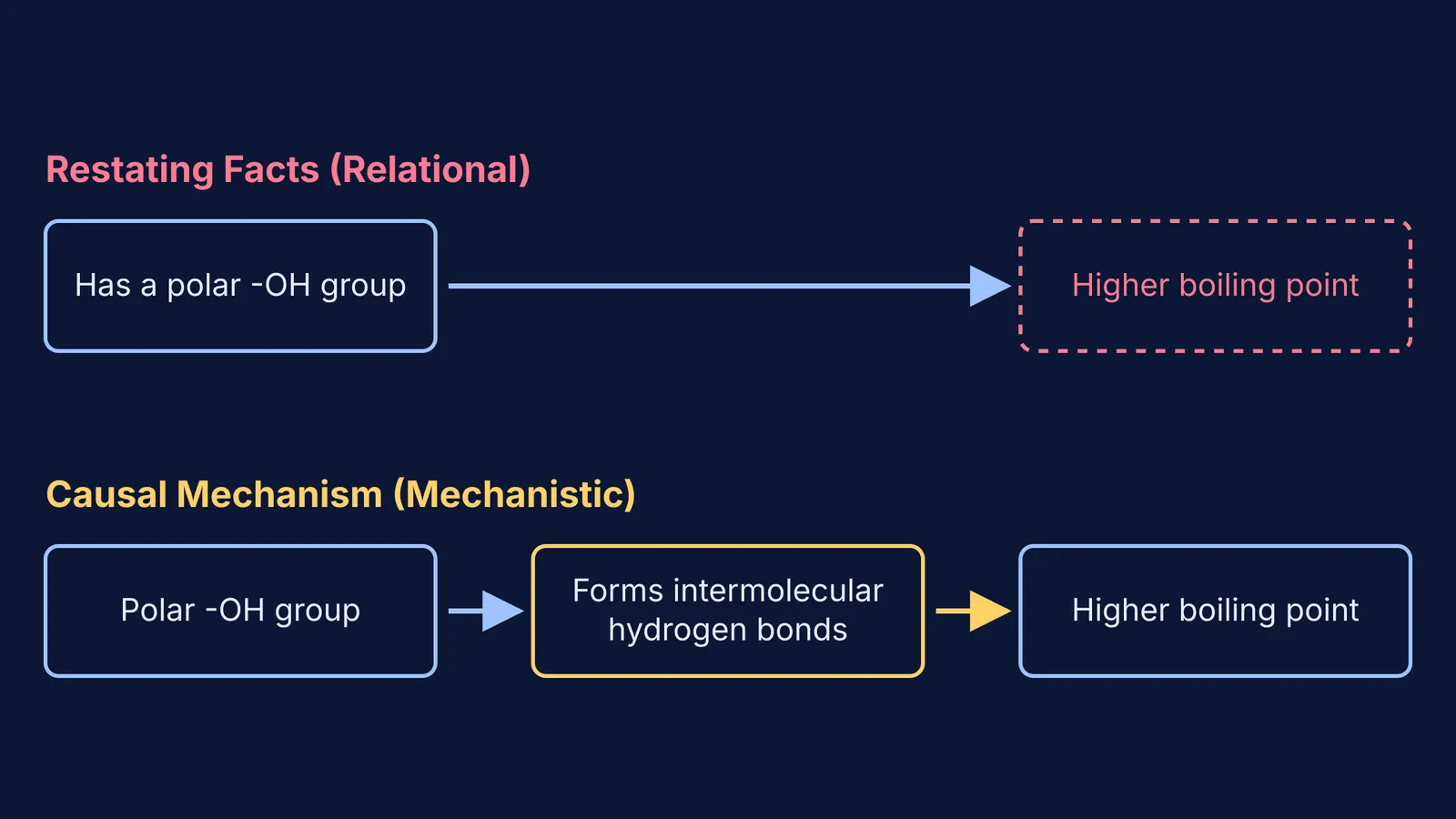
Traditional assessments often reward the recall of facts. When students encounter an "explain why" prompt, they may default to stating a rule of thumb. For example, if asked why propan-1-ol has a higher boiling point than butane, a student might write: "Because propan-1-ol has hydrogen bonding."
While true, this is a relational answer. It identifies the feature but does not explain *how* that feature causes the outcome. Board exam marking schemes routinely divide the score for a single-mark question into two parts: one part for identifying the correct chemical principle, and one part for the causal link explaining the observation.
To secure full credit, you must provide a causal mechanism: "Propan-1-ol contains a polar -OH group which forms intermolecular hydrogen bonds. These are stronger than the dispersion forces in butane, so more thermal energy is required to separate the molecules."
How do you ask an AI to check your reasoning answers?
Standard AI chatbots often just print out the textbook answer. If you copy their response, you might memorise a paragraph without understanding the mechanism. Instead, you can use an AI tutor to check your own drafts and spot where your causal chain is broken.
If you are using a dedicated learning platform, Fermi's AI tutor can help. Because it holds a line of reasoning across a whole session, it notices where a student is stuck and decides whether to explain, ask, or show. It works out what you already know and builds a plan for the session, teaching you rather than just handing over the answer.
If you are missing the vocabulary to describe the mechanism, you can look up the specific interactions (like inductive effect, hyperconjugation, or steric hindrance) in the Fermi Concept Library, which covers every concept in physics, chemistry, biology, mathematics and computing.
When you draft your answer, give the AI a specific prompt to evaluate your logic:
"Check my answer to this chemistry question: [Question]. My answer: [Answer]. Did I provide a full causal mechanism, or did I just restate a fact?"
"Where is the gap in my reasoning chain? What specific interaction am I failing to mention?"
"Score this answer as a board examiner out of 1 mark, checking for both the principle and the causal link."
How does an AI check an organic chemistry answer?
Consider a common question from organic chemistry: *Give a reason why ammonia (NH₃) is more basic than phosphine (PH₃).*
Student's draft answer: "Ammonia is more basic because nitrogen is more electronegative than phosphorus."
The AI check: "You have correctly identified a property (electronegativity), but this is just restating a fact. You have not explained the mechanism. Nitrogen is smaller than phosphorus. How does this smaller size affect the electron density of the lone pair, and why does that make it a better base?"
Revised answer: "Nitrogen has a smaller atomic size than phosphorus, leading to a higher electron density per unit volume on the nitrogen atom. This makes the lone pair of electrons on nitrogen more readily available for donation to a proton, making NH₃ a stronger base."
By forcing the AI to grade the *structure* of the reasoning rather than just the factual accuracy, you train yourself to think in mechanisms. This approach works just as well for understanding ambident nucleophiles or interpreting integrated rate law graphs—areas where missing the causal link costs crucial marks.
Whether you are identifying conjugate acid-base pairs or explaining leaving groups, mastering the causal chain ensures you get credit for what you know.


