

On this page
In the Class 12 chapter on haloalkanes, you meet several reagents that turn an alcohol into an alkyl chloride: concentrated HCl with zinc chloride, phosphorus trichloride, phosphorus pentachloride and thionyl chloride. All four do the same job. A common "give reason" question asks why thionyl chloride is the one chemists prefer. The answer is about what else ends up in the flask.
Why is thionyl chloride preferred for making alkyl chlorides?
The NCERT Class 12 Chemistry textbook, Unit 6 Haloalkanes and Haloarenes gives the reason in section 6.4.1: thionyl chloride is preferred because the alkyl halide forms along with the gases SO₂ and HCl, and "the two gaseous products are escapable, hence, the reaction gives pure alkyl halides."
The equation is R–OH + SOCl₂ → R–Cl + SO₂ + HCl.
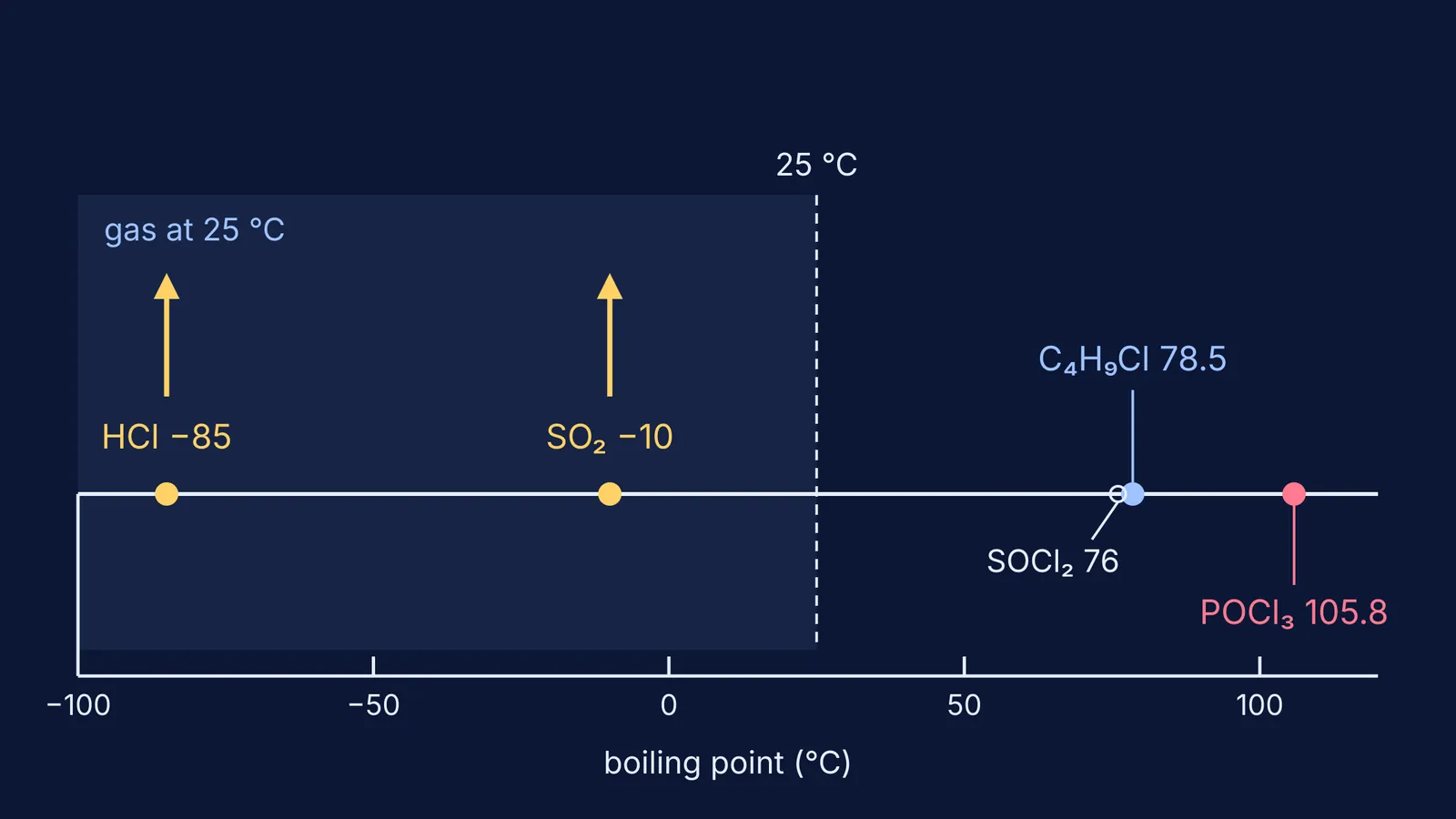
Sulphur dioxide boils at −10 °C (PubChem, sulfur dioxide). Hydrogen chloride boils at −85 °C (PubChem, hydrogen chloride). Both are far below room temperature, so they leave the reaction mixture as gases. The only organic product left behind is the one you wanted.
What do PCl₃, PCl₅ and HCl/ZnCl₂ leave behind?
The same NCERT section lists the other routes. Look at the right-hand side of each equation and ask whether each by-product is a gas.
HCl with ZnCl₂: R–OH + HCl → R–Cl + H₂O. Water stays in the mixture, and so does the zinc chloride catalyst. NCERT notes that primary and secondary alcohols need ZnCl₂, while a tertiary alcohol reacts just by shaking it with concentrated HCl at room temperature. The order of reactivity is 3° > 2° > 1°.
PCl₃: 3R–OH + PCl₃ → 3R–Cl + H₃PO₃. Phosphorous acid is not a gas, so it stays in the flask and must be separated.
PCl₅: R–OH + PCl₅ → R–Cl + POCl₃ + HCl. The HCl escapes, but phosphorus oxychloride is a liquid that boils at 105.8 °C (PubChem, phosphorus oxychloride).
SOCl₂: both by-products are gases, so nothing extra needs to be separated.
Worked example: making 1-chlorobutane
Say you want 1-chlorobutane from butan-1-ol. 1-Chlorobutane boils at 78.5 °C (PubChem, butyl chloride), and POCl₃ boils at 105.8 °C (PubChem, phosphorus oxychloride).
With PCl₅, your flask holds 1-chlorobutane (78.5 °C) and POCl₃ (105.8 °C). Both are liquids, about 27 °C apart, so you need a careful fractional distillation to separate them.
With PCl₃, you have the product plus phosphorous acid to remove.
With HCl and ZnCl₂, you have the product plus water and the catalyst. You then need to separate the layers and dry the product.
With SOCl₂, the SO₂ and HCl bubble off as the reaction runs. No by-product is left to separate.
One honest footnote for curious students: "pure" here means free of by-products. Thionyl chloride itself boils at about 76 °C (PubChem, thionyl chloride), so any unused reagent still has to be removed. That is a good point to raise if your teacher asks a follow-up question. It does not change the textbook answer.
How do you write the give-reason answer in an exam?
Use this three-part structure. It works for any "which reagent is preferred" question.
Write the equation: R–OH + SOCl₂ → R–Cl + SO₂ + HCl.
State the key fact: both by-products, SO₂ and HCl, are gases and escape from the reaction mixture.
Conclude: no separation from by-products is needed, so you get a pure alkyl chloride. With PCl₅ or PCl₃, a by-product that is not a gas, such as POCl₃ or H₃PO₃, stays behind and has to be separated.
One check before you write: none of these methods works for making aryl halides from phenols. NCERT explains that the carbon-oxygen bond in phenols has partial double bond character, which makes it hard to break. Keep that in mind if a question switches from alcohols to phenols.
Where does this fit in the rest of the chapter?
This question is one example of a wider habit: judging a reagent by what it leaves behind and by what can go wrong. The same thinking explains why sulphuric acid is not used with KI to prepare alkyl iodides. SOCl₂, PCl₅ and PCl₃ also come back when you are converting carboxylic acids to acid chlorides, with the same by-products. Why does OH need help to leave at all? See how to decide leaving group ability.
If you want to practise reagent-choice questions with every step explained, the Fermi Problem Library has worked problems with a step-by-step solver that explains the reasoning rather than printing an answer. For a gap in the background, such as catalysts or bond polarity, the Fermi Concept Library gives each chemistry concept its own lesson.


