

On this page
Acyl chlorides (acid chlorides) are among the most versatile synthetic intermediates in organic chemistry. Because the carbonyl carbon is bonded to an electronegative chlorine leaving group, acyl chlorides react readily with alcohols, amines, and organometallic reagents. In competitive exams like JEE and NEET, converting a carboxylic acid to an acid chloride is a core transformation. Three inorganic reagents dominate this reaction: thionyl chloride (SOCl2), phosphorus pentachloride (PCl5), and phosphorus trichloride (PCl3). While all three replace the carboxylic hydroxyl (-OH) group with chlorine, their distinct by-products dictate how easily the final product can be purified.
How do PCl5, PCl3, and SOCl2 convert carboxylic acids?
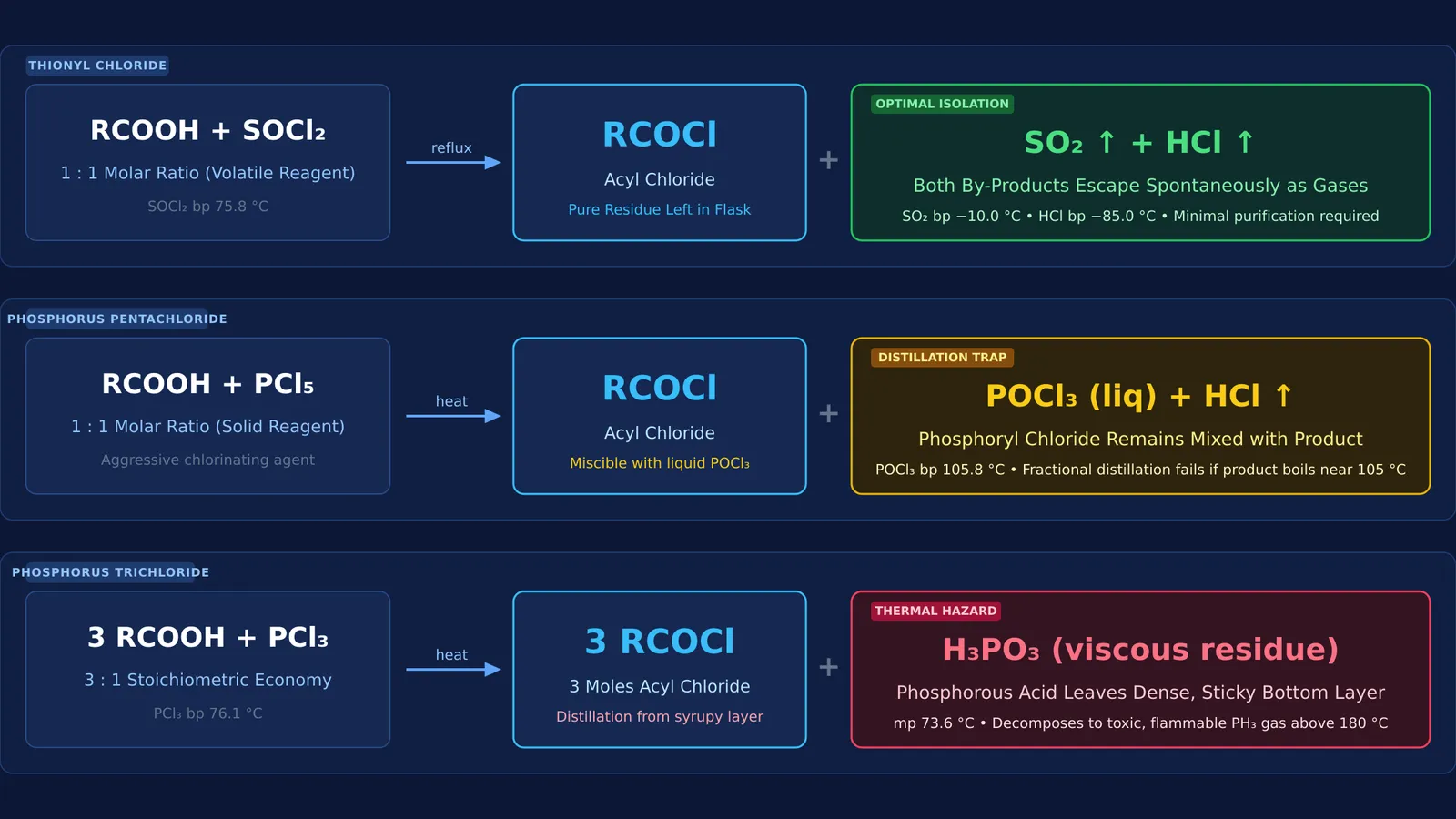
Each reagent converts the poor leaving group of a carboxylic acid into an activated species displaced by chloride, as reviewed by El-Faham and Albericio (2011) in Chemical Reviews. Their balanced equations reflect different stoichiometric demands:
Thionyl chloride (SOCl2): One mole of acid reacts with one mole of SOCl2 to yield acyl chloride, sulfur dioxide gas, and hydrogen chloride gas:
RCOOH + SOCl2 → RCOCl + SO2 + HCl
Phosphorus pentachloride (PCl5): One mole of acid reacts with one mole of solid PCl5 to produce acyl chloride, liquid phosphoryl chloride, and hydrogen chloride gas:
RCOOH + PCl5 → RCOCl + POCl3 + HCl
Phosphorus trichloride (PCl3): One mole of PCl3 converts three moles of acid into three moles of acyl chloride and one mole of phosphorous acid:
3 RCOOH + PCl3 → 3 RCOCl + H3PO3
As the NCERT Class 12 Chemistry textbook notes, thionyl chloride is preferred because its other products are gaseous and escape the mixture, greatly simplifying purification.
Why does SOCl2 make purification so much easier?
The distinct advantage of thionyl chloride comes down to phase behavior. As shown in the NCERT Class 12 Chemistry textbook, both sulfur dioxide and hydrogen chloride are gases under ambient conditions. According to the NIST Chemistry WebBook, sulfur dioxide boils at 263.1 K (-10.0 °C), while hydrogen chloride boils at 188.1 K (-85.0 °C) in the NIST Chemistry WebBook.
Because both by-products boil far below room temperature, they bubble out of the reaction flask during reflux. Once the acid is consumed, only the acyl chloride and excess thionyl chloride remain. Pure thionyl chloride boils at 348.9 K (75.8 °C) per the NIST Chemistry WebBook. Because thionyl chloride is relatively volatile, gentle heating under reduced pressure removes any excess, isolating pure acyl chloride without tedious extractions.
In contrast, phosphorus halides leave condensed residues:
PCl5 generates liquid phosphorus oxychloride (POCl3), which remains mixed with the product.
PCl3 leaves viscous phosphorous acid (H3PO3), with a melting point of 73.6 °C as reported in PubChem CID 407. Distilling acyl chlorides from crude H3PO3 above 180 °C risks thermal disproportionation into toxic, flammable phosphine gas (PH3).
What happens when product and by-product boiling points overlap?
The practical flaw of PCl5 appears when preparing acyl chlorides whose boiling points lie near that of phosphorus oxychloride. Phase change data in PubChem CID 24813 record the normal boiling point of POCl3 at 105.8 °C (378.9 K).
Consider butyryl chloride. The NIST Chemistry WebBook records the boiling point of butyryl chloride at 375.0 K (102.0 °C). When butyric acid reacts with PCl5, the product (102.0 °C) and POCl3 (105.8 °C) form a miscible liquid mixture differing by only 3.8 °C. Routine fractional distillation cannot separate them cleanly.
With SOCl2, however, the by-products escape as gases, allowing pure butyryl chloride to be isolated cleanly. In classic synthetic procedures, researchers such as Cason and Reist (1958) in The Journal of Organic Chemistry used thionyl chloride with a catalytic tertiary amine base like pyridine to prepare acid chlorides without destructive side reactions.
How should you choose a chlorinating reagent in the laboratory?
When choosing a chlorinating reagent for synthesis or exam problems, follow this checklist:
Check product boiling point: If the target acyl chloride boils near the 105.8 °C boiling point of POCl3 recorded in PubChem CID 24813, avoid PCl5 to prevent difficult separation from POCl3.
Monitor distillation temperature: When using PCl3, keep distillation temperatures below the 180 °C decomposition threshold documented in PubChem CID 407 to prevent phosphorous acid from decomposing into toxic phosphine gas.
Consider catalytic activation: For slow reactions, a drop of N,N-dimethylformamide (DMF) reacts with SOCl2 to form an active Vilsmeier intermediate that accelerates chlorination.
Scrub outgoing gases: Because SOCl2 and PCl5 evolve acidic fumes, always route the reflux condenser to an aqueous or basic gas trap.
Acyl chlorides prepared by these methods are central to carbonyl chemistry, serving as precursors in the Rosenmund reduction to prepare aldehydes and reactions covered in our guide to carboxylic acids and their derivatives. Understanding why specific reagents are chosen helps students master organic chemistry mechanisms without rote memorization.
To see how these functional group conversions link into larger synthetic routes, the Fermi Concept Library organizes every concept in physics, chemistry, biology, mathematics and computing, each with its own lesson and its place in the map. If you are practicing numerical and multi-step synthesis questions, the Fermi Problem Library provides worked problems with a step-by-step solver that explains the reasoning rather than printing an answer.


