

On this page
The speed of a pulse is distance divided by time, and the Class 9 practical asks you to measure both on a stretched slinky. CBSE's Class IX Science curriculum for 2026-27 lists it as experiment 10, "Determination of speed of a pulse propagated through a stretched string/ slinky (helical spring)", and practical work carries 5 marks of internal assessment (CBSE Science curriculum 2026-27).
What is the difference between a transverse and a longitudinal pulse?
A pulse is a single disturbance that travels along the slinky while each coil moves a little and returns.
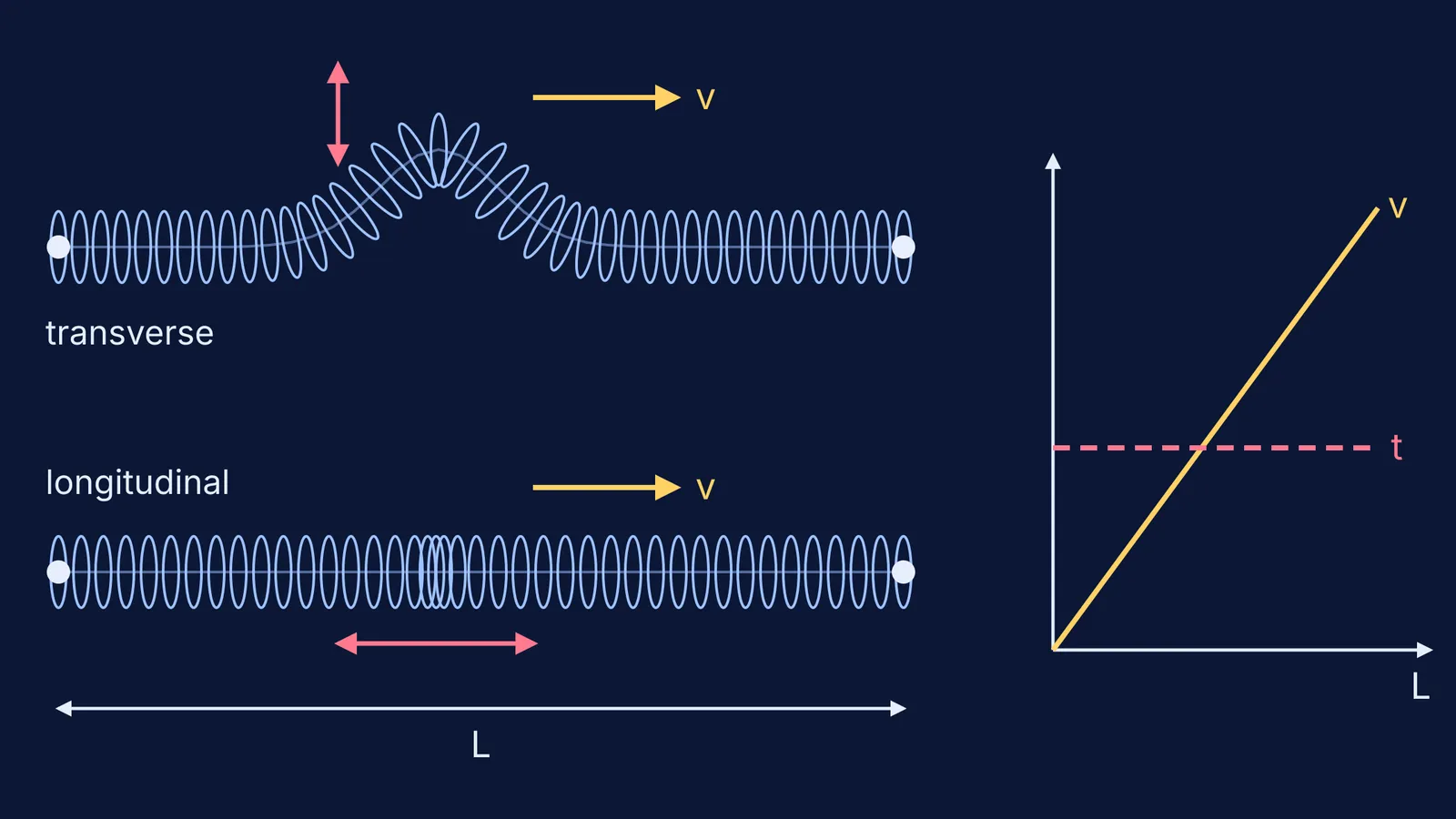
Transverse pulse: flick your end sideways once. Coils move at right angles to the direction of travel, and a hump runs along.
Longitudinal pulse: give your end one sharp push along the slinky. Coils move back and forth along the direction of travel, and a bunched-up compression runs along.
The CBSE curriculum asks you to explain that sound travels as a longitudinal wave, so the push-type pulse matters for theory too. For why the sideways kind cannot cross air, read why transverse waves cannot travel through gases.
How do you measure the speed of a pulse in a slinky?
You need a slinky, a measuring tape, a stopwatch (a phone works), chalk and a partner.
Lay the slinky on a smooth floor. Your partner holds the far end still.
Stretch it to a measured length L, say 2.0 m, and chalk both ends so every trial uses the same length.
Send one small transverse pulse and start the stopwatch together.
Stop the watch after a fixed number of crossings, say four (there and back twice), so the distance is 4L.
Repeat three to five times and average.
Repeat with a longitudinal pulse; tie a thread to one coil to follow the compression.
Speed = total distance ÷ average time.
If the pulse fades too fast, film it and count frames, as in our guide to slow-motion video physics experiments.
Does stretching a slinky change the speed of the pulse?
Yes: the more you stretch it, the faster the pulse travels. The speed of a wave on a stretched string is v = √(T/μ), where T is the tension and μ is the mass per unit length (OpenStax University Physics, section 16.3). Stretching raises T and spreads the mass out, so μ falls; both raise the speed.
Now the part that is easy to miss. A slinky's relaxed length is small next to its stretched length, so the tension is close to kL, where k is the spring constant, while μ = m/L. Then v ≈ L√(k/m), and the crossing time L ÷ v ≈ √(m/k) does not contain L at all.
R. C. Cross and M. S. Wheatland, physicists at the University of Sydney, give the same time scale for push-type pulses in the American Journal of Physics: in their model, waves in the spacing of the turns travel along a spring in a characteristic time √(m/k) (Cross and Wheatland, 2012). Their typical metal slinky had a mass of 215.5 g and a best-fit spring constant of 0.69 N/m, which by our calculation puts that time at about 0.56 s.
So doubling the stretch roughly doubles the speed but leaves the crossing time almost unchanged. Similar times at two stretches are the physics working, not a timing mistake. Because a real slinky's relaxed length is not quite zero, the transverse crossing time may fall slightly as you stretch more. For the string version, see how wave speed on a string changes with tension.
Worked example: from stopwatch readings to speed
These transverse-pulse readings are invented to match the 0.56 s crossing time worked out from Cross and Wheatland's metal slinky. L = 2.0 m, four crossings timed.
Distance: 4 × 2.0 m = 8.0 m
Times: 2.20 s, 2.28 s, 2.16 s
Average: 6.64 s ÷ 3 = 2.21 s
Speed: 8.0 m ÷ 2.21 s = 3.6 m/s
One crossing: 2.21 s ÷ 4 = 0.55 s
At 1.5 m the crossing time should stay near 0.56 s, so the predicted speed is about 2.7 m/s. Your slinky's numbers will differ. Record what you actually measure; never adjust readings to fit a prediction.
What should go in your practical file?
A sketch of each pulse, with arrows for coil motion and direction of travel.
Observations: L, crossings counted, distance, each time, average time, speed.
A stretch test: the same readings at two lengths, and one line on what changed.
Precautions: far end fixed, small pulses of equal size, no overstretching, one person timing.
Result: each pulse's speed in m/s, with the length stated.
If v = √(T/μ) feels memorised rather than understood, the Fermi Concept Library gives each physics concept its own lesson and its place in the map. For wave-speed numericals, the Fermi Problem Library has a step-by-step solver that explains the reasoning rather than printing an answer.
Chalk your lines, count four crossings, then try a second stretch.


