

On this page
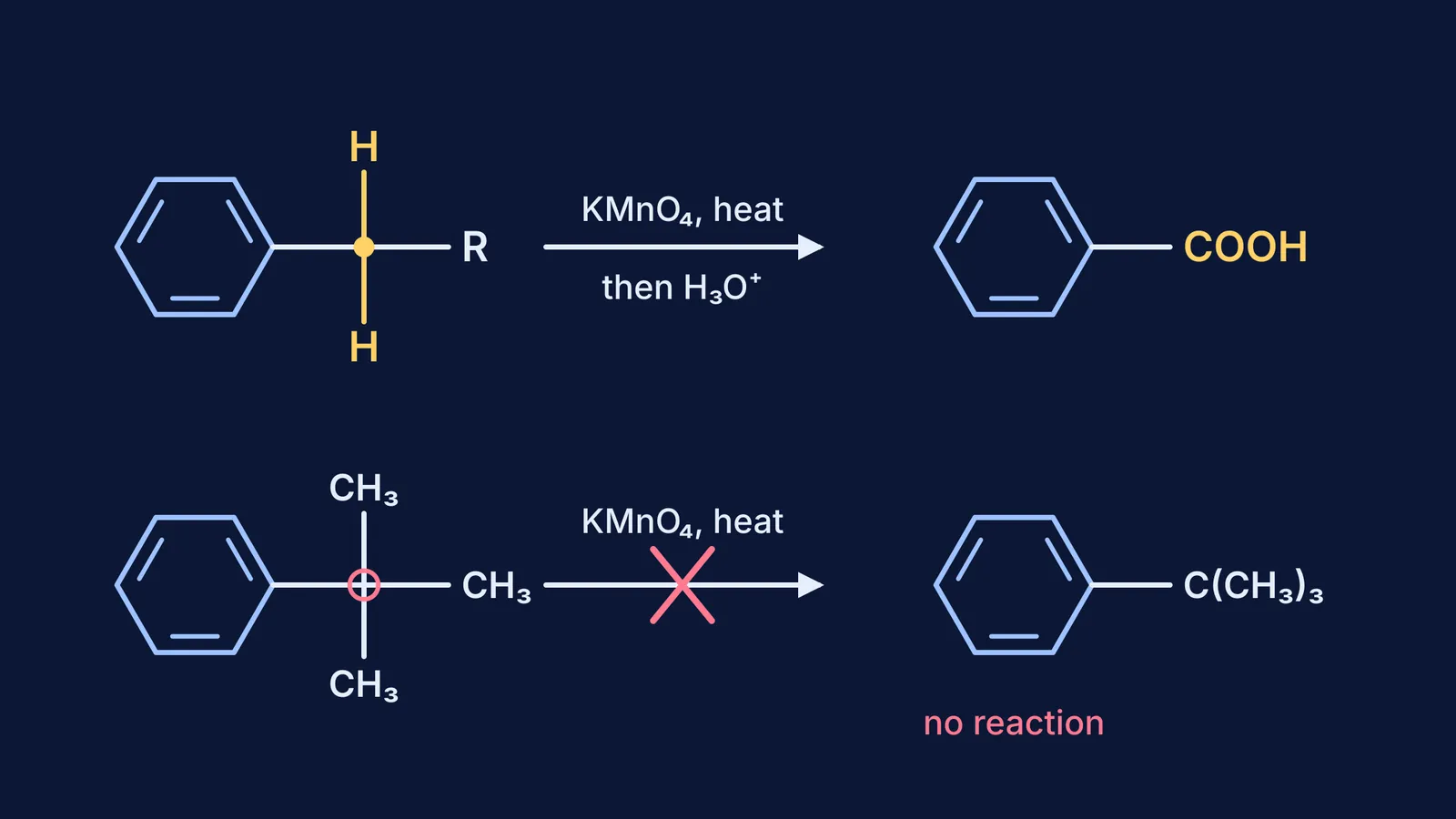
Heat toluene with alkaline KMnO4, acidify, and you get benzoic acid. Swap in propylbenzene or butylbenzene and you still get benzoic acid. Swap in tert-butylbenzene and nothing happens. One rule explains all three, and once you see it, side-chain oxidation questions in CBSE boards and JEE Main come down to one quick check.
What does KMnO4 do to an alkylbenzene?
NCERT's Class 12 chemistry textbook says that aromatic carboxylic acids can be made by vigorous oxidation of alkylbenzenes with chromic acid or with acidic or alkaline potassium permanganate, and that "the entire side chain is oxidised to the carboxyl group irrespective of length of the side chain" (NCERT Class 12 Chemistry, Aldehydes, Ketones and Carboxylic Acids, section 8.7). The same page shows toluene and propylbenzene each heated with KMnO4–KOH to give potassium benzoate, which becomes benzoic acid when acidified.
So the product keeps exactly one carbon from the side chain: the one bonded to the ring. That carbon becomes the –COOH carbon, and every other carbon in the chain is cut away. In alkaline conditions you first get the benzoate salt; the acid workup gives benzoic acid itself.
The OpenStax university textbook gives a real example: butylbenzene oxidised by aqueous KMnO4 gives benzoic acid in 85% yield (OpenStax Organic Chemistry, Oxidation of Aromatic Compounds). Three carbons of the butyl chain are lost.
Why does a benzylic hydrogen decide the outcome?
The carbon directly attached to the ring is the benzylic carbon, and the hydrogens on it are benzylic hydrogens. It is the same position you meet when sorting benzylic halides from vinylic and allylic ones.
OpenStax calls the mechanism complex, but says it "involves reaction of C–H bonds at the position next to the aromatic ring to form intermediate benzylic radicals" (OpenStax Organic Chemistry). An exercise answer on the same page says a benzyl radical is more stable than a primary alkyl radical by 52 kJ/mol, because the ring spreads out the unpaired electron. That is why the attack begins at the benzylic C–H bond and not further down the chain.
Wade's textbook on LibreTexts states the practical rule: the benzylic carbon must have at least one hydrogen attached, it ends up as a carboxylic acid group, and the other carbon–carbon bonds in the alkyl group are broken (Wade, Side-Chain Reactions of Benzene Derivatives). Chain length and branching further out do not matter. Only the hydrogen count on that one carbon does.
Why doesn't tert-butylbenzene react with KMnO4?
In tert-butylbenzene the ring is bonded to a carbon that carries three methyl groups and no hydrogen. With no benzylic C–H bond to start the reaction, OpenStax describes it as inert. NCERT puts the same idea in exam language: primary and secondary alkyl groups are oxidised, while a tertiary group is not affected (NCERT Class 12 Chemistry, section 8.7).
Read "tertiary" carefully. It describes the carbon attached to the ring, not just the prefix in the name. Isopropylbenzene (cumene) is joined to the ring through a carbon with one hydrogen, so it still gives benzoic acid. If the prefixes blur together, here is what iso, neo, sec and tert mean in organic names.
How do you predict the product of side-chain oxidation?
Use this three-step check on any question:
Mark every carbon attached directly to the ring.
Count the hydrogens on each one. One, two or three: that carbon becomes –COOH. Zero: the group stays.
Delete everything beyond each oxidised benzylic carbon. Keep the ring and its other groups where they were.
Try these before you read the answers. Each uses hot KMnO4 followed by acid workup.
Ethylbenzene
Isopropylbenzene
1,2-Dimethylbenzene (o-xylene)
1-tert-Butyl-4-methylbenzene
tert-Butylbenzene
Answers:
Benzoic acid. The CH2 carbon becomes –COOH and the CH3 carbon is lost.
Benzoic acid. The ring-attached carbon has one hydrogen, which is enough.
Benzene-1,2-dicarboxylic acid (phthalic acid). Both methyl groups are oxidised.
4-tert-Butylbenzoic acid. The methyl group is oxidised; the tert-butyl group survives.
No reaction. There is no benzylic hydrogen.
Slow down on question 4: it tests both halves of the rule in one molecule.
One more point for conversion questions. Wade notes that this oxidation turns an ortho/para-directing alkyl group into a meta-directing carboxyl group, so oxidising before or after a nitration changes where the new group lands. Permanganate also behaves differently with alkenes, where conditions decide the product; see cold dilute versus hot KMnO4 with alkenes.
Where can you practise these conversions?
If you know the rule but still lose marks on multi-step conversions, the slip is usually in the chain of reasoning. The Fermi Problem Library has worked problems with a step-by-step solver that explains the reasoning rather than printing an answer, so you can see exactly where your path went wrong. If benzylic positions or radical stability still feel shaky, the Fermi Concept Library gives each concept its own lesson and shows its place in the map.
Next time KMnO4 sits next to a benzene ring, look at one carbon and count its hydrogens.


