On this page
"SF6 is kinetically inert but SF4 is readily hydrolysed. Explain." This is a common reasoning question in Class 12 p-block chemistry and JEE, and the key word is kinetically. The answer is not that SF6 cannot react with water. It is that water cannot get close enough to start the reaction.
Is the hydrolysis of SF6 thermodynamically possible?
Yes. An inorganic chemistry text on LibreTexts/09:_Group_16/9.09:_Sulfur_Halides) puts it plainly: thermodynamically SF6 should react with water, with an enthalpy change of about −460 kJ/mol, "but the rate factors are too great".
A compound is kinetically inert when a reaction would release energy but its activation barrier is too high for the reaction to go at a useful rate under ordinary conditions.
You can see how inert SF6 is from how it is used. The US Environmental Protection Agency describes SF6 as having an extremely stable molecular structure, with an atmospheric lifetime of more than 1,000 years, and notes that it fills circuit breakers and switchgear on high-voltage power lines. A gas that survives that long in moist air is not reacting with water at any useful rate.
Why is SF6 not hydrolysed?
Hydrolysis of a covalent halide usually starts with a lone pair on water's oxygen attacking the central atom. That is the same logic we used in why CCl4 does not hydrolyse but SiCl4 does. For SF6, both ways to start that reaction are blocked.
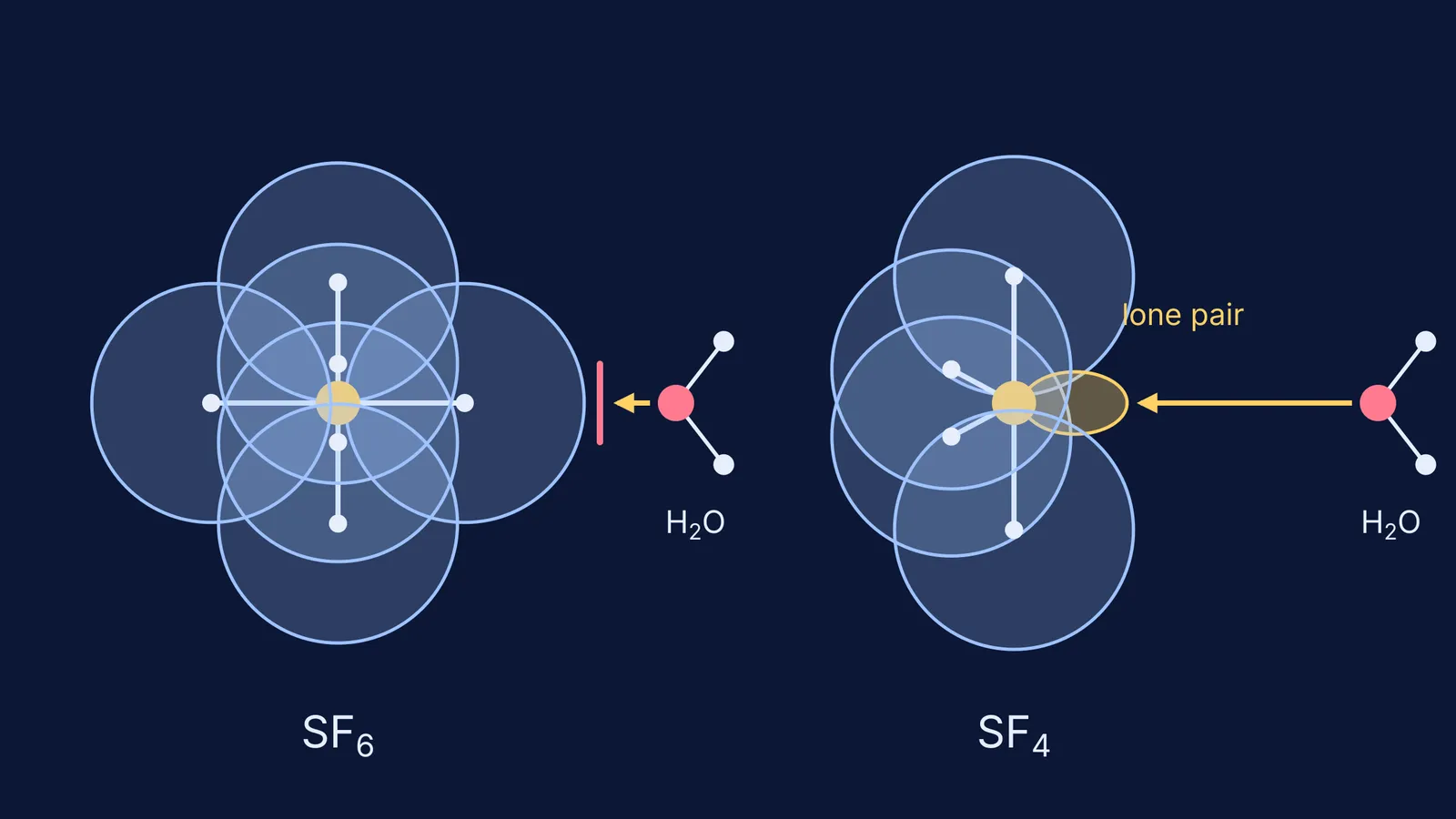
Water cannot add first. SF6 is octahedral, with six fluorines around one sulphur. The LibreTexts text calls this coordination saturation, which rules out associative reactions with nucleophiles such as water. The Wikipedia article on SF6 says a main contribution to its inertness is steric hindrance of the sulphur atom.
A fluorine cannot leave first. The same LibreTexts text says the strong S–F bond limits dissociative reactions, so sulphur does not lose a fluorine to make room.
You can check the crowding yourself with two numbers. The S–F bond in SF6 is 1.56 Å long (LibreTexts/09:_Group_16/9.09:_Sulfur_Halides)). A fluorine atom's van der Waals radius is 1.47 Å, from Bondi's 1964 table of atomic radii.
Two neighbouring fluorines sit at 90° to each other, so the distance between them is 1.56 × √2 ≈ 2.21 Å.
Two touching fluorine atoms would be 1.47 + 1.47 = 2.94 Å apart.
Since 2.21 Å is less than 2.94 Å, the fluorine "shells" overlap. They form a closed coat around sulphur with no gap for water's oxygen to reach it.
Why does SF4 hydrolyse when SF6 does not?
SF4 has only four fluorines. According to the Wikipedia article on SF4, it has a see-saw shape: a trigonal bipyramid where one equatorial position is taken by a lone pair. Our post on why lone pairs take equatorial positions in SF4 and ClF3 explains why the lone pair goes there.
There is an open side. No fluorine sits on the lone-pair side, so water can approach sulphur from there.
Sulphur is not saturated. With four bonds and one lone pair, sulphur can still take on another group as the reaction starts.
Some bonds are weaker. Wikipedia gives the axial S–F bonds as 164.3 pm and the equatorial ones as 154.2 pm. It notes that axial bonds in molecules like this are held less strongly.
The overall reaction, as given on the same Wikipedia page, is SF4 + 2H2O → SO2 + 4HF, which goes through thionyl fluoride (SOF2) as an intermediate.
How do you write the answer in a board or JEE exam?
Here is a four-line answer that covers the marking points:
Hydrolysis of SF6 is thermodynamically favourable (ΔH is negative).
In SF6, sulphur is surrounded octahedrally by six fluorine atoms, so it is sterically protected and coordinatively saturated.
Water cannot attack sulphur, and the strong S–F bonds do not break first, so the activation energy is very high. SF6 is kinetically inert.
SF4 has a see-saw shape with a lone pair and only four fluorines, so water can attack sulphur. SF4 is hydrolysed to SO2 and HF.
To predict hydrolysis for any covalent halide, ask these three questions in order:
Is the central atom fully surrounded, or is there an open side?
Can it accept a lone pair from water (room for another group, or a vacant orbital)?
Is the reaction thermodynamically favourable? If yes but the first two answers block water, call it kinetically inert.
If you are not sure how a lone pair changes a molecule's shape, revise the four-step VSEPR method first. The Fermi Concept Library gives every chemistry concept its own lesson and its place in the map, so you can trace steric hindrance back to molecular shape. When your reasoning goes wrong on a practice question, the Fermi Problem Library has worked problems with a step-by-step solver that explains the reasoning rather than printing an answer.