

On this page
In a sequential (or consecutive) reaction problem, the product of one reaction is fed straight into the next one. NCERT's Class 11 chapter defines stoichiometry as the calculation of masses, and sometimes volumes, of the reactants and products in a chemical reaction, and shows how mass, moles and number of molecules convert into one another (NCERT Class 11 Chemistry, Unit 1). Sequential problems use the same tools. They just take more steps, each a chance to lose the ratio.
This topic carries real marks. In the CBSE Class 11 chemistry syllabus for 2026-27, Unit 1, Some Basic Concepts of Chemistry, is worth 7 of the 70 theory marks and ends with "Stoichiometry and Stoichiometric Calculations" (CBSE curriculum 2026-27).
How do you chain mole ratios through two or more reactions?
The method:
Balance every equation first, each one on its own.
Mark the link species: the product of step 1 that is the reactant of step 2.
Convert the given mass or volume to moles, once.
Multiply by the mole ratio of each step, keeping fractions (2/3, not 0.67).
Check whether a limiting reagent or a yield applies at any step.
Convert to grams or litres only at the end.
Worked example 1: ammonia to nitric acid, one pass
The Ostwald process makes nitric acid in three steps (Ostwald process, Wikipedia):
4NH3 + 5O2 → 4NO + 6H2O
2NO + O2 → 2NO2
3NO2 + H2O → 2HNO3 + NO
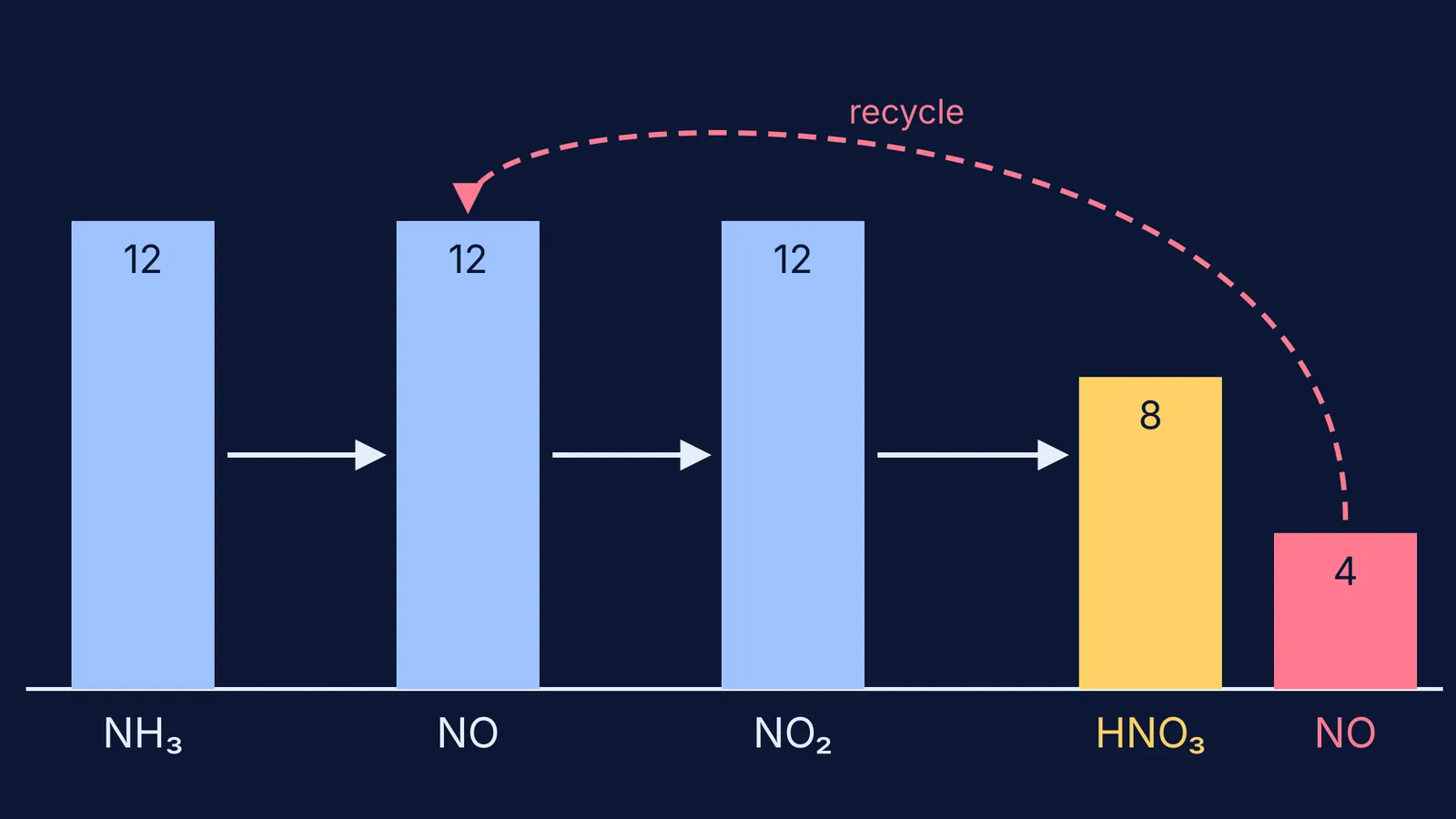
Question (board style): How much HNO3 forms from 17.0 kg of NH3 if the NO released in step 3 is not reused?
Moles of NH3: 17,000 g ÷ 17.0 g/mol = 1000 mol.
Step 1: 4 NH3 give 4 NO, so 1000 mol NO.
Step 2: 2 NO give 2 NO2, so 1000 mol NO2.
Step 3: 3 NO2 give 2 HNO3, so 1000 × 2/3 = 666.7 mol HNO3.
Mass: 666.7 mol × 63.0 g/mol = 42.0 kg.
As one line: 1000 × (4/4) × (2/2) × (2/3) = 666.7 mol. Written this way, a flipped ratio is easy to spot.
When does the atom-conservation shortcut work?
The shortcut, often called POAC (principle of atom conservation), says atoms of each element are neither made nor destroyed. NCERT gives the same idea as its rule for balancing: a balanced equation has the same number of atoms of each element on both sides (NCERT Class 11 Chemistry, Unit 1). More in our guide to the POAC principle of atom conservation.
POAC only gives the right answer if you know where every atom of your chosen element ends up. In example 1, a third of the nitrogen leaves as NO, so counting nitrogen from NH3 to HNO3 as 1:1 would give 63 kg. That is wrong for one pass, but right once the NO is fed back in, because then all the nitrogen ends up in HNO3. The overall equation, NH3 + 2O2 → HNO3 + H2O, says the same thing (Ostwald process, Wikipedia).
Worked example 2: a limiting reagent, then a chain
NCERT Problem 1.5 mixes 50.0 kg of N2 with 10.0 kg of H2 to make ammonia. H2 is the limiting reagent, and the reaction forms 3.30 × 10³ mol NH3, about 56.1 kg (NCERT Class 11 Chemistry, Unit 1).
Question (JEE style): All of that ammonia goes through the Ostwald process with the NO fully recycled. How much HNO3 forms?
Find the limiting reagent at step 1 first. The leftover N2 never reaches step 2.
Every nitrogen atom in the NH3 ends up in HNO3, and each has one N, so mol HNO3 = mol NH3 = 3.30 × 10³ mol.
Mass: 3.30 × 10³ mol × 63.0 g/mol ≈ 208 kg.
POAC works here only because recycling closes the loop. Without recycling, the answer would be 2/3 of this.
If steps have percentage yields, multiply them: 80% and then 90% gives 72% overall (see our guide to overall yield in multistep synthesis). Impure starting material works the same way, as we explain in purity of a sample in stoichiometry.
What mistakes cost marks in multistep stoichiometry?
Using an unbalanced or half-balanced equation in the middle step.
Carrying the given mass, not moles, from one step to the next.
Writing a ratio upside down (3/2 instead of 2/3).
Using POAC while some atoms leave as a by-product.
Applying the limiting reagent to the wrong step.
If you keep making these mistakes, the Fermi Problem Library has worked problems with a step-by-step solver that explains the reasoning rather than printing an answer, so you can see which step went wrong. If the mole concept itself still feels shaky, the Fermi Concept Library gives each chemistry concept its own lesson.
Try this tonight: redo example 1 with the NO recycled, then explain to someone why the answer changed.


