

On this page
When you synthesize an organic molecule across multiple consecutive reactions, the final amount of product depends directly on the efficiency of every individual stage. In school practicals and entrance examinations, students often make the mistake of averaging step yields or adding them together. However, each successive reaction operates strictly on the intermediate molecules isolated and purified from the preceding transformation.
How do you calculate the overall yield of a multistep synthesis?
To calculate the overall yield of a linear sequence of n steps, you must convert each individual percentage yield into a decimal fraction and multiply them sequentially:
Overall Yield (fraction) = Y₁ × Y₂ × Y₃ × ... × Yₙ
Overall Yield (%) = (Y₁ × Y₂ × Y₃ × ... × Yₙ) × 100%
In an undergraduate laboratory investigation published in the Journal of Chemical Education, chemists tracked this multiplicative effect across a four-step preparation of the sunscreen compound avobenzone. The opening aldol condensation achieved an average yield of roughly 75%, while the subsequent bromination, double elimination, and hydration steps yielded a combined 23%, producing an overall sequence yield of 19%. Whether a sequence has two steps or twelve, multiplying fractional yields reflects the physical reality that losses compound geometrically.
When students get stuck tracking stoichiometry or limiting reagents through complex reaction chains, the Fermi Problem Library provides worked problems with a step-by-step solver that explains the reasoning rather than printing an answer.
Why does a long linear synthesis give a poor overall yield?
As chemist James B. Hendrickson demonstrated in the Journal of the American Chemical Society, linear reaction sequences suffer from rapid geometric attrition. In isolated single-step reactions, an 80% or 90% yield represents an excellent outcome. Standard organic transformations like the Gabriel phthalimide synthesis or the Williamson ether synthesis routinely achieve individual yields of 80% to 90%. But when you string multiple high-yielding reactions into a purely linear sequence (A → B → C → D → ...), exponential decay takes over.
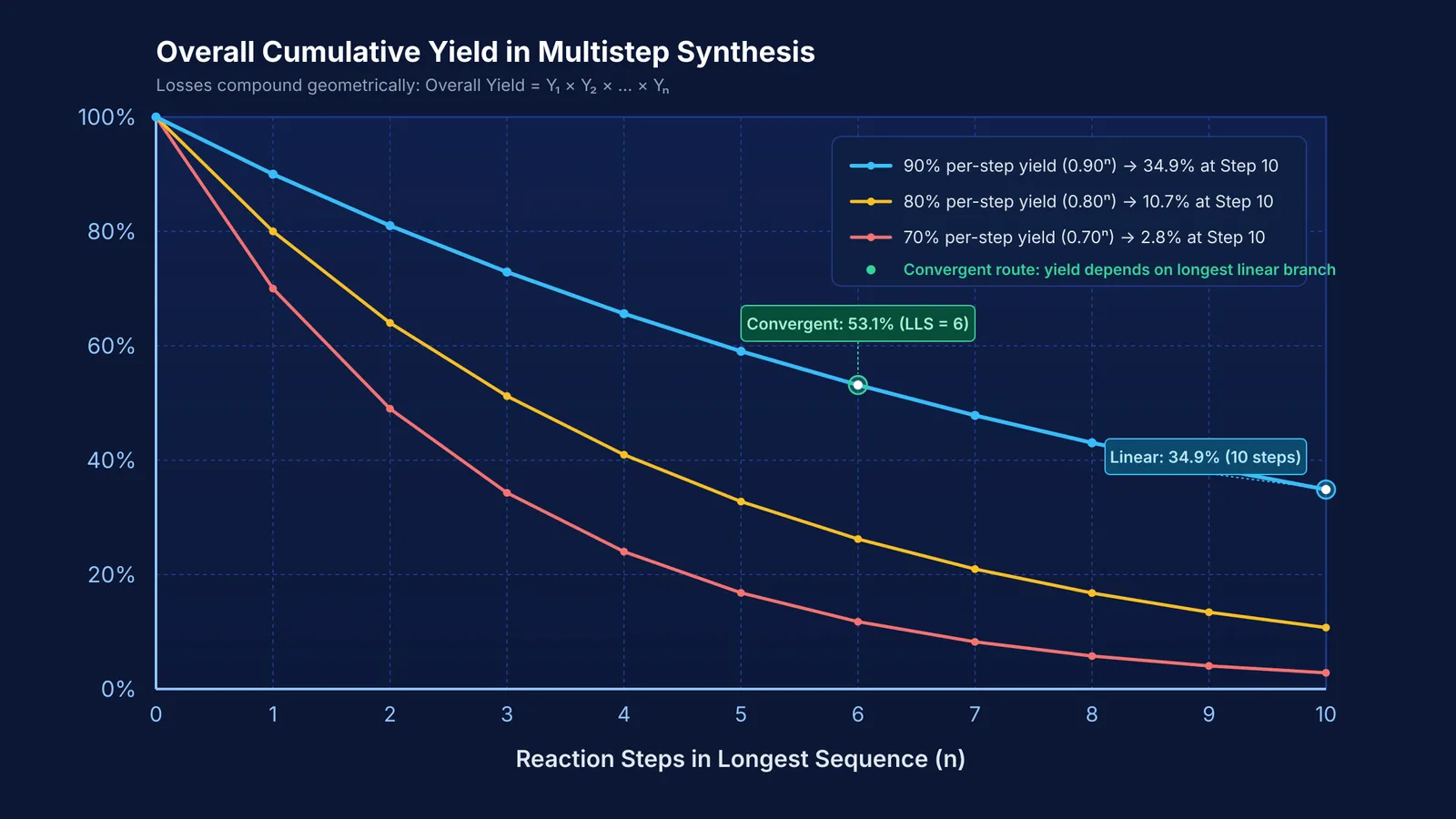
If each reaction in a linear chain achieves a 90% yield (a fraction of 0.90):
After 3 steps, the cumulative yield is 0.90³ = 72.9%.
After 5 steps, the cumulative yield drops to 0.90⁵ = 59.0%.
After 10 steps, the cumulative yield falls to 0.90¹⁰ = 34.9%.
After 20 steps, the cumulative yield plunges to 0.90²⁰ = 12.2%.
If the average per-step yield drops to 80% (0.80), the collapse is far steeper: 0.80⁵ leaves only 32.8%, and 0.80¹⁰ yields just 10.7%. By step 20, you retain a negligible 1.15% of your initial theoretical capacity.
Hendrickson formalized this mathematical relationship to prove that early starting materials in any linear synthesis carry the burden of every subsequent transformation. Because every step sheds mass through side reactions, incomplete conversion, and purification losses, a chemist executing a 20-step linear route must begin with massive quantities of raw material just to obtain a few milligrams of final product.
How does convergent synthesis preserve your final yield?
To bypass the exponential losses of long linear pathways, synthetic chemists design convergent strategies. Rather than building a target molecule one unit at a time along a single backbone, a convergent route prepares two or more complex fragments in parallel branches and couples them in a final stage.
As Nobel laureate Elias J. Corey highlighted in his classic analysis published in Angewandte Chemie International Edition, retrosynthetic logic seeks strategic disconnections that divide a complex molecule into fragments of comparable size. In a convergent synthesis, the overall yield is governed not by the total number of reactions performed, but by the longest linear sequence (LLS) required to assemble any individual fragment.
Consider a synthesis requiring 10 distinct chemical reactions:
In a linear pathway (10 sequential steps at 90% yield per step), the overall yield is 0.90¹⁰ = 34.9%.
In a balanced convergent pathway, two independent 5-step branches are synthesized simultaneously and joined in one coupling reaction. The longest linear sequence is only 5 + 1 = 6 steps. At the same 90% per-step yield, the overall yield is 0.90⁶ = 53.1%.
Splitting a 10-step synthesis into two parallel branches raises the cumulative yield from 34.9% to 53.1%—a relative recovery improvement of more than 50%. Moreover, if a late-stage reaction fails in a convergent route, it destroys only that specific branch rather than the accumulated investment of ten sequential steps. Elegant one-pot transformations, such as the Robert Robinson tropinone synthesis, compress multiple bond-forming events into a single operation, eliminating intermediate workup losses entirely.
For students exploring how diverse reaction pathways branch and connect across organic chemistry, the Fermi Concept Library covers every concept in chemistry, each with its own lesson and its place in the map.
How do you solve multistep yield problems in JEE Advanced?
Competitive examinations such as JEE Main and JEE Advanced frequently feature multistep yield calculations in organic chemistry numericals. These questions test whether you can combine stoichiometric coefficients, molar masses, and fractional yields without losing track of units.
A representative example appears in the official IIT JEE archive at jeeadv.ac.in (JEE Advanced 2020, Paper 2). The question asks for the mass in grams of an orange azo dye Q formed from 9.3 mL of aniline (P, density = 1.00 g/mL, molar mass = 93 g/mol) through a two-step sequence: diazotization with NaNO₂ and HCl at 0–5 °C to form benzenediazonium chloride, followed by azo coupling with β-naphthol in alkaline NaOH to produce 1-(phenyldiazenyl)naphthalen-2-ol (Q, molar mass = 248 g/mol), with an overall yield of 75%.
To solve any multistep yield problem systematically, follow this four-step method:
Calculate initial moles: Convert the starting material into moles using its volume and density. Here, 9.3 mL × 1.00 g/mL = 9.3 g of aniline, giving 9.3 g / 93 g/mol = 0.10 mol.
Determine theoretical product moles: Check the stoichiometry between starting material and target. Because 1 mole of aniline yields 1 mole of diazonium salt, which couples 1:1 with β-naphthol, the theoretical yield of Q is 0.10 mol.
Multiply by overall fractional yield: Apply the overall yield directly to the theoretical moles. Actual moles of Q = 0.10 mol × 0.75 = 0.075 mol.
Convert actual moles to final mass: Multiply actual moles by the target compound's molar mass: 0.075 mol × 248 g/mol = 18.6 g of Q.
By converting to moles before multiplying by fractional yields, you maintain clear dimensional analysis and avoid arithmetic traps in organic conversions.


