

On this page
What is the principle of atom conservation?
In chemistry, stoichiometry begins with balancing equations so each element satisfies mass conservation. As detailed in OpenStax Chemistry 2e Section 4.1, chemical equations must be balanced because atoms are neither created nor destroyed during chemical changes; reactions simply rearrange bonds between atoms.
The principle of atom conservation (POAC) applies this law to one element at a time. Instead of balancing every coefficient in a complex reaction, you focus on the element linking a known reactant to an unknown product.
The rule is straightforward: Moles of atoms of element X in reactants = Moles of atoms of element X in products.
If reactant A has a atoms of element X and product B has b atoms of element X, and all of element X transfers from A to B: a × n(A) = b × n(B).
Because moles equal mass divided by molar mass (n = m / M), POAC yields a direct algebraic equation. The Fermi Concept Library covers every concept in physics, chemistry, biology, mathematics and computing, each with its own lesson and its place in the map.
How do you apply POAC to a chemistry problem?
As outlined in OpenStax Chemistry 2e Section 4.3, stoichiometric factors relate the relative amounts of reacting substances in chemical reactions. Consider how this works for the thermal decomposition of potassium chlorate (KClO₃): KClO₃ → KCl + O₂ (unbalanced).
Suppose a problem asks what mass of KClO₃ decomposes to produce 6.72 litres of O₂ gas at standard temperature and pressure (STP, where 1 mole of an ideal gas occupies 22.4 litres).
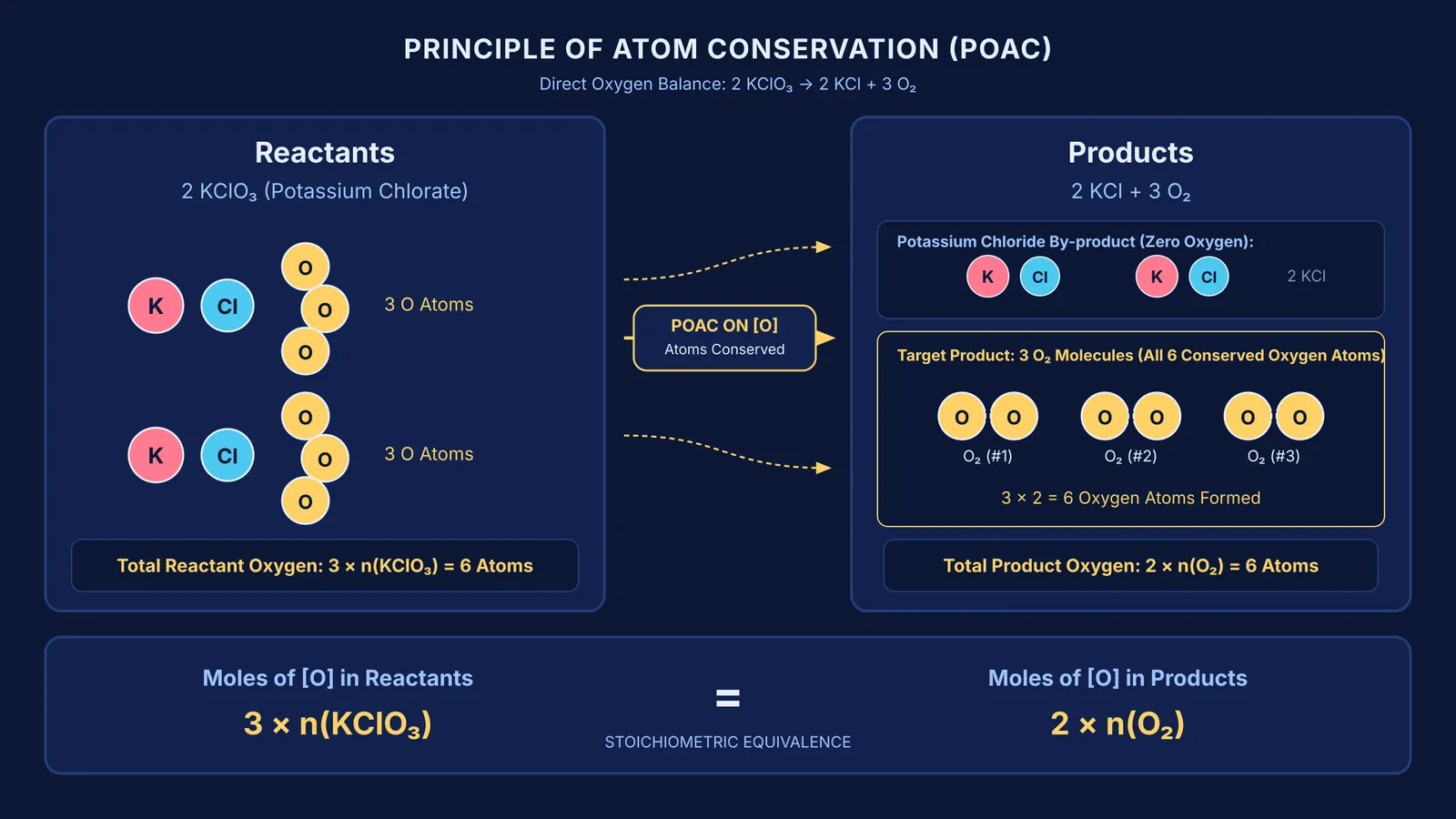
Rather than balancing the entire reaction first, apply POAC directly to the oxygen atoms:
Each KClO₃ contains 3 oxygen atoms, giving 3 × n(KClO₃) moles of oxygen atoms.
Each O₂ contains 2 oxygen atoms, giving 2 × n(O₂) moles of oxygen atoms.
Equate both sides: 3 × n(KClO₃) = 2 × n(O₂).
At STP, 6.72 litres of O₂ equals 6.72 / 22.4 = 0.30 moles. Substituting into the POAC equation: 3 × n(KClO₃) = 2 × 0.30 = 0.60 moles. n(KClO₃) = 0.20 moles.
With a molar mass of 122.55 g/mol for KClO₃ (often rounded to 122.5 g/mol in exam problems where K = 39, Cl = 35.5, and O = 16), multiplying 0.20 moles by 122.55 g/mol yields 24.51 grams of KClO₃ in three quick steps.
Why does POAC excel in multi-step reactions?
POAC saves the most time in sequential reactions where an intermediate moves through successive steps: A → B → C → D.
Standard stoichiometry requires balancing every individual equation and multiplying mole ratios across the sequence. A single incorrect coefficient breaks the chain. With POAC, if element X travels from starting reactant A into product D without loss to by-products: (atoms of X in A) × n(A) = (atoms of X in D) × n(D).
Educational research explains why tracking atoms directly prevents errors. In *Chemistry Education Research and Practice* (DOI: 10.1039/b7rp90012k), researchers Laure Gauchon and Martine Méheut observed that students who rely on rote balancing often fail to conceptualise reactions at the particulate level, struggling to track matter across stages. POAC grounds calculation in the physical persistence of atoms.
The Fermi Problem Library provides worked problems with a step-by-step solver that explains the reasoning rather than printing an answer.
When does POAC fail in competitive exams?
POAC is fast, but applying it blindly causes mistakes in three common exam situations:
Limiting reagent problems: If a reactant is in excess, unreacted atoms do not enter the product. According to OpenStax Chemistry 2e Section 4.4, product yield depends strictly on the limiting reactant consumed. Applying POAC to an excess reactant overestimates product yield. Review our guide to limiting reagent and percentage yield problems before using shortcuts.
Multiple products containing the element: When nitric acid oxidises copper, nitrogen divides into copper nitrate and nitrogen dioxide gas. You must sum all nitrogen atoms across both products rather than equating the reactant to just one.
Incomplete yield: If a reaction achieves an 85% yield, theoretical moles calculated under OpenStax Chemistry 2e Section 4.4 must be multiplied by 0.85.
Studying common mole concept errors and balancing redox reactions helps identify when full balancing is necessary.
How can you safely apply atom conservation in five steps?
Before using POAC on exam questions, follow this five-step check:
Choose a bridge element that connects the known reactant to the target product.
Confirm the source compound is the limiting reactant so that all of its atoms react.
Check whether the element splits into multiple products; if so, sum their moles.
Multiply each substance's moles by the element's subscript in its chemical formula.
Convert moles into required units such as mass, molarity, or gas volume.


