

On this page
Naming the five sense organs takes a minute. The useful part of the Class 3 EVS lesson is what each organ picks up, how the brain uses it, and how to look after it. This guide is for children in Classes 2 to 4 and the parent beside them, with tests you can do at home.
What are the five sense organs and what does each detect?
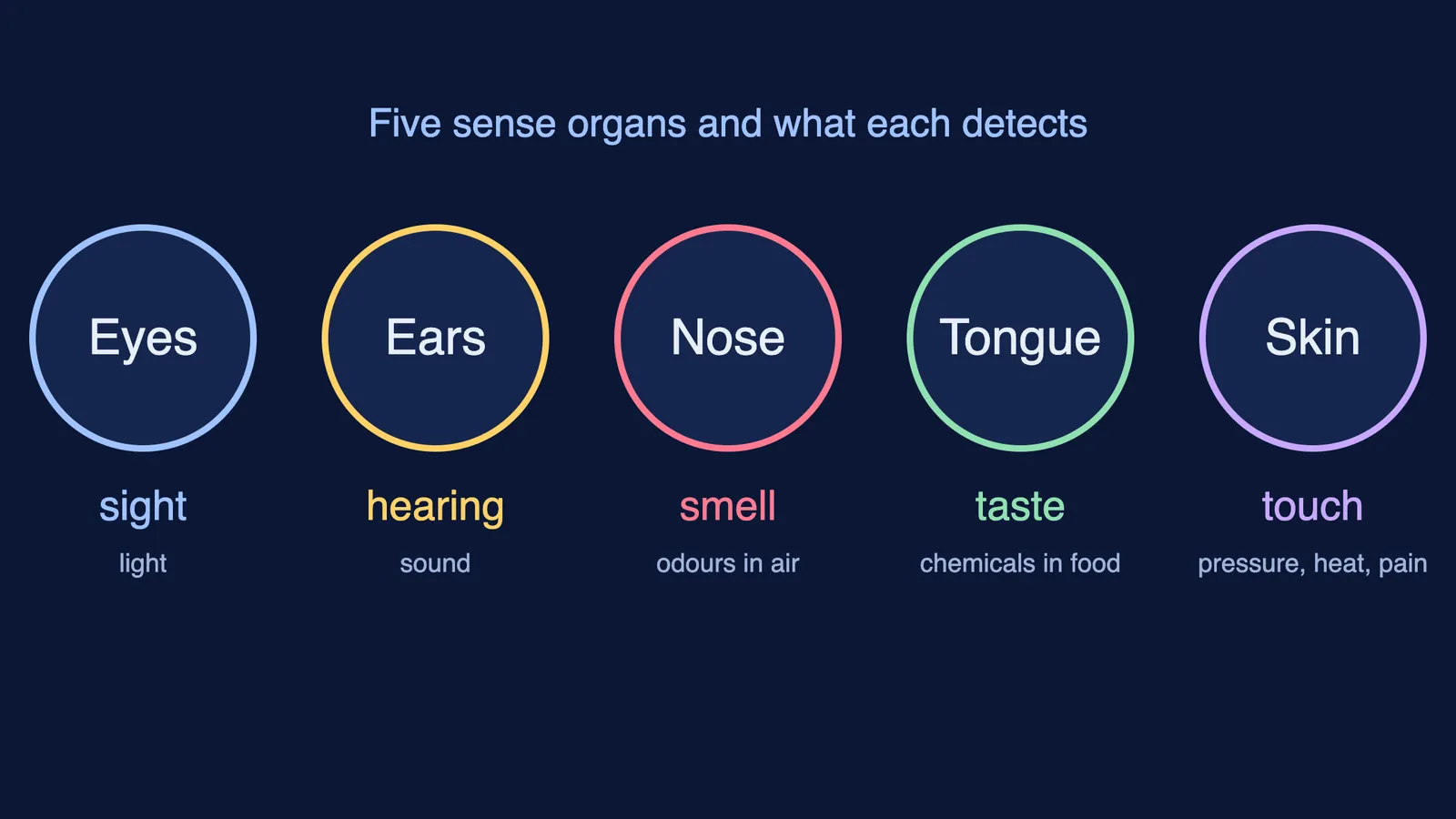
A sense organ has special cells that notice something around us and send a message to the brain. There are five:
Eyes (sight): they take in light, so you can see colour, shape, size and movement.
Ears (hearing): they pick up sound, from a whisper to a pressure cooker whistle.
Nose (smell): smells are detected by olfactory sensory neurons in a small patch of tissue high inside the nose, according to the US National Institute on Deafness and Other Communication Disorders (NIDCD).
Tongue (taste): taste cells sit in taste buds on the tongue, the roof of the mouth and the lining of the throat, and we are born with about 10,000 taste buds, says the NIDCD page on taste.
Skin (touch): receptors in the skin can sense pain, temperature, pressure, friction and stretch, as Arizona State University's Ask A Biologist explains.
The same NIDCD taste page lists at least five basic tastes: sweet, sour, bitter, salty and umami.
How do sense organs send messages to the brain?
The organ is only the first step. Skin receptors send their signals to the spinal cord and the brain, says Ask A Biologist, and the brain puts the messages together. You know a samosa is hot, crisp and spicy because skin, ears, nose and tongue all report at once.
Smell and taste work as a team. "Without smell, foods tend to taste bland and have little or no flavor," says the NIDCD. That is why food seems dull when you have a blocked nose.
How should children take care of their sense organs?
Eyes: play outside every day. The American Academy of Ophthalmology says time outdoors, especially in early childhood, can slow the progression of nearsightedness. On a computer, sit about an arm's length from the screen and look up at something far away every so often, as the AAO's screen tips suggest. For TV, read our explainer on whether sitting close to the TV damages eyesight.
Ears: with earphones, keep the volume at no more than 60% of maximum and give your ears frequent breaks, says the World Health Organization. Never put cotton buds inside the ear: the ear cleans itself, and a swab can damage the canal or eardrum or push wax deeper, says Harvard Health Publishing. Parents of older children can use our guide on a teen who wears earphones all day.
Nose: blow gently, one side at a time, and never push small objects inside.
Tongue: brush your teeth twice a day and don't taste things you don't know.
Skin: wash with soap and water, keep cuts clean and covered, and wear a cap in strong sun.
Nearly 60% of hearing loss in children is due to avoidable causes, according to the WHO fact sheet on deafness and hearing loss.
What simple tests can a Class 3 child try at home?
Try this 20-minute senses game on a Sunday morning, and write each result in a notebook.
Sight, one eye or two: hold a pencil in each hand at arm's length and try to touch the tips together. Do it with both eyes open, then with one eye closed. Which was easier?
Hearing, where is the sound? With eyes closed, the child points to where a parent claps softly: in front, behind, left or right.
Smell and taste, the blocked-nose test: pinch the nose and eat a small piece of apple, then of cucumber. Can you tell them apart? Now let go and try again.
Taste, name it: with eyes closed, taste a pinch of sugar, a pinch of salt, a drop of lemon juice and a tiny bit of karela. Name each as sweet, salty, sour or bitter.
Touch, the mystery bag: put a coin, a key, a leaf, a cotton ball and a spoon in a cloth bag. Feel each one and guess. Then hold a spoon from the fridge and one from a cup of warm water: which is colder?
Ask "why do you think that happened?" after each test.
If an older sibling in Class 9 or 10 wants to learn how nerves and receptors work, the Fermi Concept Library covers every concept in physics, chemistry, biology, mathematics and computing. For the ear itself, our post on how the cochlea detects different frequencies explains what happens after sound goes in.


