

On this page
If you have sown seeds on wet cotton for a practical file, the number your teacher wants is the germination percentage. The harder part is setting up the trial so that any difference you see comes from the one factor you changed.
What is germination percentage?
Germination percentage is an estimate of the viability of a population of seeds, calculated as seeds germinated divided by total seeds, times 100, as a plant physiology lab handout from the College of Saint Benedict and Saint John's University sets out.
Germination percentage = (number of seeds germinated ÷ total number of seeds sown) × 100
Labs are stricter about what counts. In the procedure described by Tamil Nadu Agricultural University's seed testing guide, the result is expressed as a percentage by number of normal seedlings, averaged over four replicates of 100 seeds and rounded to the nearest whole number. A seed that sprouts into a deformed seedling does not count in a lab. In a school trial you usually count a seed once its radicle, the first root, shows.
Percentage answers only one question. A review by Marli Ranal and Denise Garcia de Santana in the Revista Brasileira de Botânica separates how many seeds germinate from how fast and how evenly they do so.
How do you set up a seed germination trial?
A home method from the University of Arkansas Cooperative Extension Service uses 50 or 100 seeds on a paper towel, rolled up in a sealable bag, kept moist but not saturated at room temperature for 3 to 5 days for most species. Labs work at a bigger scale: the TNAU guide asks for at least 400 seeds, in four replicates of 100, eight of 50 or sixteen of 25. For a school trial:
Use one seed type from one packet, such as moong (green gram), and set aside broken seeds.
Write down your germination rule, for example "radicle at least as long as the seed".
Sow four dishes of 25 seeds for each condition, labelled by condition and dish number.
Give every dish the same cotton, the same volume of water and the same spot on the shelf.
Count at the same time each day and record each dish separately, even one that looks bad.
How to calculate percentage of seed germination: a worked example
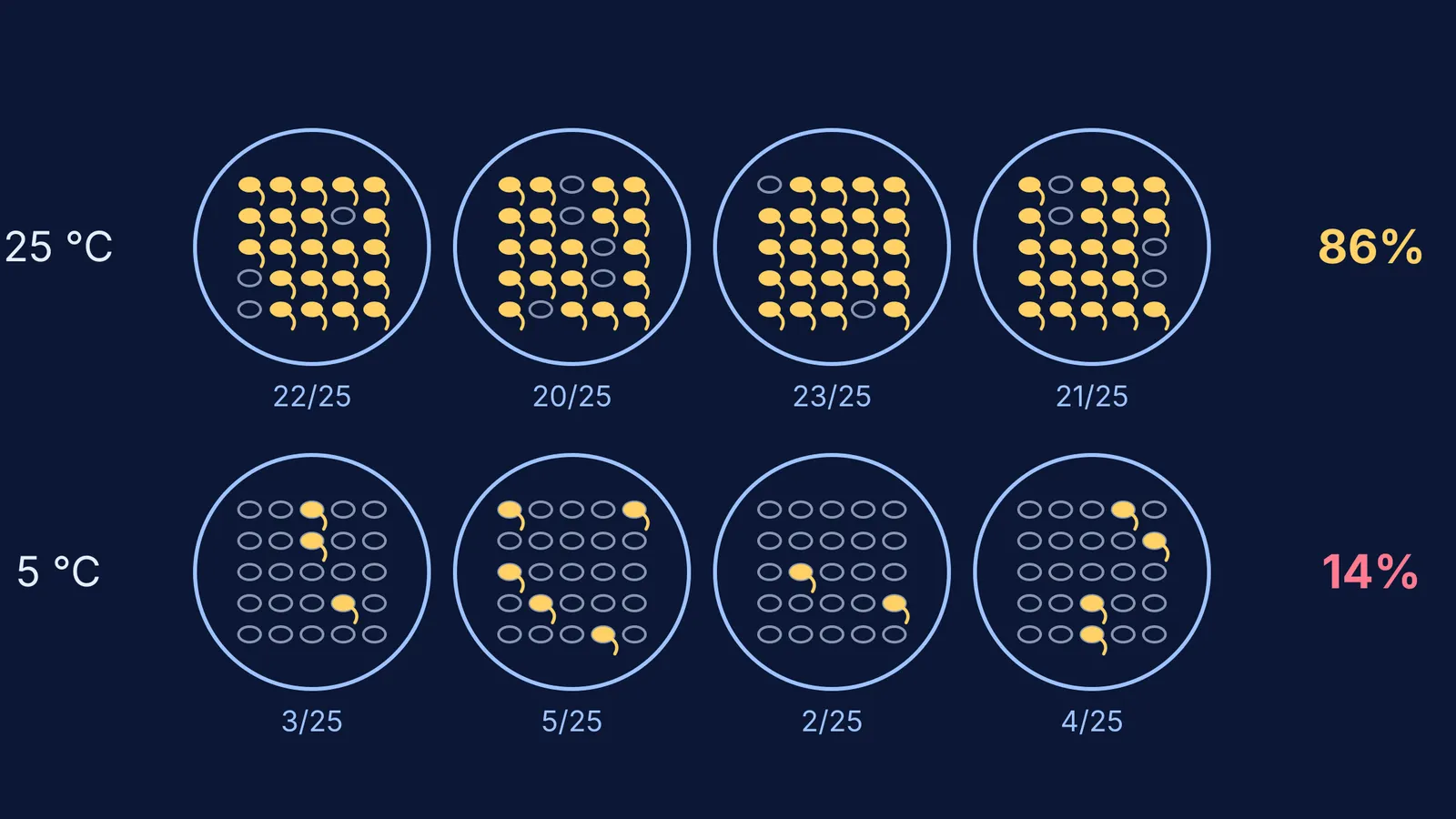
Say you compare moong at room temperature (about 25 °C) with moong in a refrigerator (about 5 °C). These counts are made up to show the arithmetic, not results to copy.
Room temperature, day 3: 22, 20, 23 and 21 germinated out of 25 in each dish.
Refrigerator, day 3: 3, 5, 2 and 4 out of 25.
Room temperature: 86 of 100 seeds germinated, so (86 ÷ 100) × 100 = 86%. Dish by dish that is 88%, 80%, 92% and 84%, which also average 86%. Refrigerator: 14 of 100, or 14%, with dishes ranging from 8% to 20%.
The ranges do not overlap, so the gap is far bigger than the wobble between dishes, and you can fairly write that the cold made the difference in your trial, as long as both sets were kept dark. Had they overlapped, the honest conclusion is "unclear, test more seeds".
A shortcut from the Arkansas extension method: with 100 seeds, the number sprouted is the germination percentage; with 50, double it. For other totals, our guide to working out percentages in your head with the 10% rule helps.
How do you compare water, temperature and light fairly?
The NC State Extension Gardener Handbook lists what a viable seed needs: water, proper temperature, oxygen and, for some species, light. A fair comparison changes one of these and holds the rest steady.
Water: compare dry and moist dishes side by side. A flooded dish also cuts off oxygen, so it tests two things at once.
Temperature: a fridge is cold and dark, so keep the room-temperature dishes in a closed box too, or darkness becomes a hidden second variable.
Light: cover half the dishes with a box and keep both sets in the same room. Expect species to differ: the NC State handbook lists lettuce and petunia among seeds that require light, while Penn State Extension notes that most seeds germinate best in the dark, though all seedlings need sunlight.
In your write-up, name what you changed, what you measured (germination percentage on a fixed day) and what you kept the same; our post on checking your independent and dependent variables helps, and the virtual four-tube germination experiment lets you predict outcomes before you sow.
A daily running total per dish also shows how fast seeds germinate, not just how many.
If a practical-file question leaves you unsure which number goes on the bottom of the fraction, the Fermi Problem Library has worked problems with a step-by-step solver that explains the reasoning rather than printing an answer. For the biology behind the trial, the Fermi Concept Library gives each concept in biology its own lesson.


