

On this page
When you first learn about scalars and vectors in Class 11, the rule seems simple: a scalar has only magnitude, while a vector has both magnitude and direction.
But then you meet electric current. It clearly flows in a specific direction through a wire, yet your textbook calls it a scalar. To understand why, you need a more reliable way to test physical quantities.
The three-step test for scalars and vectors
If you are stuck on whether a quantity is a scalar or a vector, run it through this three-step test:
Does it have a magnitude? Both scalars and vectors have a size or amount (like 50 kg or 20 m/s).
Does it have a specific direction? If it has no direction (like mass or temperature), it is a scalar. If it has a direction, move to the third step.
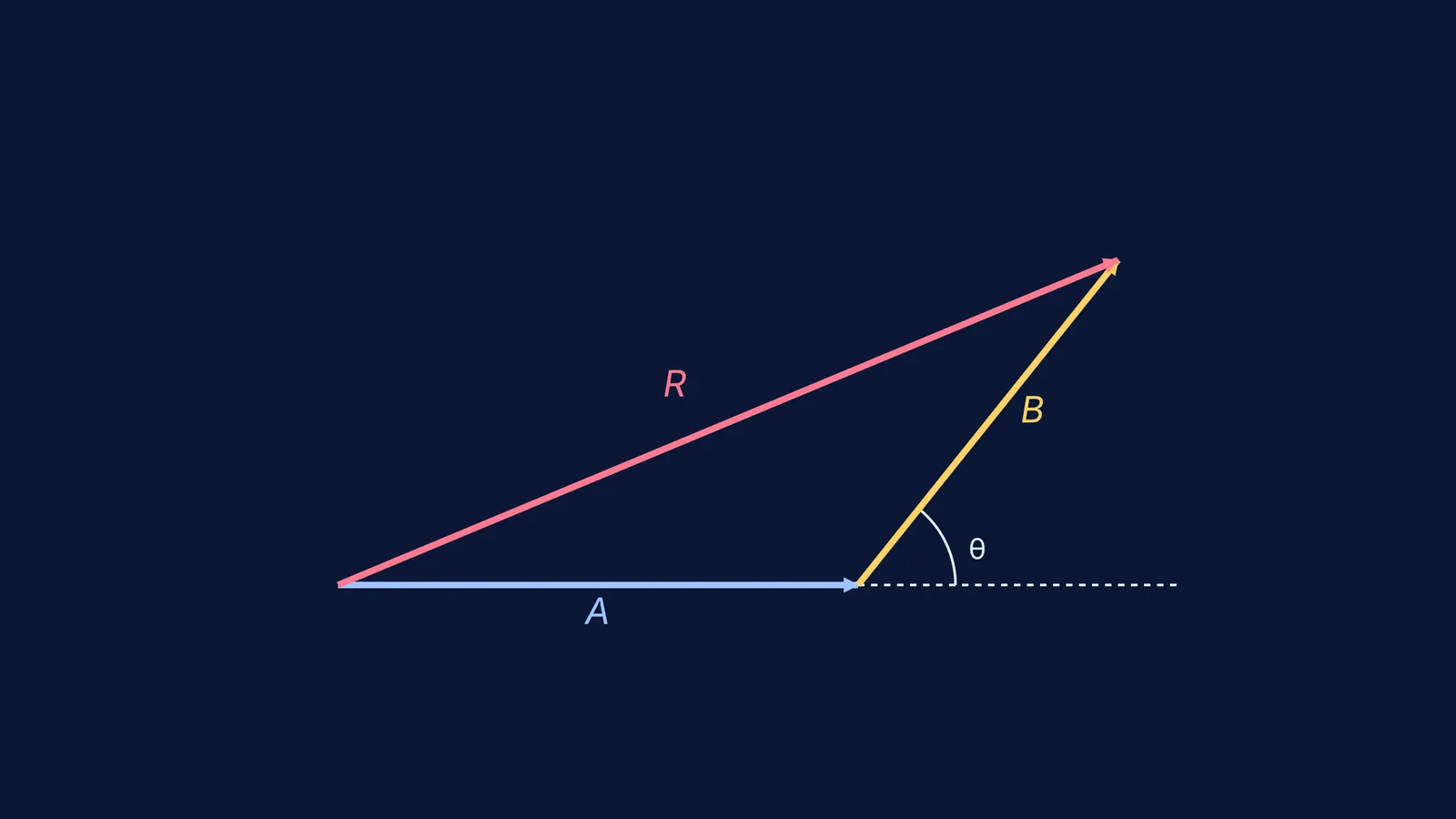
Does it obey the triangle law of vector addition? If two values add together like arrows placed head-to-tail, the quantity is a vector. If they add together like regular numbers (algebraically), it is a scalar.
According to the National Council of Educational Research and Training, a vector must obey the specific laws of vector algebra, such as the triangle law or parallelogram law. If it fails this test, it is a scalar.
When you practice with the Fermi Problem Library, the step-by-step solver explains the reasoning rather than printing an answer, including whether to add quantities algebraically or break them into directional components.
Why are electric current and pressure scalars?
Let's apply the test to two of the most common trick questions in physics exams.
Electric Current: Current has a magnitude (for example, 5 Amperes) and a direction (it flows from positive to negative). However, it fails the third step of our test. If a 3 A current and a 4 A current meet at a wire junction at a 90° angle, the total current leaving the junction is exactly 7 A (3 + 4 = 7). If current were a vector, you would have to resolve a vector along two non-perpendicular axes or use the triangle law, which would force the resultant to be 5 A (because √(3² + 4²) = 5). Because it adds algebraically according to Kirchhoff's junction rule, electric current is a scalar.
Pressure: Pressure is defined as force per unit area. While force is a vector, pressure itself is a scalar. Inside a fluid, pressure acts equally in all directions, as defined by Pascal's Law. Because it has no unique direction of its own, it fails the second step of our test and is classified as a scalar.
Is area a scalar or a vector?
In your early geometry classes, area is just the size of a surface—a pure scalar. But in Class 12 electromagnetism, area suddenly becomes a vector.
When calculating electric flux, you need to know not just how big a surface is, but which way it faces. Physics introduces the "area vector" to solve this. The magnitude is the size of the area, and its direction is perpendicular (or normal) to the surface. For a closed 3D shape, the area vector always points outward. This orientation is crucial; as shown in the Simulation Lab, turning a coil in a magnetic field changes the flux precisely because the area vector's angle changes.
When is angular displacement a vector?
Angular displacement (θ) is the angle through which an object rotates. It is one of the rare quantities that changes its classification depending on its size.
Large (finite) angular displacements are scalars. If you rotate a book 90° around the x-axis and then 90° around the y-axis, you get a different final position than if you did the y-axis rotation first. Because the order matters, finite rotations do not obey the commutative law of vector addition (A + B ≠ B + A).
However, very small (infinitesimal) angular displacements (dθ) do obey the commutative law. Therefore, infinitesimal angular displacement is treated as a vector, with its direction given by the right-hand thumb rule.
If you want to visualise how multiple vectors stack up, try our Vector addition simulation: predict the resultant first. And if you are testing your understanding of vector rules, checking whether three vectors of given magnitudes add to zero is a great place to start. If you want to explore the mathematical rules governing these, the Concept Library groups them into a complete physics map.


