

On this page
Every year, hilsa leave the Bay of Bengal and swim up rivers to spawn, and sockeye salmon make a similar run on the other side of the world.
Why do fish migrate from the sea to rivers?
Fish that migrate from fresh water to feed in the ocean, and come back to rivers to breed, are called anadromous; fish that migrate from the ocean to feed in fresh water are called catadromous. A 1988 paper in Science by Mart Gross and colleagues asked why each direction evolved.
Their answer is food. Oceans are more productive than fresh water in temperate latitudes, and there anadromous species predominate; catadromous species generally occur in the tropics, where fresh water is more productive than the ocean (Gross, Coleman and McDowall, 1988).
Breeding has its own needs. Hilsa spawning grounds need near-fresh water, with salinity below 0.1 parts per thousand, according to a Down To Earth report on hilsa.
How does a fish survive moving from salt water to fresh water?
Osmoregulation is how an animal keeps its body's water and salt steady. Water moves by osmosis towards the saltier side, the same effect you see when salt pulls water out of a salad.
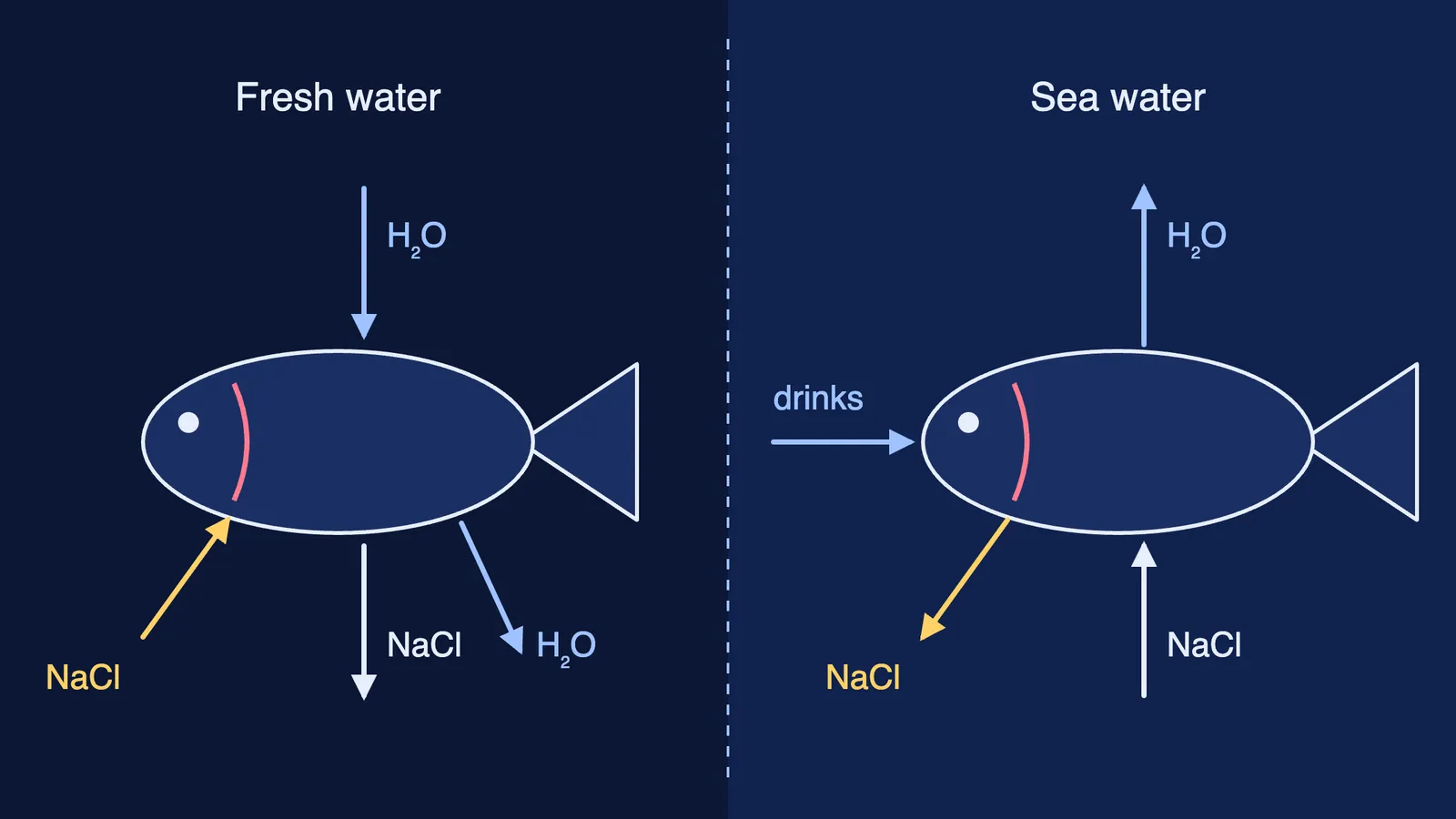
In the sea, a bony fish's body fluids are less salty than the water around it, as David Evans explains in his brief history of the study of fish osmoregulation. So the fish keeps losing water. It drinks seawater, absorbs water through its gut, and pumps the extra salt out across its gills.
In a river the problem flips: water seeps in and salt leaks out. Gills carry specialised cells called ionocytes, and in Atlantic salmon researchers can tell apart ionocytes that absorb ions from those that secrete salt, as Hiroi and McCormick review. The hormone prolactin is known as the "freshwater-adapting hormone": it helps fish conserve ions and get rid of water through the gill, kidney, gut and bladder (Breves, McCormick and Karlstrom, 2014). The kidney's role fits the wider story of excretory organs across animal groups.
Salmon prepare before they leave. Smolting is a hormone-driven change in young salmon that raises salinity tolerance, turns them silver and sends them downstream; cortisol, growth hormone and thyroid hormones promote it, while prolactin holds it back (Björnsson, Stefansson and McCormick, 2011).
Sockeye salmon spend 1 to 3 years in fresh water and usually 2 to 3 years at sea, and all die within a few weeks of spawning, according to NOAA Fisheries.
How do salmon find their way back to the river they were born in?
Close to home, smell does the work: before heading to sea, juvenile salmon learn the odours of their home stream, and adults later use those odour memories to find it, as Dittman and Quinn review.
Across the open ocean, Earth's magnetic field seems to help. Nathan Putman and colleagues analysed 56 years of fishery records for sockeye returning to the Fraser River in Canada, which must swim around Vancouver Island by a northern or a southern passage (Current Biology, 2013). The more the magnetic field at a passage entrance had drifted from the field at the river mouth, the fewer fish used that passage. Field drift explained 16% of the variation in route and sea temperature 22%. The authors read this as the first evidence that salmon imprint on the field where they first enter the sea (ScienceDaily's summary). Birds use magnetism too, alongside the sun and the stars.
What is happening to hilsa in the Ganga?
Hilsa is anadromous too: its young grow in river channels, feed and grow at sea, and return as adults to breed. Hilsa spawn more or less all year, with a major season in September to October and a minor one in February to March, according to Banglapedia.
A blocked river breaks that loop. Hilsa once swam up the Ganga as far as Varanasi and Prayagraj, but their journey was severely disrupted after the Farakka Barrage was commissioned in 1975, reports ICAR. Between 2019 and June 2026, ICAR-Central Inland Fisheries Research Institute ranched more than 3.85 lakh juvenile and adult hilsa and released eggs and young fish upstream of the barrage; monitoring in 2023-25 recorded ranched fish moving upstream as far as Mirzapur. Erratic monsoons add another problem: weaker river surges let seawater push into estuaries, Down To Earth reports.
Check yourself: can you predict the arrows?
A salmon smolt enters the sea. Water? Out, so it drinks seawater and its gills pump salt out.
An adult hilsa enters a river to spawn. Water? In, so it gets rid of water and holds on to salt.
Which hormone helps a fish in fresh water? Prolactin.
A salmon in its home river reaches a fork between two streams. Which sense picks the right one? Smell.
If the first two tripped you up, the gap is usually osmosis itself. The Fermi Concept Library gives every biology concept its own lesson, so you can fix osmosis first. If you are not sure where to start, Fermi's AI tutor can work out what you already know and build a plan for the session.


