

On this page
Rub a balloon on your hair, hold it against a wall, and it hangs there as if glued. Rubbing charges the balloon, the charge polarises the wall, and the air decides how long the charge lasts.
What happens when you rub a balloon on your hair?
When two materials rub, charge can move from one to the other, “particularly if one material has a greater affinity for electrons than another,” as the OpenStax University Physics textbook puts it. The balloon ends up with a net charge, and your hair with an equal and opposite one.
Rubber is an insulator, so the charge stays roughly where the rubbing put it. Up close it is messier than the textbook picture: a 2011 study in Science found that rubbing creates “patches of positive and negative charge on both surfaces”, not one uniform sign (Baytekin et al., Science). What matters for the wall is the net charge left over.
Which material gains electrons? See how rubbing creates static charge.
Why does a charged balloon stick to a neutral wall?
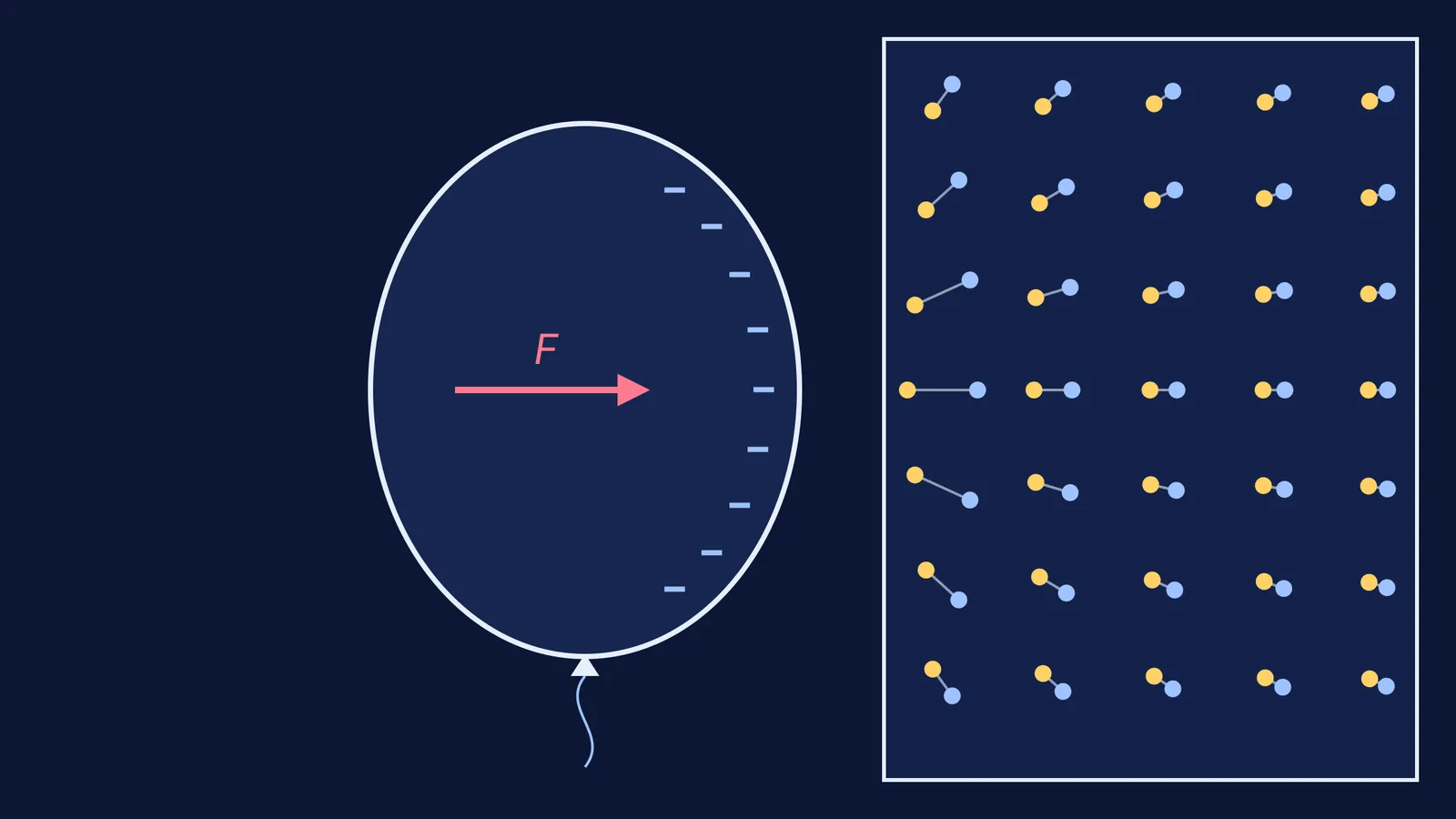
The wall has no net charge, but its molecules contain charges that can shift a little. Near a charged balloon, each molecule's opposite charge moves slightly toward the balloon and its like charge slightly away. This is polarisation.
Why doesn't it cancel out? “Since the electrostatic force decreases with distance, the repulsion of like charges is weaker than the attraction of unlike charges, and so there is a net attraction,” explains OpenStax. The same page notes that neutral objects can be attracted to any charged object, so the balloon sticks whether its net charge is positive or negative.
How big is the pull on one wall molecule?
Coulomb’s law says the force between two charges falls as 1/r². Picture one wall molecule whose opposite charge sits 1.0 mm from the balloon’s charge and whose like charge sits 1.1 mm away. Real molecules stretch far less than this; the distances are exaggerated to keep the arithmetic easy.
Attraction on the near end is proportional to 1/(1.0)² = 1.00.
Repulsion on the far end is proportional to 1/(1.1)² = 0.83.
The net pull is 1.00 − 0.83 = 0.17 of the attraction, pointing toward the balloon.
Countless molecules each add a pull like this, and with friction between rubber and paint, the total holds a light balloon up. Move the balloon away and the near and far distances become almost equal, so the pulls nearly cancel.
Our explainer on how a dielectric gets polarised in an electric field takes the idea further, into capacitors.
Why does the balloon fall off on a humid day?
Water molecules from the air settle on surfaces, including the balloon and the wall, and that thin layer gives the charge a way to leak off. A 2017 study in ACS Omega put it this way: “The overall reduction in charge by moisture is associated with lowering surface resistivity because of water molecules adsorbing on the surface” (Biegaj et al., ACS Omega).
How much this matters depends on the surface. In that study, raising relative humidity from 25% to 75% made charge decay 1.6 times faster on glass beads with a water-repelling fluorine coating and 12.2 times faster on beads with a cyano coating (Biegaj et al., ACS Omega).
Humidity also limits how much charge you build in the first place. In an experiment with shaken polymer beads, samples of about 2000 spheres “become highly charged at low humidity levels (<30 %RH), but acquire almost no charge for humidity levels above 80 %RH” (Schella, Herminghaus and Schröter, arXiv). Those were beads, not balloons, but the lesson carries over: a muggy monsoon afternoon is a poor time for this trick. It is also why static shocks are more common in dry winter weather.
How can you test this at home?
A ten-minute experiment turns the explanation into your own evidence.
Use one balloon and the same patch of painted wall each time.
Rub it on clean, dry hair with ten counted strokes.
Press it to the wall, let go, and time how long it stays.
Repeat three times and note the middle value.
Repeat in a steamy bathroom after a shower, or on a rainy day, and compare.
Predict first: which room gives the shorter time, and why? If the result surprises you, check whether something else changed, like oily hair.
Where does this show up in physics class?
The same reasoning explains a charged comb picking up bits of paper. To check each link in the chain, from charge to Coulomb’s law to polarisation, the Fermi Concept Library gives every physics concept its own lesson and its place in the map. If stretching molecules are hard to picture, the Fermi Simulation Lab has interactive simulations for ideas that are easier to see than to read.
Next dry day, rub the balloon, stick it to the wall and time it.


