

On this page
The Rotor is a big upright drum. It spins up, the floor drops away, and you stay up. According to Wikipedia's entry on the ride), German engineer Ernst Hoffmeister designed and patented it in 1948, and it was first shown at Oktoberfest in 1949. The same entry says the barrel turns at 33 revolutions per minute and gives riders almost 3 g.
Nothing pushes you outward. You stay up because of two ordinary forces, and they do two separate jobs.
Why do people stick to the wall in a rotor ride?
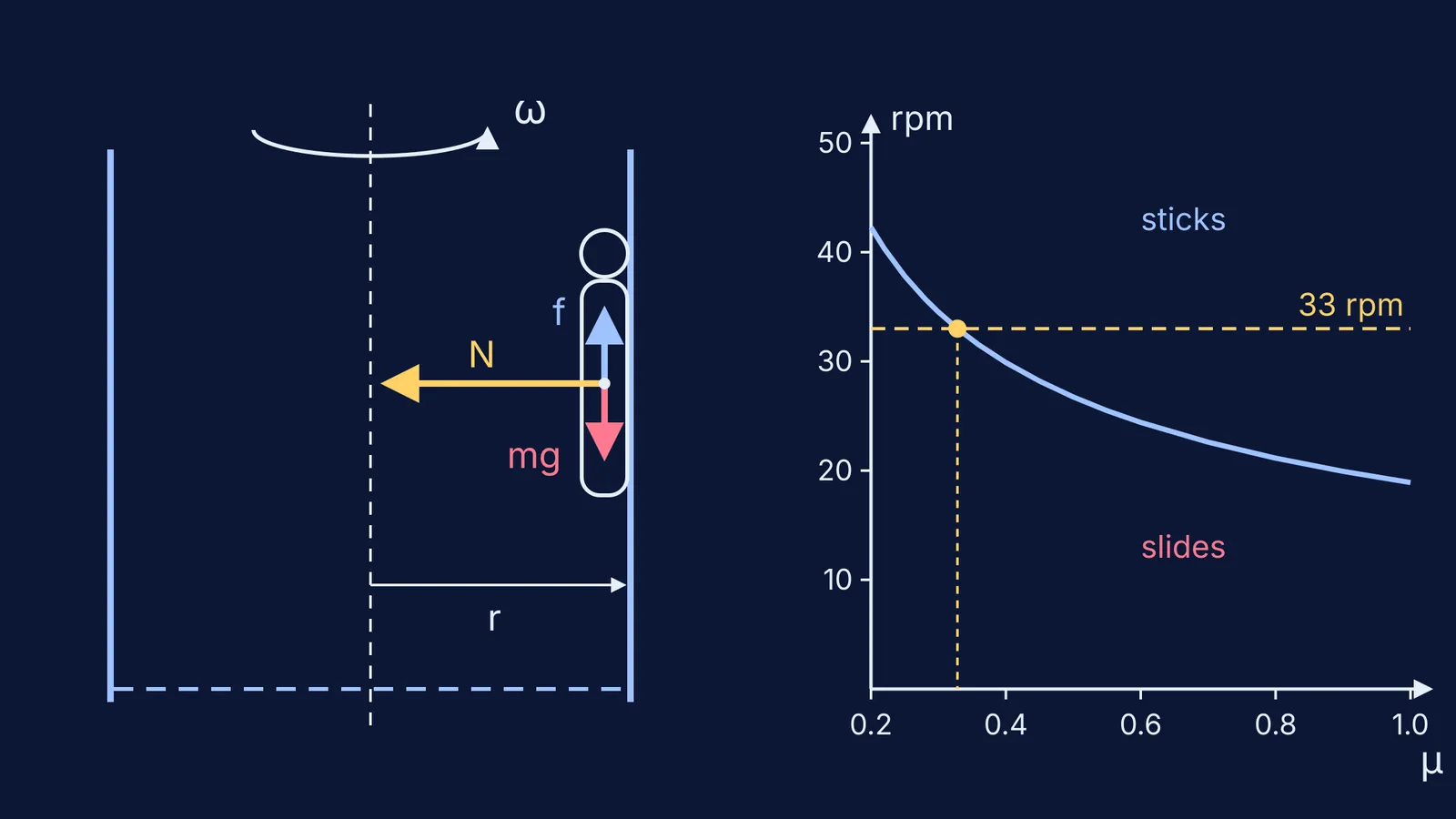
To move in a circle, your body needs a net force pointing towards the centre. That is the centripetal force, F = mv²/r = mω²r (OpenStax University Physics, section 6.3). In the Rotor, the only thing touching you sideways is the wall. So the wall's normal force N, pointing inward towards the axis, supplies all of it: N = mω²r.
The feeling of being thrown outward is your inertia: your body tries to go straight, and the wall keeps bending its path into a circle. OpenStax puts it plainly: "Centrifugal force is a commonly used term, but it does not actually exist" (OpenStax 6.3). If the wall disappeared, you would fly off along a tangent, just like a stone when its string breaks.
The normal force is horizontal, so it cannot hold you up. That job falls to friction. Gravity pulls you down with mg, and static friction from the wall pushes up along it. Static friction can grow only up to a limit: f ≤ μN, where μ is the coefficient of static friction (OpenStax University Physics, section 6.2).
What is the minimum speed for a rotor ride?
For you not to slide, friction must balance your weight, and the friction needed must not exceed the friction available:
Vertical balance: f = mg.
Limit on friction: mg ≤ μN.
Put in N = mω²r: mg ≤ μmω²r.
Cancel m and rearrange: ω ≥ √(g/(μr)), or in speed terms v ≥ √(gr/μ).
Your mass cancels, so a child and an adult stay up at the same spin rate if their clothes grip equally well. More grip or a wider drum lets the ride turn more slowly.
Worked example: how fast must the drum spin?
Wikipedia does not give the drum's size, so take a radius of r = 2.5 m and g = 9.8 m/s². This radius fits the entry's figures: at 33 rpm, ω = 33 × 2π/60 ≈ 3.46 rad/s, and ω²r ≈ 29.9 m/s², about 3 g, close to the entry's "almost 3 g" (Wikipedia)).
No table lists μ for clothing on a ride wall. To see how much grip matters, borrow three textbook values of static friction from OpenStax's table: 0.5 (wood on wood), 0.6 (dry steel on steel) and 1.0 (rubber on dry concrete). Add an assumed 0.3 for a slippery surface.
μ = 1.0: ω ≥ √(9.8/2.5) ≈ 1.98 rad/s, or about 19 rpm.
μ = 0.5: ω ≥ √(9.8/1.25) = 2.80 rad/s, or about 27 rpm, with a wall speed of about 7.0 m/s.
μ = 0.3: ω ≥ √(9.8/0.75) ≈ 3.61 rad/s, or about 35 rpm.
Turn the question around: at 33 rpm, the smallest μ that works is g/(ω²r) = 9.8/29.9 ≈ 0.33. Below that grip, you slide down even at full speed.
Now check the forces on a 50 kg rider at 33 rpm. Weight is 50 × 9.8 = 490 N. The wall's normal force is 50 × 29.9 ≈ 1490 N, about three times the weight. With μ = 0.5, the wall could supply up to about 750 N of friction, but it supplies only 490 N, exactly enough to balance the weight. Writing f = μN here is a classic exam slip; see why static friction is not always equal to μsN.
How do you set up a rotor problem in an exam?
Use this checklist for any "stuck to the wall" question in JEE Main or board exams:
Draw the free-body diagram with three forces only: mg down, f up and N towards the axis. Do not add a centrifugal force if you are working in the ground frame.
Write the radial equation: N = mω²r.
Write the vertical equation: f = mg.
Apply the limit only at the edge of slipping: f = μN gives the minimum ω.
Check units and convert rpm with ω = 2πn/60.
For a case where friction itself does the turning, read when an accelerating car skids on a circular track.
If you keep getting the direction of N or the friction inequality wrong, work through similar circular-motion problems in the Fermi Problem Library. Its step-by-step solver explains the reasoning rather than printing an answer. To refresh centripetal force itself, see the Fermi Concept Library.


