

On this page
Whirling a stone tied to a string is one of the oldest experiments in physics. But what actually happens at the exact moment the string snaps?
If you guessed that the stone flies straight outward, you are not alone—it is a common misconception. However, physics tells a different story about where the stone goes and why.
What is the path of a stone when its string breaks?
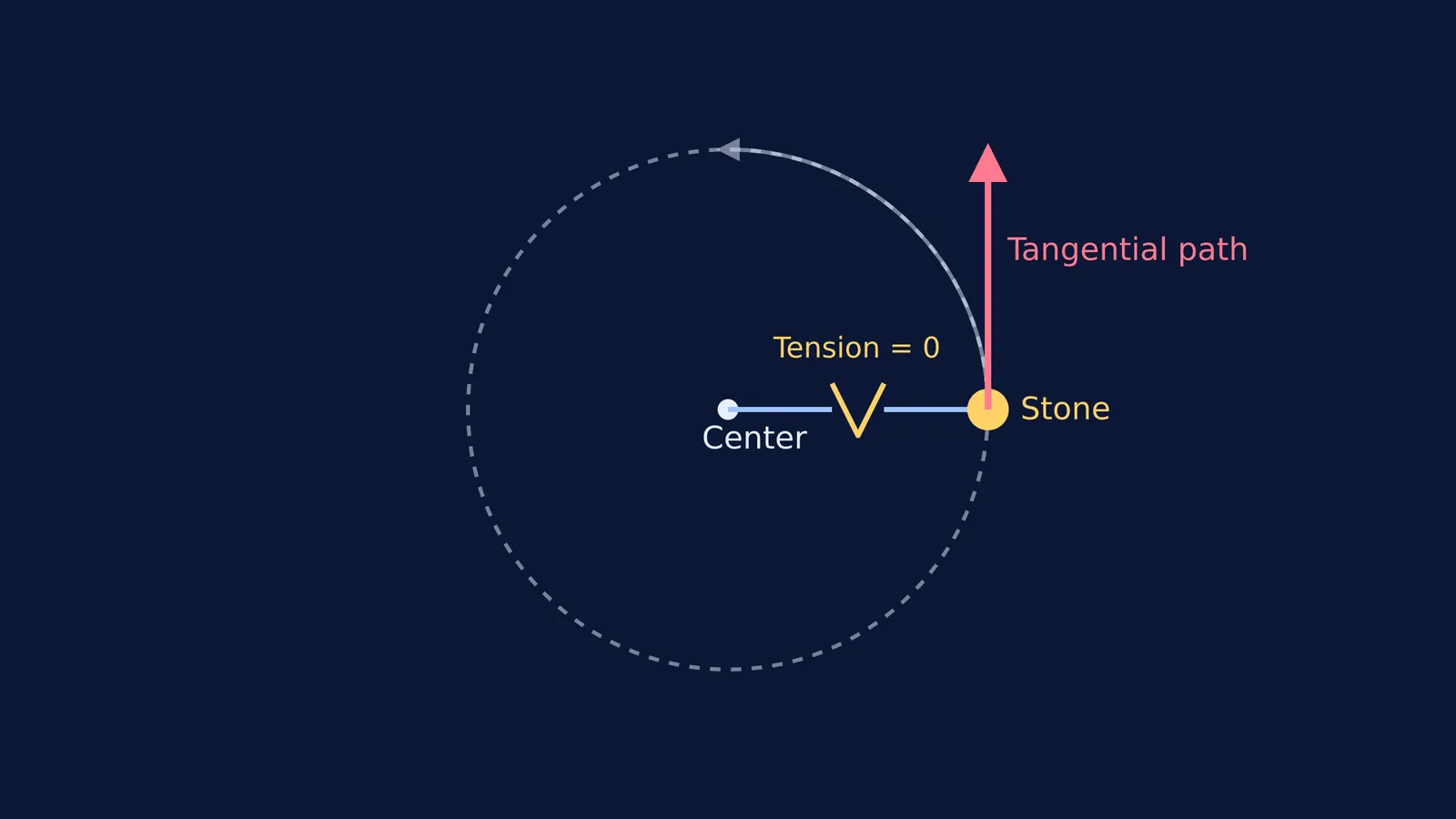
According to the NCERT Class 9 Science curriculum, when a string holding a whirling stone breaks, the stone flies off along a straight line that is a tangent to the circular path. When the tension providing the centripetal force vanishes, the object no longer accelerates toward the center.
While the string is intact, it pulls the stone toward the center of the circle. This inward pull is the centripetal force. It constantly changes the stone's direction, bending its path into a circle. The stone's velocity at any single instant, however, is pointing straight ahead along the tangent.
When the string breaks, the tension drops to zero instantly. Without the inward pull, the stone simply obeys its own inertia. As detailed in OpenStax University Physics, a centripetal force is required to maintain a curved path; if that force is removed, Newton's first law of motion dictates that the object will continue in a straight line tangent to the circle at the point of release.
Why doesn't the stone fly straight outward?
Many students assume a broken string means the stone will shoot radially outward, away from the center. This mistake comes from a misunderstanding of centrifugal force.
In an inertial frame of reference (like you standing and watching the stone), there is no outward force pushing the stone away. The only force acting on the stone in the horizontal plane was the tension pulling it *inward*. Just as tension in the string of a simple pendulum dictates its swing, the tension here dictates the circle.
When the string breaks, there is no mysterious outward push. The stone travels tangentially, and because a tangent line naturally diverges from the circle, the stone gradually gets further away from the center.
If you struggle to picture how these velocity and force vectors behave at the exact moment of release—much like calculating the sudden changes when cutting a string in a spring system—Fermi's AI tutor can help. The tutor teaches rather than answers: it draws the figure on a board and runs a simulation so you can check your understanding as it goes.
Is centrifugal force real?
The reason the "straight outward" myth persists is because of the feeling of centrifugal force. If you are sitting inside a car that takes a sharp left turn, you feel pushed to the right, toward the door. It feels like an outward force.
However, that outward push is a "fictitious force." In reality, your body is simply trying to follow its original straight-line path (due to inertia), while the car turns into your path. The car door pushes inward against you to force your body to turn with the car.
Similarly, from the perspective of the stone, it might "feel" an outward pull, but to an outside observer, there is only the inward tension of the string keeping it in the circle. When the string snaps, the stone stops turning and simply flies straight ahead. There is no centrifugal force to shoot it radially outward.
Where do we see this in the real world?
You can see this exact physics principle at work in the Olympic hammer throw. An athlete spins rapidly in a small circle, building up massive tension in the wire connecting them to a heavy metal ball. The wire provides the centripetal force.
The moment the athlete releases the handle, that tension drops to zero. The hammer does not fly radially outward from the athlete's chest; it travels forward along the tangent line it was moving on at the instant of release. Throwers must time their release perfectly, anticipating the tangent path, to send the hammer straight down the middle of the landing sector.
How to answer circular motion questions in exams?
Whether you are preparing for school board or competitive exams, questions about a force suddenly disappearing are extremely common. They often present a diagram of a circle and ask you to select the correct arrow (tangent, radial, or curved) for the object's path.
Use this three-step framework to avoid traps:
Identify the instantaneous velocity: Before reading the rest of the question, draw an arrow showing the object's velocity vector. It is always tangent to the path. In a counter-clockwise circle, the velocity at the top (12 o'clock) points straight left.
Remove the centripetal force: Cross out the string, the gravitational pull, or the magnetic field that was causing the circular motion. Note that the net inward force is now zero.
Trace the straight line: Extend your tangent velocity vector into a straight line. Unless gravity or another new force acts on it in that plane, this straight line is the object's new path.
If these concepts still feel abstract, you can find a complete breakdown of Newton's laws and circular motion in the Fermi Concept Library. For ideas that are easier to see than read, we also built the Fermi Simulation Lab so you can turn forces on and off and watch exactly how the path changes.


