

On this page
Many complex-number geometry questions come down to one move: turning a segment through a fixed angle. Once you see that multiplying by e^(iθ) is a rotation, the missing corner of a square or equilateral triangle takes three lines, not a page of coordinate geometry.
Why does multiplying by e^(iθ) rotate a point?
Euler's formula says e^(iθ) = cos θ + i sin θ, and Leonhard Euler first published it in 1748 (Euler's formula). For any real θ, e^(iθ) has modulus 1, so it sits on the unit circle at angle θ.
When you multiply two complex numbers, the absolute values are multiplied and the arguments are added (Complex number). Multiplying z by e^(iθ) therefore keeps |z| the same and adds θ to arg z. That is exactly an anticlockwise rotation through θ about the origin. If adding arguments still feels shaky, revise why arguments add when complex numbers multiply first.
The NCERT Class 11 chapter on complex numbers gives the picture: x + iy is the point (x, y) in the Argand plane, and its modulus is the distance from the origin.
Four multipliers do most of the work:
i = e^(iπ/2) turns a point 90° anticlockwise, so (3 + 4i) × i = −4 + 3i.
−i turns it 90° clockwise.
−1 turns it through 180°.
e^(iπ/3) = 1/2 + (√3/2)i turns it through 60°.
How do you rotate a point about a centre that is not the origin?
Shift, rotate, shift back. To rotate z through θ about a point a:
z′ = a + (z − a)e^(iθ)
Example: rotate 5 + 2i through 90° anticlockwise about 2 + i. Then z − a = 3 + i, times i gives −1 + 3i, so z′ = 1 + 4i. Both points are √10 from the centre, as they should be.
What is the rotation theorem for angles?
Let A, B, C be the points z1, z2, z3, and let α be the angle turned anticlockwise from AB to AC. Then:
(z3 − z1)/(z2 − z1) = (|z3 − z1| / |z2 − z1|) e^(iα)
The angle at A is the argument of the quotient of the two side vectors starting at A. If that quotient is purely imaginary, AB is perpendicular to AC; if it is real, A, B and C are collinear.
How do you find the vertices of a square using complex numbers?
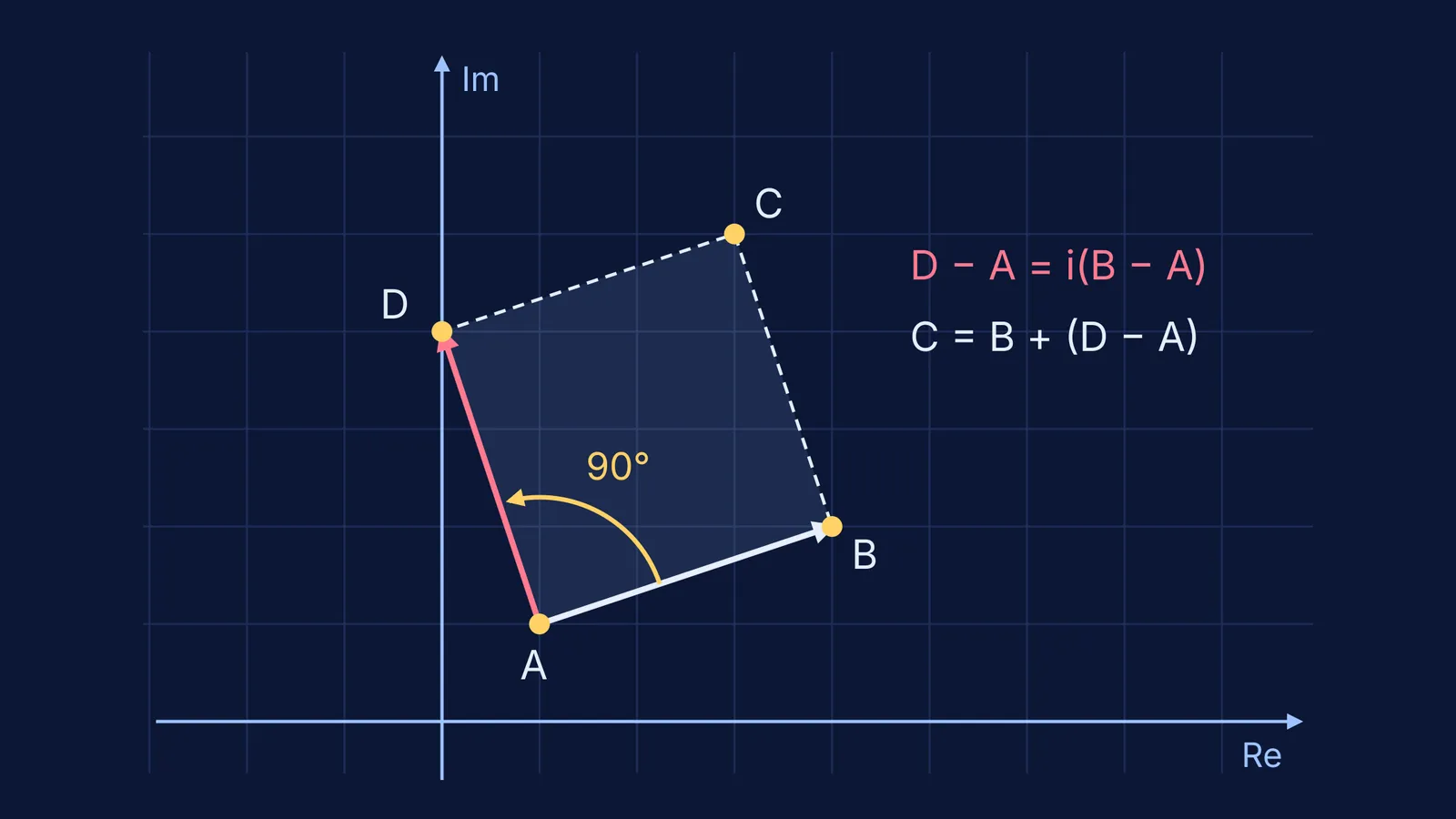
Take adjacent vertices A = 1 + i and B = 4 + 2i, with ABCD anticlockwise. Side AD is AB turned 90° anticlockwise about A, with equal length.
Find the side vector: B − A = 3 + i.
Rotate it: D − A = i(B − A) = −1 + 3i, so D = 4i.
Complete the parallelogram: C = B + (D − A) = 3 + 5i.
Check: |B − A| and |D − A| are both √10.
The square on the other side of AB uses −i: D = 2 − 2i and C = 5 − i. Step 3 is the parallelogram rule for adding complex numbers.
Given a diagonal AC instead, rotate about its midpoint M: B = M + i(A − M) and D = M − i(A − M).
How do you find the third vertex of an equilateral triangle?
Rotate one side through 60° about a shared vertex. With A = 1 + i and B = 5 + i:
C − A = (B − A)e^(±iπ/3) = 4(1/2 ± (√3/2)i) = 2 ± 2√3 i
So C = 3 + (1 + 2√3)i or C = 3 + (1 − 2√3)i.
Quick check: z1, z2, z3 form an equilateral triangle when z1² + z2² + z3² = z1z2 + z2z3 + z3z1. That condition depends only on differences, so you may shift A to 0. The vertices become 0, 4 and 2 + 2√3i, and both sides come to 8 + 8√3i.
Which mistakes cost marks in rotation problems?
Check every answer:
Rotate about the vertex, not the origin.
Match the direction: e^(iθ) is anticlockwise, e^(−iθ) clockwise.
Keep the modulus ratio when the sides are unequal.
Give the second position when the order is not fixed.
Convert e^(iπ/3) as 1/2 + (√3/2)i, not the other way round.
The same quotient idea appears when you find the locus of z in the complex plane.
If you keep landing on the wrong vertex, the Fermi Problem Library has worked problems with a step-by-step solver that explains the reasoning rather than printing an answer, so you can see which line went wrong.
Try it now: with A = 2 and B = 2 + 2i, find both squares on side AB.


