

On this page
Thinking about panels on the roof? Two questions decide it: what happens to the units you don't use, and how many years the panels take to pay for themselves.
How does net metering work?
Net metering means a bi-directional meter counts the units your panels send to the grid and the units you draw from it, and you pay only for the net energy used, according to the Ministry of New and Renewable Energy's consumer FAQ on grid-connected rooftop solar.
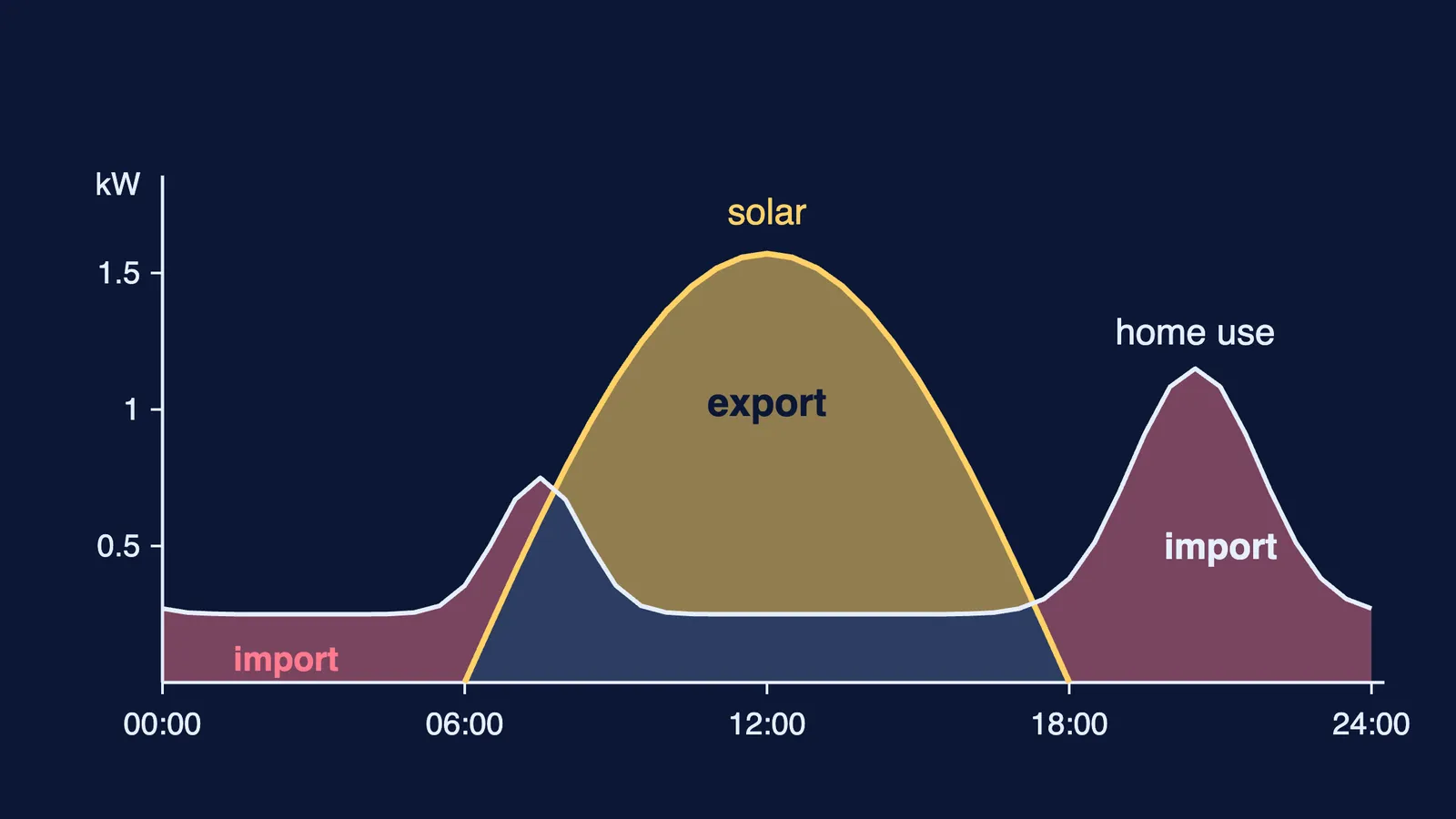
By day your home uses solar power first and the extra flows out to the grid (export). At night, or under cloud, you draw from the grid (import). The DISCOM bills imported minus exported units.
Delhi's 2014 net metering regulations from the Delhi Electricity Regulatory Commission carry it forward to the next bill as an energy credit, and any credit still unused at the end of the financial year is paid for at rates the Commission notifies. Every state's regulator has notified its own net metering rules, the MNRE FAQ notes, so read yours.
How many units does 1 kW of rooftop solar generate in India?
On a clear sunny day, a 1 kWp rooftop plant can generate 4 to 5.5 units, according to the MNRE FAQ. One unit is one kilowatt-hour; our post on how a smart meter counts kWh shows how the meter keeps the tally.
Output varies with location, sunshine hours, tilt and cleaning, the FAQ says, and 1 kW generally needs about 10 square metres of shadow-free roof. Under the government scheme, panels must be warranted to give at least 90% of rated power after 12 years and 80% after 25 years.
For the sums below we use 4 units per kW per day, the bottom of that clear-day range. Cloudy and monsoon days give less, so this sunny-day figure is our assumption, not an official average.
What does a day of export and import look like?
Take a 3 kW system making 12 units on a sunny day (3 × 4, from the MNRE clear-day range) and a home using about 10 units. We modelled solar output as an arch from 6 am to 6 pm and home use with morning and evening peaks (the diagram above):
Generated: 12 units
Used straight from the panels: about 3.5 units
Exported around midday: about 8.5 units
Imported before 8 am and after 5 pm: about 6.4 units
The meter bills 6.4 − 8.5 ≈ −2, so about 2 units go into credit; over a sunny 30-day month, about 60 units that a cloudy month can use. The grid works like a bank for the midday surplus.
If areas under curves are new, the Fermi Concept Library has a lesson for every concept in physics and mathematics.
How long does rooftop solar take to pay back?
Under PM Surya Ghar: Muft Bijli Yojana, the central subsidy for homes is ₹30,000 per kW up to 2 kW and ₹18,000 per kW for additional capacity up to 3 kW, capped at ₹78,000, as listed on Delhi's official solar portal. Some states, Delhi among them, add a state subsidy; we leave it out.
The price and unit rate below are made up: use your own quote and bill.
System: 3 kW. Subsidy: 2 × ₹30,000 + 1 × ₹18,000 = ₹78,000.
Assumed quote: ₹1,80,000. Your cost: ₹1,80,000 − ₹78,000 = ₹1,02,000.
Yearly units, if every day gave 4 units per kW: 3 kW × 4 units × 365 days = 4,380 units.
Value of a unit: say ₹7, an assumed top-slab rate. Yearly saving: 4,380 × ₹7 = ₹30,660.
Simple payback: ₹1,02,000 ÷ ₹30,660 ≈ 3.3 years.
Now test it. At ₹5 a unit the saving falls to ₹21,900 and payback stretches to about 4.7 years. The sum also assumes you use at least 4,380 units a year, about 365 a month; surplus left at year end earns the rate the regulator notifies, not necessarily your bill rate, so a smaller user may save less. Size the system to match a year of your own use. Fixed charges stay on your bill, the MNRE FAQ warns, so a zero bill is rare. With slab tariffs, solar usually removes units from your highest slab first, as our post on electricity slab rates as a piecewise function explains. The sum ignores cloudy days, ageing and repairs: treat it as a first estimate.
What should you check before you sign?
Twelve months of bills, for your average monthly units.
Midday shade from tanks, trees or the next building.
The DISCOM's approved (L1) rate: MNRE advises paying no more.
A written generation estimate and warranties.
Your state's rule for paying year-end credit.
For a student project, read your net meter for a week, plot export and import, and compare with the model above. Fermi's AI tutor can work out what you already know and build a plan for the session, so the curve, the area and the bill sum fit together.


