

On this page
Textbooks usually derive rms for a sine wave, so 0.707 sticks in your head. Then an exam hands you a square wave, a sawtooth or a rectified current, and 0.707 is wrong for all of them. One method works for any shape, and here it is for each wave you are likely to meet.
What does rms actually measure?
NCERT's Class 12 Physics textbook, Chapter 7 on alternating current, points out that the average of a sinusoidal current over one cycle is zero, yet the resistor still heats up. Heating depends on i²R, and i² is never negative.
The rms current is the steady DC current that would produce the same average power in a resistor, as NCERT puts it in section 7.2. For a sine wave this gives I = i_m/√2 = 0.707 i_m (NCERT equation 7.6).
The general definition, from the root mean square entry on Wikipedia, is I_rms = √[(1/T) ∫ I² dt]; for a periodic current you take the integral over one period T. Read the name backwards and you have the recipe:
Square the current at every instant: I².
Take the mean of I² over one full period: (1/T) ∫ I² dt.
Take the square root of that mean.
How do you find the rms value of a square wave?
A square wave sits at +I₀ for half the period and at −I₀ for the other half.
Square it: I² = I₀² for the whole period, because (−I₀)² = I₀².
Mean of I² over the period: I₀².
Root: I_rms = I₀.
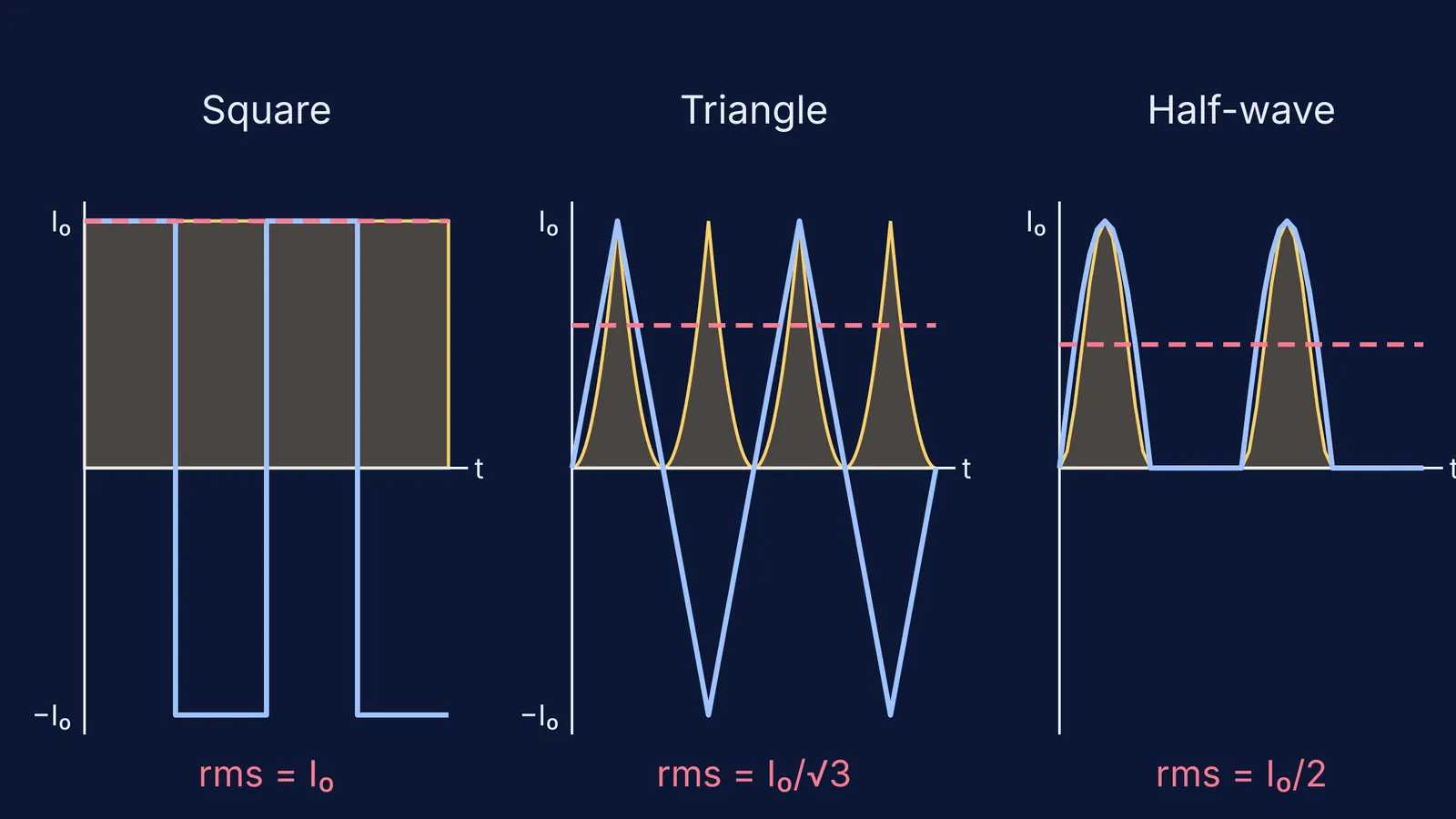
A symmetric square wave's rms value equals its peak value, as the table of waveforms on Wikipedia lists. Its average, by contrast, is zero.
How do you find the rms value of a triangular or sawtooth wave?
Take the sawtooth first, since it is a single ramp. Over one period it rises steadily from −I₀ to +I₀: I = I₀(2t/T − 1) for 0 ≤ t ≤ T.
Square it: I² = I₀²(2t/T − 1)².
Average it. Substitute x = 2t/T − 1, so dt = (T/2) dx and x runs from −1 to 1. The mean is (1/T) × I₀² × (T/2) × ∫ x² dx from −1 to 1 = (I₀²/2) × (2/3) = I₀²/3.
Root: I_rms = I₀/√3 ≈ 0.577 I₀.
A triangular wave of the same peak gives the same answer, I₀/√3, according to the same Wikipedia table. Here's why, without a second integral: in both waves the size of the current changes in straight lines between 0 and I₀, so every value of |I| gets the same share of time. Squaring removes the sign, and an average doesn't care about order, so the two means of I² are equal.
What about half-wave rectified AC?
A half-wave rectifier passes the positive half of a sine wave and blocks the other half. So I = I₀ sin ωt for the first half period and 0 for the second.
Square it: I₀² sin² ωt for the first half, 0 for the second.
Over a full period, the average of sin² ωt is 1/2 (NCERT shows this in section 7.2). Over a half period, the integral is exactly half the full-period value, so ∫ I² dt = I₀²T/4. Dividing by the full period T gives a mean of I₀²/4.
Root: I_rms = I₀/2.
The Wikipedia article on rectifiers gives the same rms value, peak/2, and gives the average as peak/π, about 0.318 I₀. The classic trap is dividing by T/2 instead of T: the zero half still belongs to the period. For a fuller walk-through, see our post on the rms and average value of half-wave rectified AC.
Why is the rms value different from the average?
The average lets positive and negative parts cancel. The rms squares first, so nothing cancels and large values count for more. For peak I₀, over one full period:
Square wave: average 0, rms I₀.
Ordinary sine wave: average 0, rms I₀/√2 ≈ 0.707 I₀.
Triangular or sawtooth wave: average 0, rms I₀/√3 ≈ 0.577 I₀.
Half-wave rectified sine: average I₀/π ≈ 0.318 I₀, rms I₀/2.
These match the Wikipedia waveform table and the rectifier article. The square wave spends all its time at full size and the half-wave is off half the time, so they have the largest and smallest rms values of the four.
Adding a DC level? See rms value of DC plus AC. For mains voltage, read why rms voltage is 230 V and peak voltage is 325 V.
Stuck on a new waveform? Practise on worked problems in the Fermi Problem Library, whose step-by-step solver explains the reasoning rather than printing an answer. If averages over a period still feel shaky, the Fermi Concept Library gives each concept its own lesson.


