

On this page
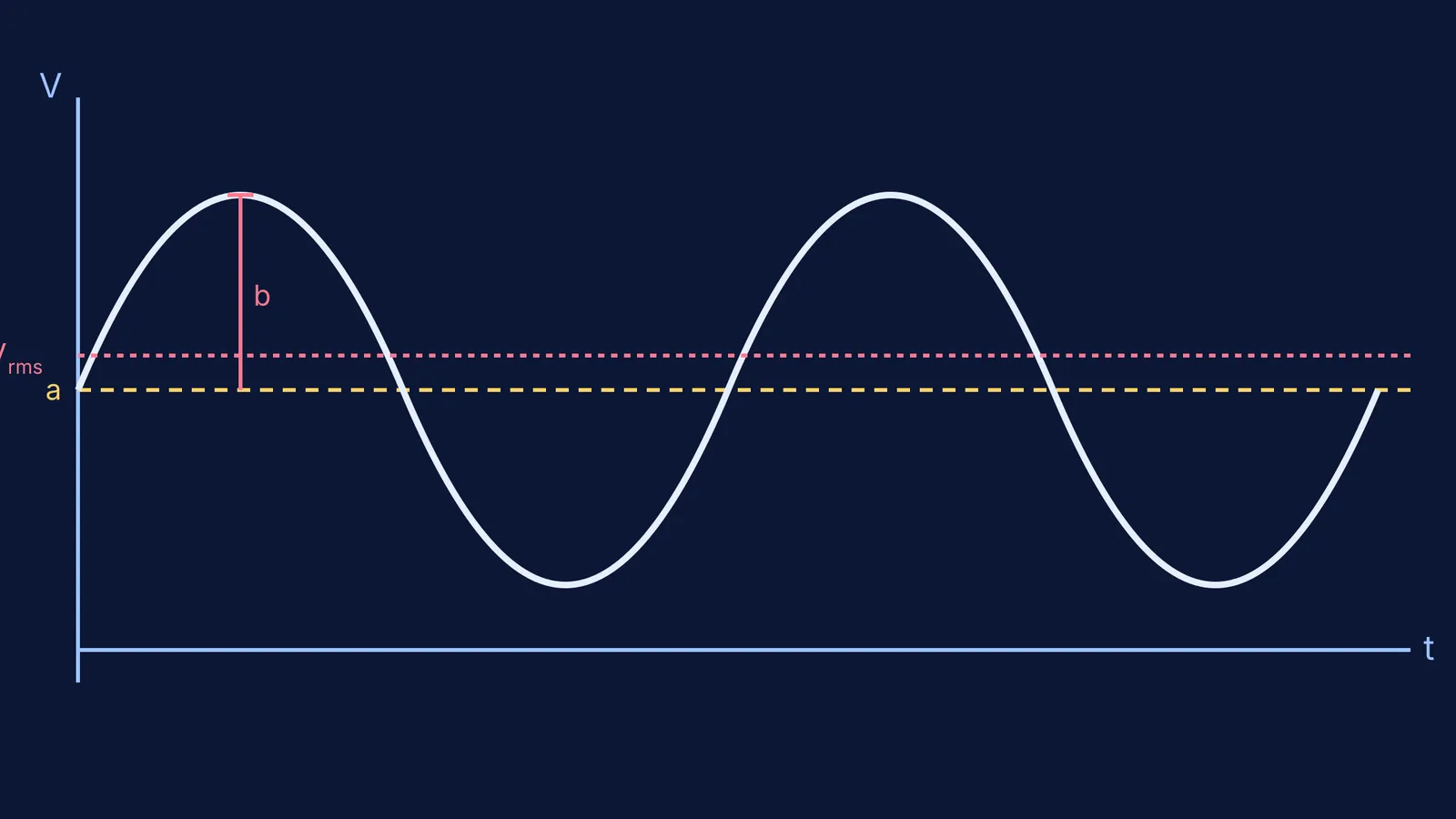
When a circuit contains both a direct current (DC) offset and an alternating current (AC) ripple, finding the effective voltage is a common problem in physics and engineering. The standard formula for a voltage V = a + b sin ωt is V_rms = √(a² + b²/2). But a frequent mistake is simply adding the DC value to the AC RMS value. Here is why that fails, and how the mathematics of average power gives the correct answer.
What is the RMS value of a DC plus AC voltage?
If a voltage signal has a constant DC level a and a sinusoidal AC component with peak amplitude b, we write it as V(t) = a + b sin ωt.
The root-mean-square (RMS) value of an alternating current is defined as the value of a constant direct current (DC) that would dissipate the same amount of power in a resistive load (Wikipedia).
For the combined signal, the total RMS value is the square root of the sum of the squares of the individual RMS values. Since the RMS value of the DC part is just a, and the RMS value of the AC part is b / √2, the total is V_rms = √(a² + b²/2).
Why can you not just add the two RMS values?
The RMS calculation is not about finding the average voltage. The average of a pure sine wave over one cycle is zero, which is why we square it first.
Because RMS represents the "effective" value for calculating power, and power is proportional to the square of the voltage (P = V² / R), we must average the squares. When you square the combined voltage (a + b sin ωt)², you get three terms:
a² (the DC square)
b² sin² ωt (the AC square)
2ab sin ωt (the cross term)
When we average this over a full cycle, the first term stays a². The second term averages to b²/2. The third term, the cross product, averages exactly to zero because the sine wave spends equal time positive and negative.
Because the cross term vanishes, there is no mixing of the powers. The total mean square is simply a² + b²/2. Taking the square root of this sum gives the correct RMS value. If you added the RMS values directly as (a + b/√2), you would falsely introduce a cross term of ab√2, which overestimates the true heating effect.
If you struggle with evaluating integrals over a cycle, reviewing the Integrals of √(a² − x²) and √(x² ± a²): the standard results can build confidence in handling standard calculus forms.
How does the combined voltage heat a resistor?
The reason we care about RMS values is practically tied to heat. If you connect this a + b sin ωt voltage across a resistor R, how hot does it get?
The total average power is simply the sum of the power from the DC source and the power from the AC source:
Total Power = (V_dc² / R) + (V_ac,rms² / R)
This mathematical independence means we can treat the DC offset and the AC ripple as two entirely separate heating elements working in the same resistor. Because the average of the fluctuating interaction between them is zero, the total heat produced is exactly the sum of the heat each would produce if it were acting alone.
If you need to brush up on how generators produce that AC voltage in the first place, see our guide on transformers and AC generators.
If you keep making the mistake of adding values linearly rather than as squares, the Fermi Problem Library has worked problems with a step-by-step solver that explains the reasoning rather than printing an answer. Fermi's AI tutor teaches rather than answers: it checks your understanding as it goes, notices if you try to add RMS values directly, and guides you to the correct sum of squares.
How do you calculate the RMS value step by step?
Here is a worked example to see the numbers in action. If a circuit has a voltage V = 3 + 4 sin(100t) volts, find the RMS voltage.
Identify the DC component: a = 3 V.
Identify the AC peak amplitude: b = 4 V.
Calculate the square of the DC RMS: 3² = 9.
Calculate the square of the AC RMS: 4² / 2 = 16 / 2 = 8.
Add the squares: 9 + 8 = 17.
Take the square root: V_rms = √17 ≈ 4.12 V.
If you had incorrectly added the two RMS values, you would have calculated 3 + (4/√2) = 3 + 2.83 = 5.83 V, which is completely wrong and would make you predict far more heat dissipation than actually occurs.


