On this page
A board question shows a cell, a fixed resistor, a rheostat and three meters. The slider moves to the right, and you have to say what each meter does. A quicker way than writing equations is to follow one chain of cause and effect, in order: total resistance, then current, then each voltage. Get the directions right first and the numbers become a check.
This post covers the usual setup, where the rheostat is in series as a current limiter. If yours is wired as a potential divider, with all three terminals in use, read how a rheostat works as a potential divider or a current limiter first, because the answers change.
What happens to the ammeter reading when you move the rheostat slider?
First, work out which way the slider changes the length of wire the current passes through. More wire in the path means more resistance. Call the rheostat's resistance x, the fixed resistor R and the cell's internal resistance r.
In series, resistances simply add, and the same current flows through every part (OpenStax University Physics, resistors in series). So the total resistance is R + x + r.
The current from a cell with emf ε and internal resistance r through an external load R is I = ε/(r + R) (OpenStax University Physics, electromotive force). Here the load is R + x, so I = ε/(R + x + r).
The emf is fixed, so:
Slider puts more wire in the path: x rises, total resistance rises, current falls, ammeter reading falls.
Slider puts less wire in the path: x falls, total resistance falls, current rises, ammeter reading rises.
The ammeter is in series, so it reads that same current wherever it sits in the loop. For why it goes in series and the voltmeter in parallel, see how to connect an ammeter and a voltmeter, and why it matters.
Which voltmeter readings go up and which go down?
With the current settled, take each voltmeter in turn, using whichever formula has only one quantity changing.
Across the fixed resistor R. Ohm's law gives V = IR (OpenStax, Ohm's law). R is constant and I falls, so this reading falls.
Across the cell's terminals. The terminal voltage is V = ε − Ir, and it "decreases as the current increases due to the potential drop Ir" (OpenStax, electromotive force). Turn that round: when I falls, the terminal voltage rises.
Across the rheostat. Here both I and x change, so Ix gives no clear direction. Use the rest of the loop instead: the voltage across the rheostat equals ε − I(R + r). The current falls, so less is lost across R and r, and the rheostat reading rises.
The terminal voltage step is the one most often written backwards. For the same effect in everyday batteries, see why battery terminal voltage drops with load.
A worked example with numbers
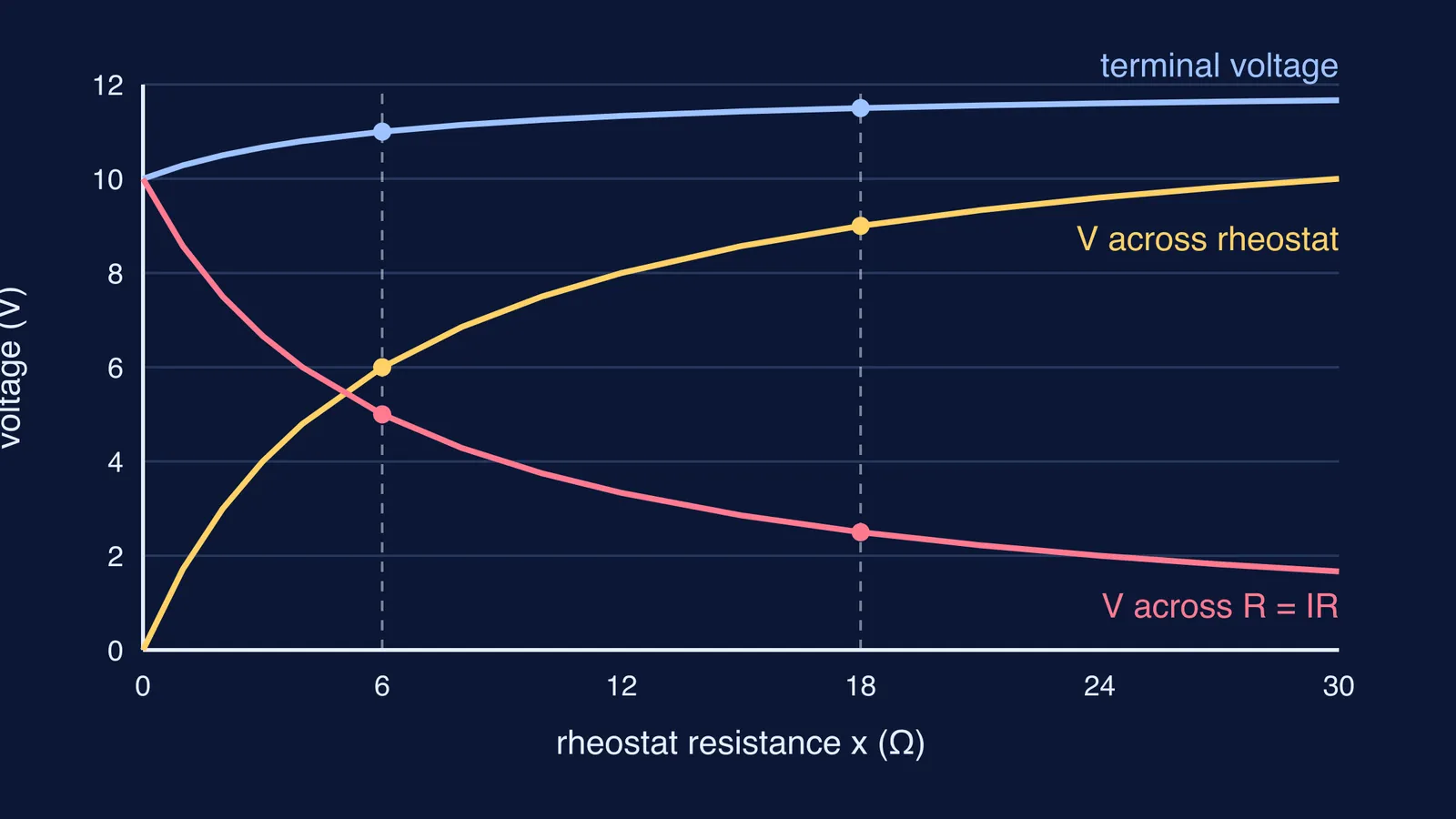
Take ε = 12 V, r = 1 Ω and R = 5 Ω. The slider moves so the rheostat goes from 6 Ω to 18 Ω. The formulas come from OpenStax section 10.1.
Before:
Total resistance 5 + 6 + 1 = 12 Ω, so I = 12/12 = 1 A.
Across R: 1 × 5 = 5 V.
Across the rheostat: 1 × 6 = 6 V.
Terminal voltage: 12 − 1 × 1 = 11 V.
After:
Total resistance 5 + 18 + 1 = 24 Ω, so I = 12/24 = 0.5 A.
Across R: 0.5 × 5 = 2.5 V.
Across the rheostat: 0.5 × 18 = 9 V.
Terminal voltage: 12 − 0.5 × 1 = 11.5 V.
The ammeter halved, the reading across R fell, and the readings across the rheostat and the terminals rose. As a check, 2.5 + 9 = 11.5 V: the voltages outside the cell add up to the terminal voltage.
What are the common traps in these questions?
Reading the rheostat's voltage as IR. That logic says it falls because I falls, which is wrong. Use ε minus the drops across everything else.
Treating the cell as ideal when r is given. With no internal resistance, the terminal voltage stays at ε and never changes. With r, it does change.
Not checking which part of the wire is in use. Trace the current path from one end terminal to the slider before deciding whether x went up or down.
Starting with numbers. If your arithmetic gives a rising current for a rising resistance, the chain shows the mistake at once.
If a step in a longer problem still goes wrong, the Fermi Problem Library has worked problems with a step-by-step solver that explains the reasoning rather than printing an answer. If the idea of a voltage drop itself feels shaky, the Fermi Concept Library gives each physics concept its own lesson.