

On this page
Flip a number's digits, add, and repeat. Almost every number soon lands on a palindrome, a number that reads the same both ways. Here is a shortcut that predicts the steps for any two-digit number, and why 196 has resisted decades of computing.
How does the reverse-and-add process work?
The 196-algorithm takes any positive integer of two or more digits, reverses its digits and adds the reversed number to the original (MathWorld, 196-Algorithm). You repeat until the result is a palindrome. John Walker's 1990 report on the palindrome quest starts with 87:
87 + 78 = 165
165 + 561 = 726
726 + 627 = 1353
1353 + 3531 = 4884, a palindrome
If no column of the addition produces a carry, the answer is automatically a palindrome, because each digit is the same pair added in the opposite order. Carries break the mirror.
How many steps do two-digit numbers take?
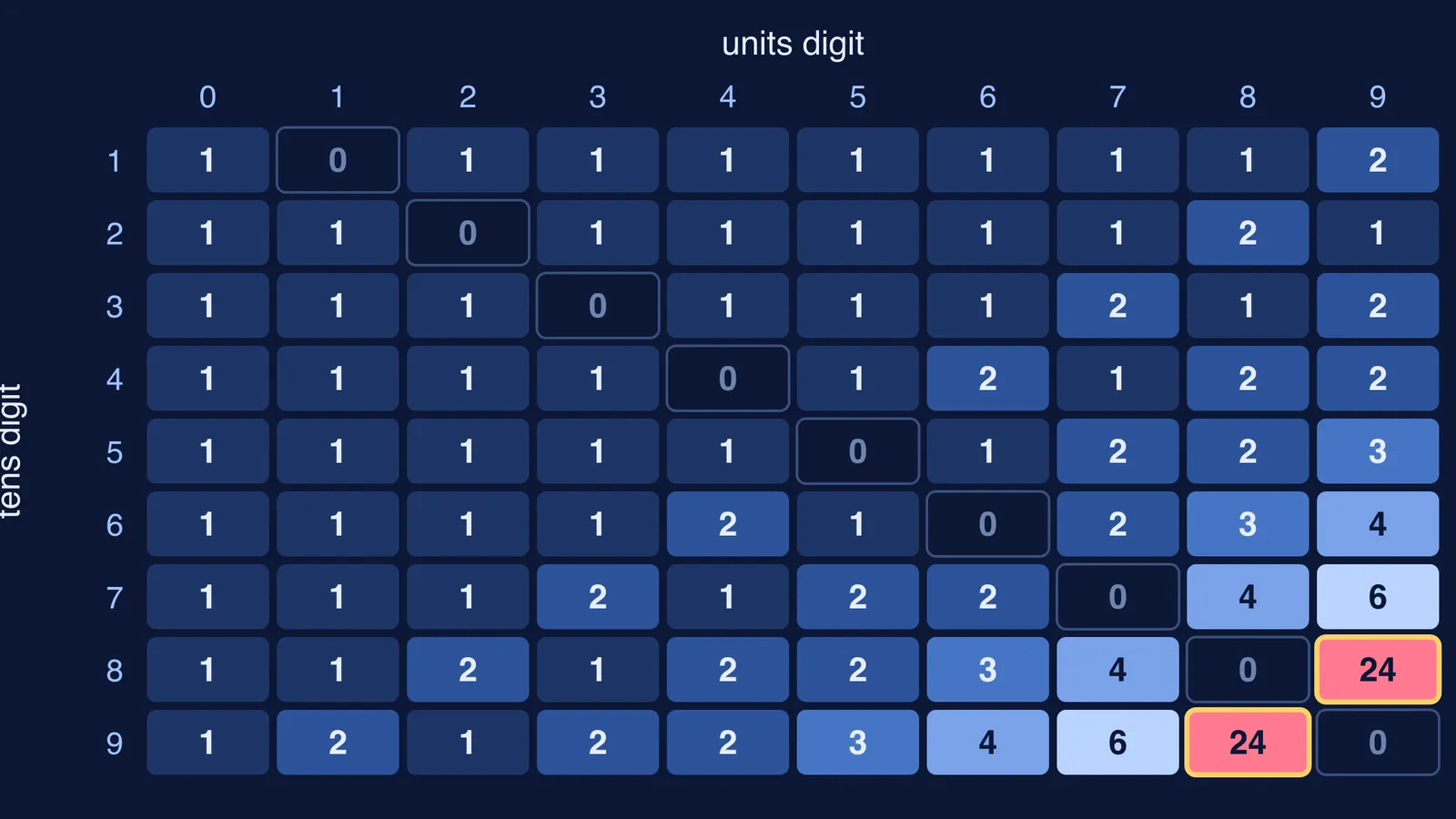
Write a two-digit number as 10a + b. Its reverse is 10b + a, and the sum is 11(a + b). So the whole path depends only on the digit sum. The step counts below match OEIS sequence A033665, which lists the number of reverse-and-add steps for every starting number:
Digit sum 1 to 9 (12, 45, 72...): the first sum is 11 times a single digit, such as 33 or 99. One step.
Digit sum 10 (19, 28, 37...): 110, then 121. Two steps.
Digit sum 11 (29, 38, 47...): 121. One step.
Digit sum 12 (39, 48, 57...): 132, then 363. Two steps.
Digit sum 13 (49, 58, 67...): 143, then 484. Two steps.
Digit sum 14 (59, 68, 86, 95): 154, 605, 1111. Three steps.
Digit sum 15 (69, 78, 87, 96): 165, 726, 1353, 4884. Four steps.
Digit sum 16 (79, 97): 176, 847, 1595, 7546, 14003, 44044. Six steps.
Digit sum 17 (89, 98): 187, then 23 more steps to 8,813,200,023,188. 24 steps.
Counting from that table, of the 81 two-digit numbers that are not already palindromes, 49 finish in one step, 69 finish in two or fewer, and only 89 and 98 need more than six.
Larger numbers behave similarly. Of the 900 three-digit numbers, 90 are palindromes to start with and 735 of the rest take fewer than 5 reversals and additions (Walker, 1990). Except for 196.
Why is 196 famous?
196 is the smallest number that has never been seen to reach a palindrome. Numbers like this are called Lychrel candidates, and the OEIS list A023108 begins 196, 295, 394, 493, 592, 689, 691, 788. Many of them are really one chain: 196 + 691 = 887 and 295 + 592 = 887, so after one step they are the same problem.
According to Walker's report, P. C. Leyland had already carried 196 through 50,000 reversals and additions to more than 26,000 digits. Walker set a Sun 3/260 workstation on it on 12 August 1987. In May 1990, after 2,415,836 reversals and additions, the number had 1,000,000 digits and still no palindrome. In 1995 Tim Irvin took it to two million digits in two months on a supercomputer.
Romain Dolbeau's distributed program p196_mpi reached one billion iterations (over 413 million digits) on 2 October 2011, and a billion digits in February 2015.
Why not declare 196 stuck forever? As Dolbeau's page puts it, a brute force approach "will not prove 196 is a Lychrel number (it can only disprove)". Walker's intuition: as a number grows huge, the odds that no digit pair sums to 10 or more become tiny. Tiny is not zero. In base 10 nobody has proved that any number never forms a palindrome, though Walker notes Ronald Sprague proved 10110 in base 2 never does. For another easy-to-state, unsettled problem, read about the Collatz conjecture and its 3n + 1 puzzle.
How can you explore it yourself?
A 20-minute session for a Class 8 to 10 student, with a parent checking the arithmetic:
Prove the 11(a + b) rule with algebra, the same move used in two-digit number problems where the digits are reversed.
Do the three-digit version: 100a + 10b + c plus its reverse is 101(a + c) + 20b. With no carries (a + c at most 9, b at most 4) one step is enough. Test 123, 241 and 352, then explain why 209 still finishes in one step (209 + 902 = 1111).
Work 79 by hand and check you reach 44044 in six steps.
Do five steps of 196: 887, 1675, 7436, 13783, 52514. Circle every carry.
Compare it with the 1089 trick, where you reverse and subtract, and explain why that one ends at 1089 for most three-digit starting numbers.
If a step of the algebra will not come out, the Fermi Problem Library has worked problems with a step-by-step solver that explains the reasoning rather than printing an answer.
Then try 89: twenty-four steps by hand is a real test of careful addition.


