

On this page
Fragment-counting questions in Class 12 biotechnology and NEET-UG-style MCQs look harder than they are. You need three things: whether the DNA is linear or circular, how many cuts there are, and what a gel does with the pieces.
How many fragments does a restriction enzyme make?
A restriction endonuclease recognises a specific palindromic sequence, binds there and cuts both DNA strands, as the NCERT Class 12 chapter Biotechnology: Principles and Processes describes. EcoRI, for example, cuts only where the sequence GAATTC is present, according to the same chapter.
So each recognition site gives one cut, assuming the digest runs to completion. Then:
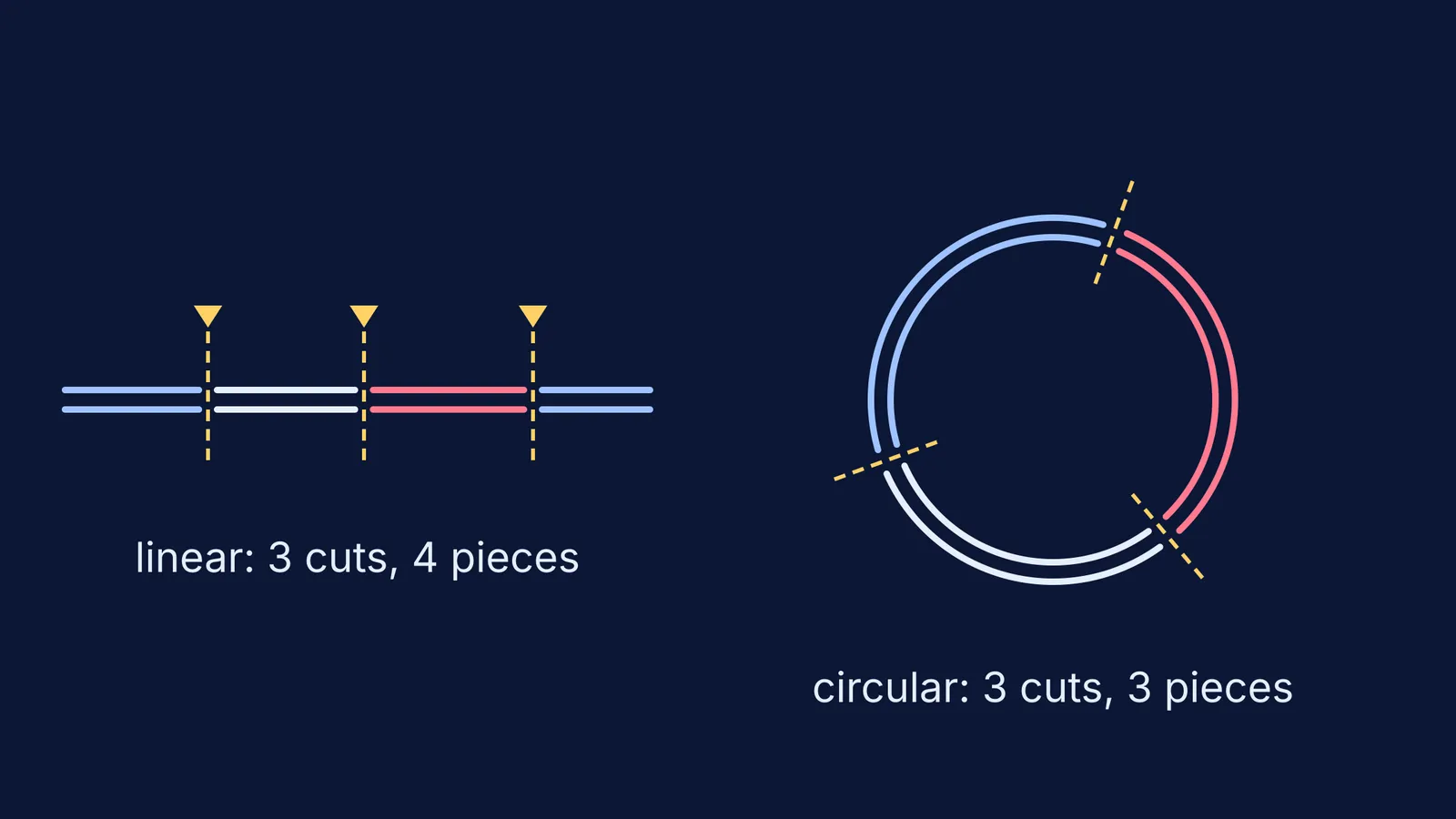
Linear DNA cut n times gives n + 1 fragments.
Circular DNA cut n times gives n fragments (for n of 1 or more).
Circular DNA with no site stays one uncut circle.
If the palindrome idea is still fuzzy, read our explainer on what a palindromic sequence in a restriction site means first.
Why does circular DNA give one fewer fragment?
Think of a string and a bangle. Cut a string once and you hold two pieces; cut a bangle once and you hold one piece, opened out. A plasmid has no ends, so its first cut only opens it, and every cut after that adds one piece. That is the trap in many MCQs: the plasmid is mentioned in the first line and forgotten by the last.
What happens in a double digest?
In a double digest you cut the same DNA with two enzymes together. If their sites do not overlap, total cuts = sites for enzyme A + sites for enzyme B; then apply the linear or circular rule. The two practice problems below use made-up numbers.
Problem 1. A linear 10,000 bp molecule has 2 EcoRI sites and 1 BamHI site. How many fragments in a double digest?
Total cuts = 2 + 1 = 3.
Linear, so fragments = 3 + 1 = 4.
Problem 2. A 4,000 bp plasmid has an EcoRI site at position 500 and HindIII sites at 1,500 and 3,000. How many fragments, and how many bands on a gel?
Total cuts = 1 + 2 = 3.
Circular, so fragments = 3.
Sizes: 500 to 1,500 is 1,000 bp; 1,500 to 3,000 is 1,500 bp; 3,000 round past the end to 500 is 1,000 + 500 = 1,500 bp.
Check: 1,000 + 1,500 + 1,500 = 4,000 bp, the whole plasmid.
Two fragments are the same size, so they sit in one band. Answer: 3 fragments, 2 bands.
Fragments and bands are not the same count, and that is where marks are lost. For the chemistry of how EcoRI leaves its overhangs, see our post on restriction enzyme sticky ends.
How do you read fragment sizes on a gel?
The NCERT chapter on biotechnology principles explains that DNA fragments are negatively charged, so an electric field pulls them through an agarose gel towards the anode. The gel acts as a sieve, so the smaller the fragment, the farther it moves. The bands become visible only after staining with ethidium bromide and exposure to UV light, the chapter adds.
Thermo Fisher's Lambda DNA/EcoRI Marker user guide lists 6 fragments from lambda DNA completely digested with EcoRI: 21,226, 7,421, 5,804, 5,643, 4,878 and 3,530 bp. Those six add up to 48,502 bp. Lambda DNA is a linear molecule, and the guide places its sticky cos ends on the two end fragments, so 6 fragments means EcoRI cut it 5 times.
The same guide shows how real gels can mislead a fragment count:
On its 0.7% agarose gel, the 5,804 and 5,643 bp bands run very close together, because they differ by only 161 bp.
The 21,226 and 3,530 bp fragments carry lambda's cohesive cos ends, which may pair up and form an extra band at 24,756 bp. Heating to 65 °C for 5 minutes and then cooling on ice for 3 minutes separates them again.
A four-step check for any digest question
Is the DNA linear or circular? Underline the word in the question.
Count the sites for each enzyme and add them to get total cuts.
Apply cuts + 1 (linear) or cuts (circular).
If sizes are given, check that they sum to the full length, and merge equal sizes into one band.
If your count is right but your sizes are wrong, check the wrap-round step for plasmids. The Fermi Problem Library has worked problems with a step-by-step solver that explains the reasoning rather than printing an answer, so you can see exactly where your working went off. To revise recognition sites, vectors and gel electrophoresis as connected ideas, the Fermi Concept Library gives each concept its own lesson and its place in the map.
Next, decode the names on these enzymes with our guide to how restriction enzymes like EcoRI are named.


