

On this page
A ring problem looks like a new kind of circuit, but it is just two resistors in parallel. Once you see that, every variation comes down to one formula.
How do you find the resistance between two points on a circular wire loop?
Start with how a uniform wire behaves. Resistance is R = ρL/A, so for the same material and cross-section, resistance is proportional to length (OpenStax University Physics, Vol. 2). That is the same idea behind what happens when a wire is folded into two.
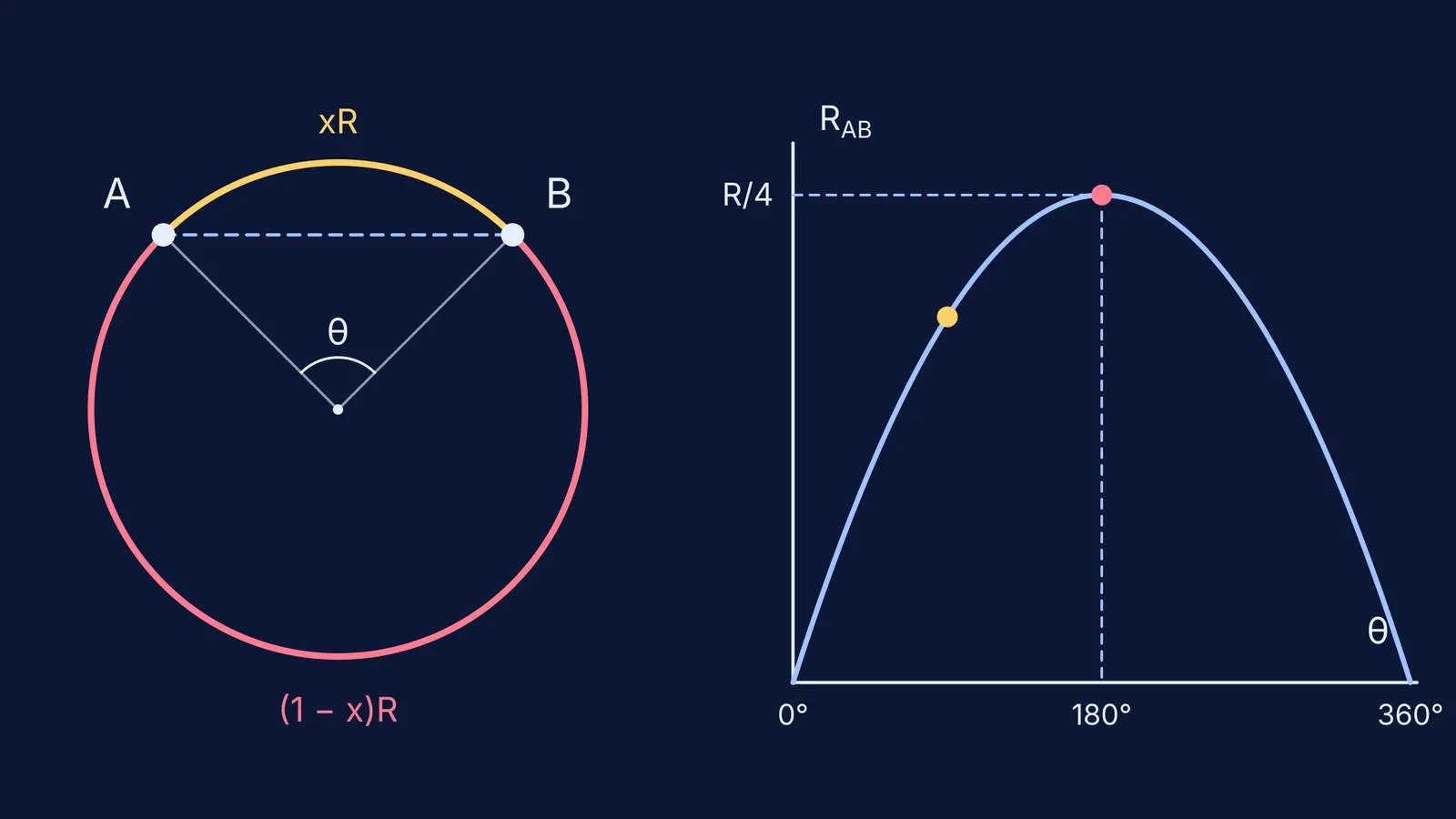
Now take a ring of total resistance R and pick two points A and B that subtend an angle θ at the centre. They cut the ring into two arcs:
the short arc, a fraction x = θ/360° of the ring, with resistance xR
the long arc, a fraction (1 − x), with resistance (1 − x)R
Both arcs share the same two end points, so they are in parallel. For two resistors in parallel, 1/R_eq = 1/R₁ + 1/R₂, and the result is always less than the smaller resistor (OpenStax, resistors in series and parallel).
Product over sum gives the formula worth remembering:
R_AB = R · x(1 − x), with x = θ/360°.
Worked example: a 12 Ω ring at different angles
Take a ring of total resistance 12 Ω.
θ = 90°: arcs of 3 Ω and 9 Ω. R_AB = (3 × 9)/(3 + 9) = 27/12 = 2.25 Ω, which is 3R/16.
θ = 60°: arcs of 2 Ω and 10 Ω. R_AB = 20/12 ≈ 1.67 Ω, which is 5R/36.
θ = 120°: arcs of 4 Ω and 8 Ω. R_AB = 32/12 ≈ 2.67 Ω, which is 2R/9.
θ = 180°: arcs of 6 Ω and 6 Ω. R_AB = 36/12 = 3 Ω, which is R/4.
60° and 300° give the same answer: the arcs just swap names.
At what angle is the resistance of a ring maximum?
The expression x(1 − x) is a downward parabola. It is zero at x = 0 and x = 1 and peaks at x = 1/2, where it equals 1/4. So the resistance between two points on a ring is largest when they are diametrically opposite, and that maximum is R/4.
Without calculus: the arcs always add up to R, and for a fixed sum the product is largest when the two are equal. Equal arcs of R/2 in parallel give R/4. This is the n = 2 case of n identical resistors in parallel: n equal resistors r combine to r/n.
What changes if you add a diameter or a chord across the loop?
Assume the straight wire is the same wire as the ring, so its resistance scales with length. A ring of radius a has length 2πa, so a diameter (length 2a) has resistance R/π, and a chord across an angle θ has resistance R·sin(θ/2)/π.
Case 1: the diameter joins A and B. Now there are three paths from A to B: two half-rings of R/2 each and the diameter of R/π. All three are in parallel:
1/R_AB = 2/R + 2/R + π/R, so R_AB = R/(4 + π).
For the 12 Ω ring, that is 12/7.14 ≈ 1.68 Ω, down from 3 Ω.
Case 2: the diameter is perpendicular to AB. If A and B are opposite ends of one diameter and the extra wire joins the other two quarter-points C and D, each quarter arc is R/4. By symmetry, C and D sit at the same potential, so no current flows in CD. It is a balanced Wheatstone bridge, and R_AB stays R/4. Symmetry saves a Kirchhoff calculation, as it does for an infinite grid of resistors.
Case 3: a chord joins A and B at 90°. The chord has resistance R·sin 45°/π ≈ 0.225R. For the 12 Ω ring that is about 2.70 Ω, in parallel with the 3 Ω and 9 Ω arcs:
1/R_AB = 1/3 + 1/9 + 1/2.70 ≈ 0.815, so R_AB ≈ 1.23 Ω.
A four-step method for any ring question
Mark the two terminals and every junction where a straight wire meets the ring.
Write each arc as a fraction of R using its angle, and each straight wire from its length.
Look for symmetry: points at the same potential carry no current between them.
Combine in series and parallel, then sanity-check against R/4 for a plain ring.
If your setup keeps going wrong, the Fermi Problem Library has worked problems with a step-by-step solver that explains the reasoning rather than printing an answer. If the shaky part is parallel combination itself, the Fermi Concept Library gives each concept its own lesson.
Try this before your next mock: a 20 Ω ring, points 72° apart. You should get 3.2 Ω.


