

On this page
The infinite grid of resistors is a classic physics challenge that shows up in advanced secondary exams like the JEE Advanced, physics olympiads, and university interviews. At first glance, a never-ending square lattice of identical resistors R seems impossible to solve. You cannot combine resistors in series or parallel, and writing Kirchhoff's loop equations for an infinite number of meshes produces an endless system of equations.
Yet, there is an elegant shortcut. By superposing two symmetrical states, you can bypass the infinite complexity and find the answer in a few lines of basic algebra.
What is the infinite grid resistance problem?
The standard problem asks you to find the equivalent resistance Req between two adjacent nodes in an infinite two-dimensional square grid, where every line segment connecting two nodes is a resistor of resistance R.
Because the grid extends infinitely in all directions, any node looks exactly like any other node. This symmetry is the secret to solving the circuit without doing heavy calculus. While solving for diagonal nodes requires rigorous discrete Laplace equations and double integrals, the adjacent node problem is solved purely by superposition.
For practice with other symmetry-based circuit tricks that use similar logic, you can explore our guide on solving the infinite ladder of resistors.
How does the superposition trick work?
Instead of applying a voltage source across nodes A and B, we split the problem into two thought experiments involving a constant current source. This is the superposition principle: the net current in any branch is the sum of the currents produced by each source acting alone.
Here is the step-by-step framework for calculating the equivalent resistance between adjacent nodes A and B:
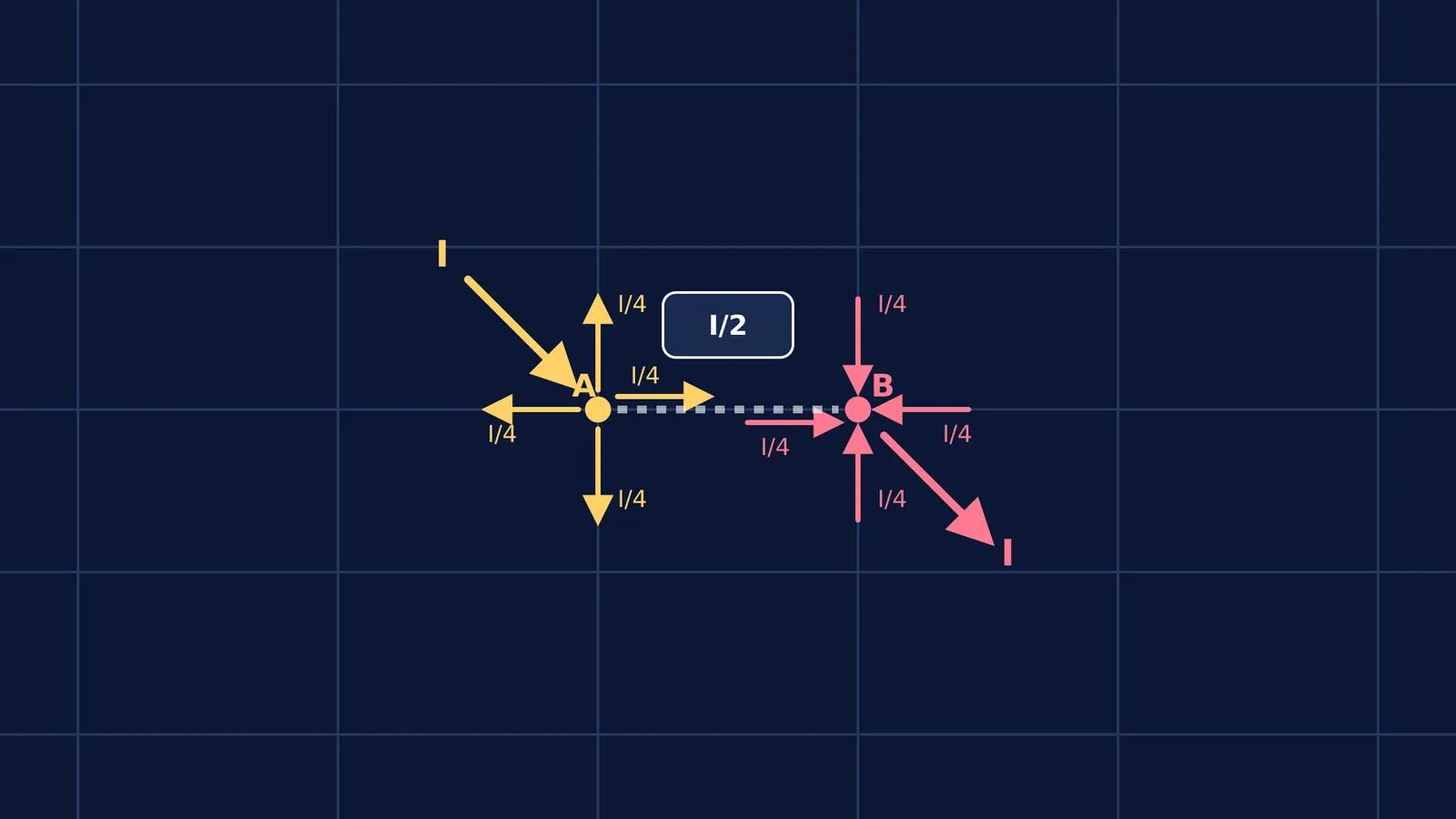
Inject current at node A: Imagine injecting a total current I into node A, and letting it flow outward to the edges of the grid at infinity.
Extract current at node B: Imagine drawing a total current I out of node B, having it flow inward from the edges of the grid at infinity.
Superpose the states: Combine the injection at A and the extraction at B. This creates a net state where current I enters the grid at A and exits the grid at B, exactly mimicking a real circuit measurement.
If you get stuck trying to set up circuit equations for complex grids, the Fermi Problem Library provides worked problems with a step-by-step solver that explains the reasoning rather than printing an answer.
Why does the current split equally into I/4?
Let's look closely at the first state: injecting current I at node A while the edges of the grid are at infinity.
Because the grid is infinite and identical in all four directions, the current I must split equally among the four resistors connected directly to node A. There is no physical reason for the current to prefer one path over another. The resistance to infinity is the same in every direction.
Therefore, the current flowing from node A to the adjacent node B in this first state is exactly I/4.
Now consider the second state: extracting current I from node B. By the exact same symmetry argument, the current must converge equally from all four directions toward node B. Because it is being drawn from infinity equally along the four branches, the current flowing from node A to node B is again exactly I/4.
What happens when you combine the two states?
When we superpose, or add, both scenarios together, we are simultaneously injecting a current I at node A and extracting a current I at node B.
Let's find the total current flowing directly through the single resistor R connecting nodes A and B:
From the first state (the injection at A), a current of I/4 flows directly from A to B.
From the second state (the extraction at B), a current of I/4 also flows directly from A to B.
Adding these two directional currents together gives a total branch current of I/4 + I/4 = I/2.
The potential difference V_AB across the adjacent nodes A and B is dictated by Ohm's Law across that single connecting resistor. Since a current of I/2 flows through a resistance of R, the voltage drop is:
V_AB = I_branch × R = (I/2) × R
By definition, the equivalent resistance of an entire network between two points is the total voltage drop between those points divided by the total current entering and leaving the system. In our superposed state, the total current entering at A and leaving at B is I.
Req = V_AB / I = (I/2 × R) / I = R/2
This neat mathematical result shows that the entire infinite grid behaves identically to a single R/2 resistor connected directly between the adjacent nodes.
Mastering this superposition method changes how you approach complex networks. It prepares you for applying the node potential method to other difficult topologies. Whenever you face infinite arrays or highly symmetrical circuits, look for ways to inject and extract current symmetrically instead of solving endless loop equations.


