

On this page
When you change the shape of a wire, you change its electrical resistance. In physics problems, examiners love to test your understanding of this by asking what happens when a wire is folded, cut, or stretched.
According to OpenStax University Physics, the resistance (R) of a uniform conductor is directly proportional to its length (L) and inversely proportional to its cross-sectional area (A). The formula is R = ρL/A, where ρ is the resistivity of the material.
Because both length and area change when you fold a wire, the resistance changes dramatically.
Why does length affect resistance?
Imagine electrons flowing through a wire like water flowing through a pipe, or people walking down a busy hallway. As the electrons travel, they constantly collide with the metal atoms inside the conductor. Every collision slows them down and dissipates energy as heat. A longer wire means a longer journey, resulting in more collisions. If you halve the length, you halve the number of obstacles.
Why does area affect resistance?
Now consider the thickness of the wire. If you widen a hallway, more people can walk side-by-side without bumping into each other. Similarly, a larger cross-sectional area gives the electrons more parallel paths to flow through. Doubling the area halves the traffic congestion, which makes it much easier for current to pass.
Why does resistance become one-fourth when folded?
When you fold a wire exactly in half, two things happen to its physical dimensions at the same time (as explained in OpenStax University Physics):
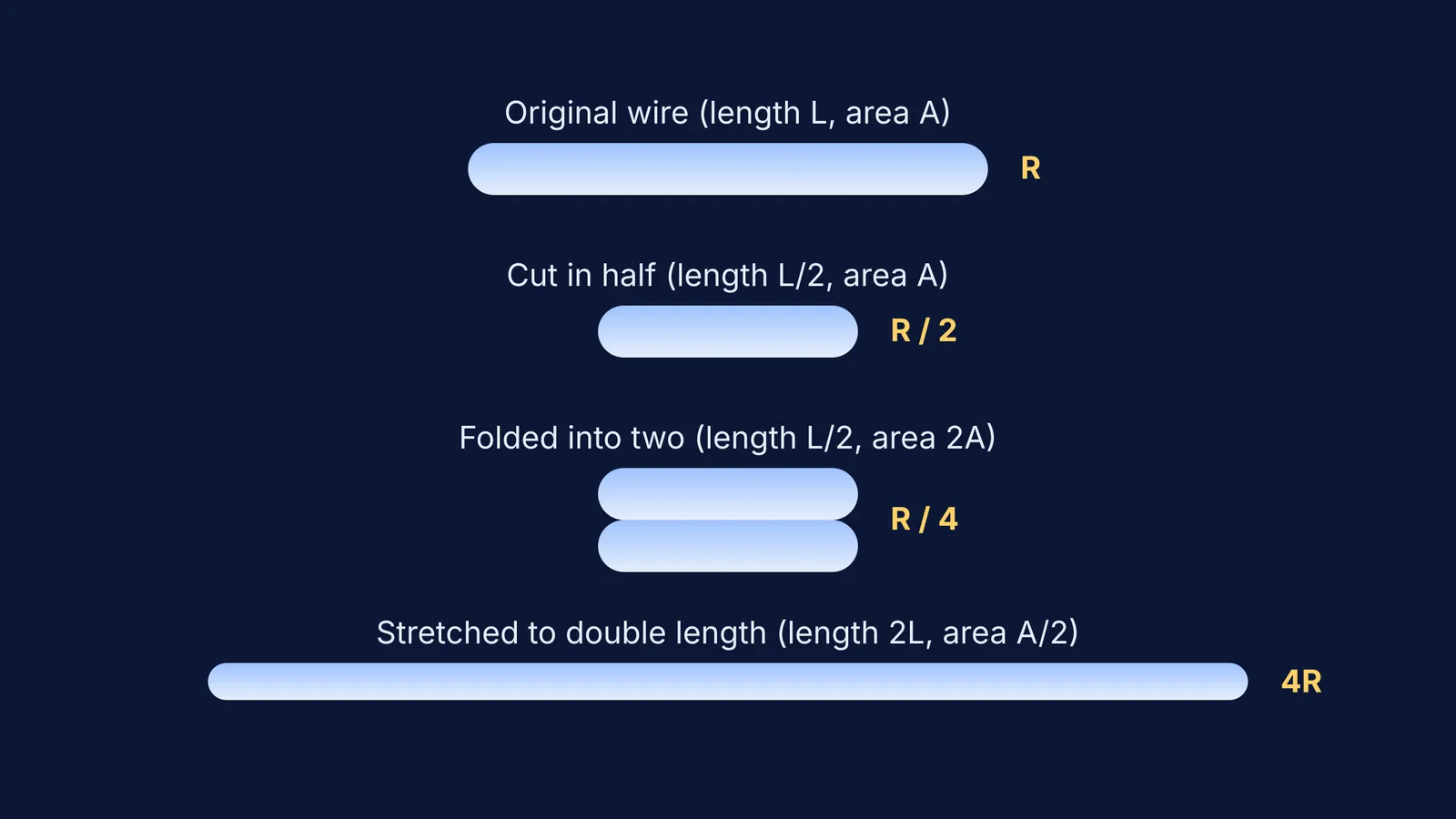
The length is halved. The current now only has to travel half the distance (L/2). Because resistance is directly proportional to length, this step alone cuts the resistance in half.
The area is doubled. The two halves of the wire now sit side-by-side, giving the electrons twice as much space to flow through. The new cross-sectional area is 2A. Because resistance is inversely proportional to area, doubling the thickness cuts the resistance in half again.
Combining these two effects: the new resistance is 1/2 × 1/2 = 1/4 of the original value. Mathematically, the new resistance = ρ(L/2) / (2A) = 1/4 × (ρL/A) = R/4.
What happens to resistance when a wire is cut in half?
Cutting a wire is not the same as folding it, a distinction derived from the principles in OpenStax University Physics. If you take a pair of wire cutters and snip the wire into two equal pieces, the length of each piece becomes L/2.
However, unlike folding, the thickness of each piece does not change. The cross-sectional area remains A.
Therefore, the resistance of each cut piece is exactly half of the original resistance (R/2). If you are tackling a complex circuit problem and need help visualising how current splits across different paths, the Fermi Problem Library provides a step-by-step solver that explains the reasoning behind equivalent resistance rather than just printing an answer.
How does folding compare with stretching a wire?
Stretching is the exact opposite of folding, and it is a classic trap in competitive exams like JEE and NEET. According to OpenStax, when you stretch a wire to double its length, its total volume remains constant. To get twice as long (2L), the wire must get thinner. The cross-sectional area halves (A/2).
Using the resistance formula: New resistance = ρ(2L) / (A/2) = 4 × (ρL/A) = 4R.
So, stretching a wire to double its length multiplies its resistance by four, while folding it in two divides its resistance by four. If you want to explore the mathematical rules behind these changes, you can read our guide on stretching a wire: how its resistance changes with length. For conductors with non-uniform shapes, the calculation requires integration, as shown in our post on resistance of a tapered conductor: setting up the integral.
How can you solve wire resistance problems quickly?
To avoid making mistakes under time pressure, use this quick reference whenever a wire's shape is altered without adding or removing material (based on the principles from OpenStax).
Worked Example: Imagine you start with a copper wire that has a resistance of 16 Ω.
Cut in half: Length is halved, area stays the same. The resistance of one piece is 8 Ω.
Folded in two: Length is halved, area is doubled. The new resistance is 4 Ω.
Stretched to double length: Length is doubled, area is halved. The new resistance is 64 Ω.
Keeping these proportions straight is the key to solving numericals quickly. Rather than memorising each case, look at the underlying physical relationships. The Fermi Concept Library holds every concept in physics, chemistry, biology, mathematics and computing, each with its own lesson and its place in the map. This helps you trace how a single formula like R = ρL/A governs everything from simple circuits to advanced electrodynamics.


