

On this page
Have you ever accidentally written on a whiteboard with a permanent marker, only to find that no amount of water will wash it off? But a squirt of hand sanitiser clears it in seconds. This everyday chemistry trick comes down to the rule of solubility: "like dissolves like".
What is in permanent marker ink?
Permanent marker ink is a mixture designed to be water-resistant and long-lasting on almost any surface. It generally consists of a main carrier solvent like isopropyl alcohol, a colorant, and a resin binder that helps the ink adhere to surfaces 1.
Colorant: The pigment or dye that provides the colour.
Resin: A polymer or plastic binder that acts as glue.
Carrier solvent: A liquid, usually an alcohol, that keeps the ink wet inside the pen.
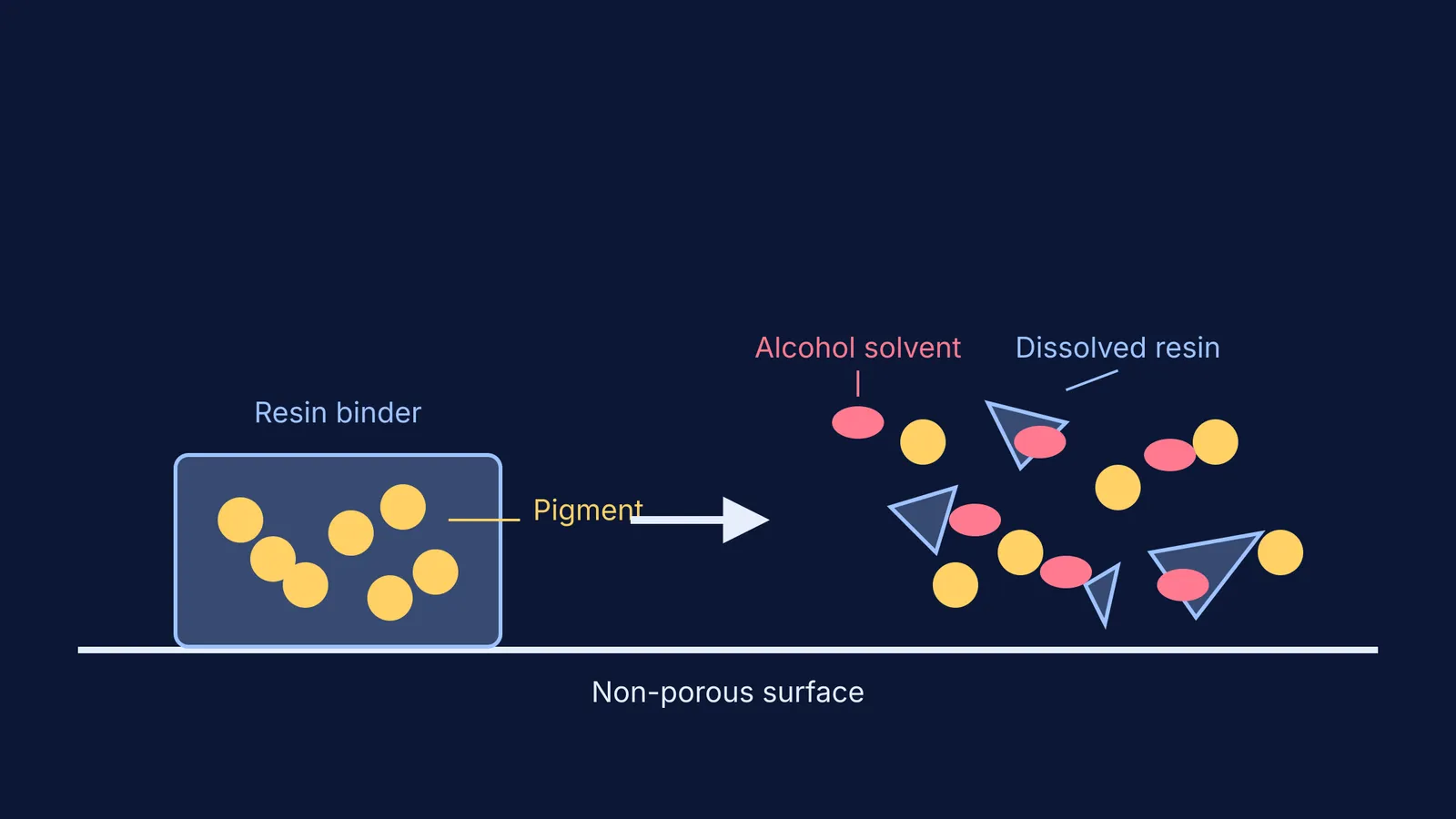
When you draw on a surface, the carrier solvent evaporates quickly into the air. The resin is left behind, hardening into a solid film that locks the pigment tightly onto the board or table. Because this resin is non-polar, water cannot dissolve it. Water molecules are polar, meaning they only mix well with other polar substances.
The "like dissolves like" principle
In chemistry, the rule "like dissolves like" explains why some substances mix and others separate. Molecules can be either polar or non-polar. Polar molecules, like water, have an uneven distribution of electrical charge—one end is slightly positive and the other is slightly negative. Non-polar molecules, like the resin in permanent markers, have an even charge distribution.
Because of this difference, polar and non-polar substances repel each other, much like oil and water. If you try to wipe permanent marker with a wet cloth, the water molecules stick to each other rather than interacting with the resin.
Alcohol is special because it is amphiphilic, meaning it has both a polar end and a non-polar end. The non-polar carbon chain in an alcohol molecule can interact with the non-polar resin, while the polar hydroxyl group allows it to mix with water. This dual nature makes alcohol an excellent solvent for breaking down tough, waterproof stains.
Why does hand sanitiser remove permanent marker stains?
The active ingredient in most hand sanitisers is alcohol. The CDC recommends using a hand sanitiser that contains at least 60% alcohol to effectively kill germs 2.
This high alcohol content is the key to removing the ink. When you apply hand sanitiser to the stain, you introduce a fresh supply of a solvent very similar to the one that originally carried the ink. The alcohol molecules penetrate the dried film and redissolve the hardened resin.
Once the resin turns back into a liquid, the pigment is no longer locked to the surface. You can then easily wipe the liquid slurry away with a cloth. Hand sanitiser is often better for this job than plain liquid rubbing alcohol because its gel formula evaporates slowly. The gel holds the alcohol against the stain, giving it enough time to break down the resin before vanishing into the air.
A practical method to remove permanent marker
If you have marked the wrong surface, follow these steps to clean it safely:
Apply the gel: Squeeze a drop of hand sanitiser directly onto the permanent marker stain. Ensure the whole mark is covered.
Wait briefly: Let the gel sit for a few moments so the alcohol has time to penetrate and redissolve the hardened resin.
Wipe away: Use a dry cloth or paper towel to wipe the area clean. If a faint shadow remains, repeat the process.
Visualising how solvents work
Understanding why one liquid dissolves a solid while another does not is a core part of chemistry. If you are preparing for exams, memorising the rule "like dissolves like" is a start, but seeing the molecules interact makes it stick.
In the Fermi Simulation Lab, you can build virtual solutions and watch how different solvents pull apart solid structures. Instead of just reading about polar and non-polar bonds, you can mix them, change the temperature, and see exactly when a solute stops dissolving.
Chemistry in the real world
Applying the principles of solubility to a stubborn stain shows how classroom chemistry solves daily problems in your own home. Whether it is removing an accidental scribble or cleaning a sticky surface, understanding the properties of solvents helps you choose the right tool for the job. If you want to explore more about how everyday substances react, you can read about How Does Lemon Juice Invisible Ink Appear on Heating? or look at the thermodynamics behind Why Cold Packs Get Cold: The Chemistry of Endothermic Dissolving. For a deeper look at solubility rules, try the Salt solubility simulation: saturation, Ksp and the common ion.


