

On this page
Modern telescopes collect light with a mirror, not a lens. If you are studying ray optics for CBSE or JEE Main, the reason is a favourite short-answer question, and it comes down to three ideas: what goes wrong with large lenses, why mirrors avoid it, and how the Cassegrain design fits a long focal length into a short tube.
Why are reflecting telescopes better than refracting telescopes?
A refracting telescope uses a lens as its objective. A reflecting telescope uses a concave mirror. The NCERT Class 12 Physics chapter on ray optics (section 9.7.2) says a telescope's two main jobs are gathering light and resolving fine detail, and both depend on the diameter of the objective. So the goal is a large objective.
NCERT notes that the largest lens objective in use is 40 inches (about 1.02 m) across, at the Yerkes Observatory in Wisconsin, USA. Big lenses are very heavy, hard to support by their edges, and expensive to make free of chromatic aberration.
The same NCERT section gives the mirror's advantages: it has no chromatic aberration, it weighs much less than a lens of the same optical quality, and it can be supported across its entire back surface rather than only at its rim. Together these let mirrors be built far bigger.
Why does a lens have chromatic aberration but a mirror does not?
A lens bends light by refraction, and the refractive index of glass differs slightly for each colour, so violet focuses closer to the lens than red and a star shows coloured fringes. Our post on combining two lenses to cancel chromatic aberration shows the fix, which adds glass and weight.
A mirror works by reflection, and the angle of reflection equals the angle of incidence for every wavelength, so nothing splits the colours. That is the story behind Newton's reflecting telescope of 1668.
One caution: a spherical mirror still has spherical aberration, which is why telescope mirrors are ground to non-spherical shapes, such as a paraboloid. See our explainer on spherical aberration and paraxial rays.
How much better is a bigger mirror? A worked example
A telescope can just resolve two stars if the stars are separated by at least the angle θ = 1.22λ/D, where λ is the wavelength and D is the diameter of the lens or mirror, according to OpenStax University Physics, section 4.5. A smaller θ means finer detail.
Compare the Yerkes lens (D = 1.02 m, from NCERT above) with one Keck mirror. The twin Keck telescopes in Hawaii each have a primary mirror 10 m in diameter, made of 36 hexagonal segments, and sensors and actuators adjust each segment relative to its neighbours with an accuracy of four nanometres. Take green light, λ = 550 nm.
Yerkes: θ = 1.22 × 550 × 10⁻⁹ / 1.02 ≈ 6.6 × 10⁻⁷ rad, about 0.14 arcseconds.
Keck: θ = 1.22 × 550 × 10⁻⁹ / 10 ≈ 6.7 × 10⁻⁸ rad, about 0.014 arcseconds.
Light gathered depends on area, so the ratio is (10 / 1.02)² ≈ 96. One Keck mirror collects about 96 times as much light as the Yerkes lens.
These are ideal limits; on the ground, moving air blurs images further. Still, a 10 m objective is only practical as a mirror.
NCERT mentions the 2.34 m reflector at Kavalur, Tamil Nadu. Since then, ARIES has commissioned the 3.6 m Devasthal Optical Telescope near Nainital in 2016, which it describes as the largest telescope in India for optical observations.
How does a Cassegrain telescope work?
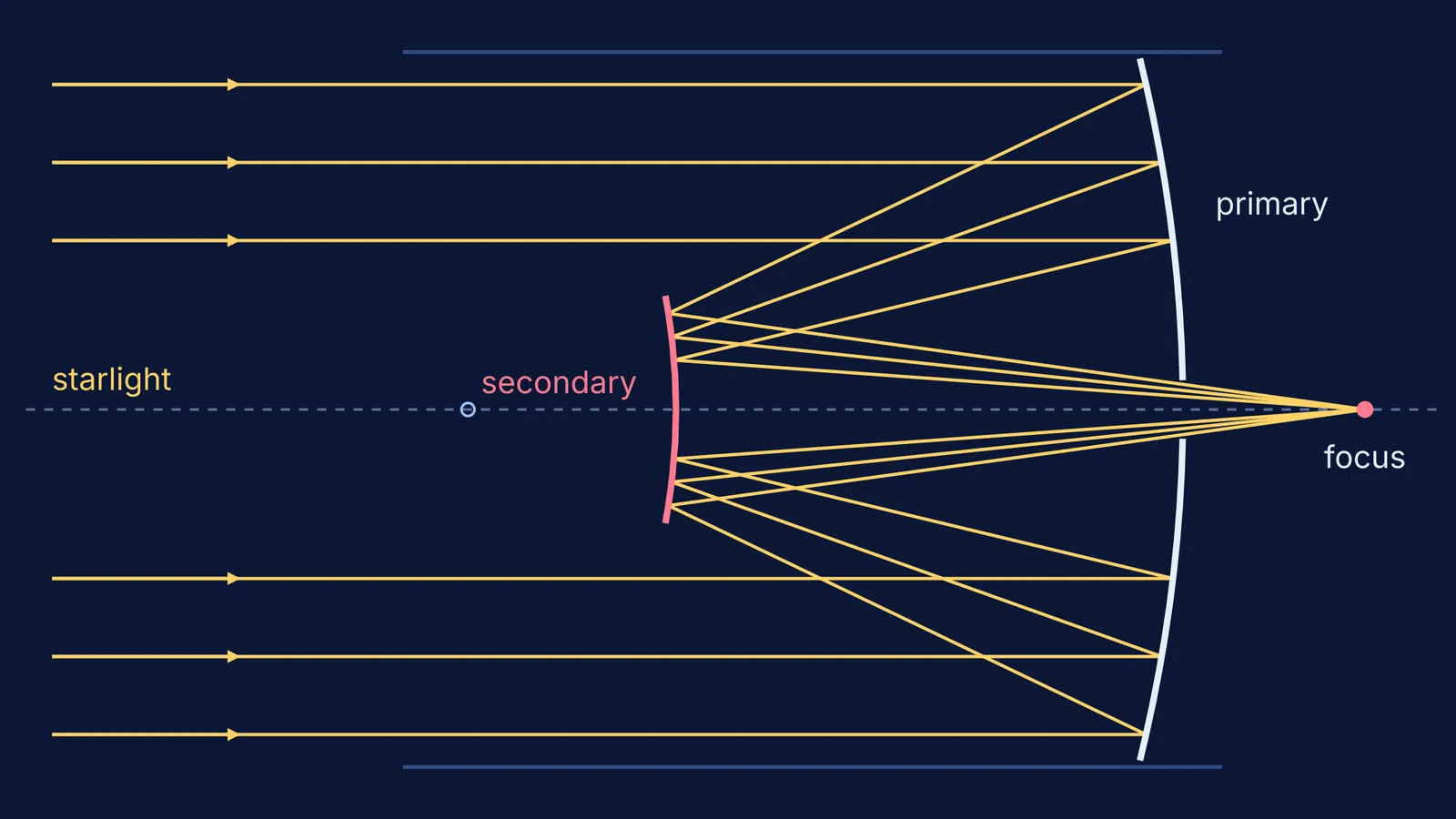
A concave mirror focuses light inside the tube, where an observer would block incoming light. The NCERT chapter (Fig. 9.26) describes the fix:
Starlight hits the large concave primary mirror.
Before it reaches focus, a small convex secondary mirror reflects it back.
The light passes through a hole in the centre of the primary.
It focuses behind the primary, where the eyepiece sits.
NCERT sums up the benefit as a large focal length in a short telescope: the folded path gives high magnification in a compact tube.
If the folded ray path is hard to picture, the Fermi Simulation Lab has interactive simulations for ideas that are easier to see than to read.
How do you write this answer in a board exam?
For a 3-mark answer, cover these points in order:
Aim: a large objective gives more light-gathering and resolving power.
Lens problem: large lenses are heavy, held only at the rim, and show chromatic aberration.
Mirror: no chromatic aberration, since reflection does not depend on wavelength.
Mirror: lighter and supported over its whole back, so it can be made much larger.
Extra marks: a parabolic mirror removes spherical aberration; sketch the Cassegrain layout.
If resolving power or dispersion still feels shaky, the Fermi Concept Library has a lesson on every concept in physics, so you can fill the gap before the exam.


