

On this page
Soak chopped red cabbage in hot water and you get a purple liquid that works as a rough universal indicator. One jug of it can tell lemon juice from soap. Here is the chart, the chemistry behind it, and a way to run the test so you learn from it, not just admire the colours.
What colour is red cabbage indicator at each pH?
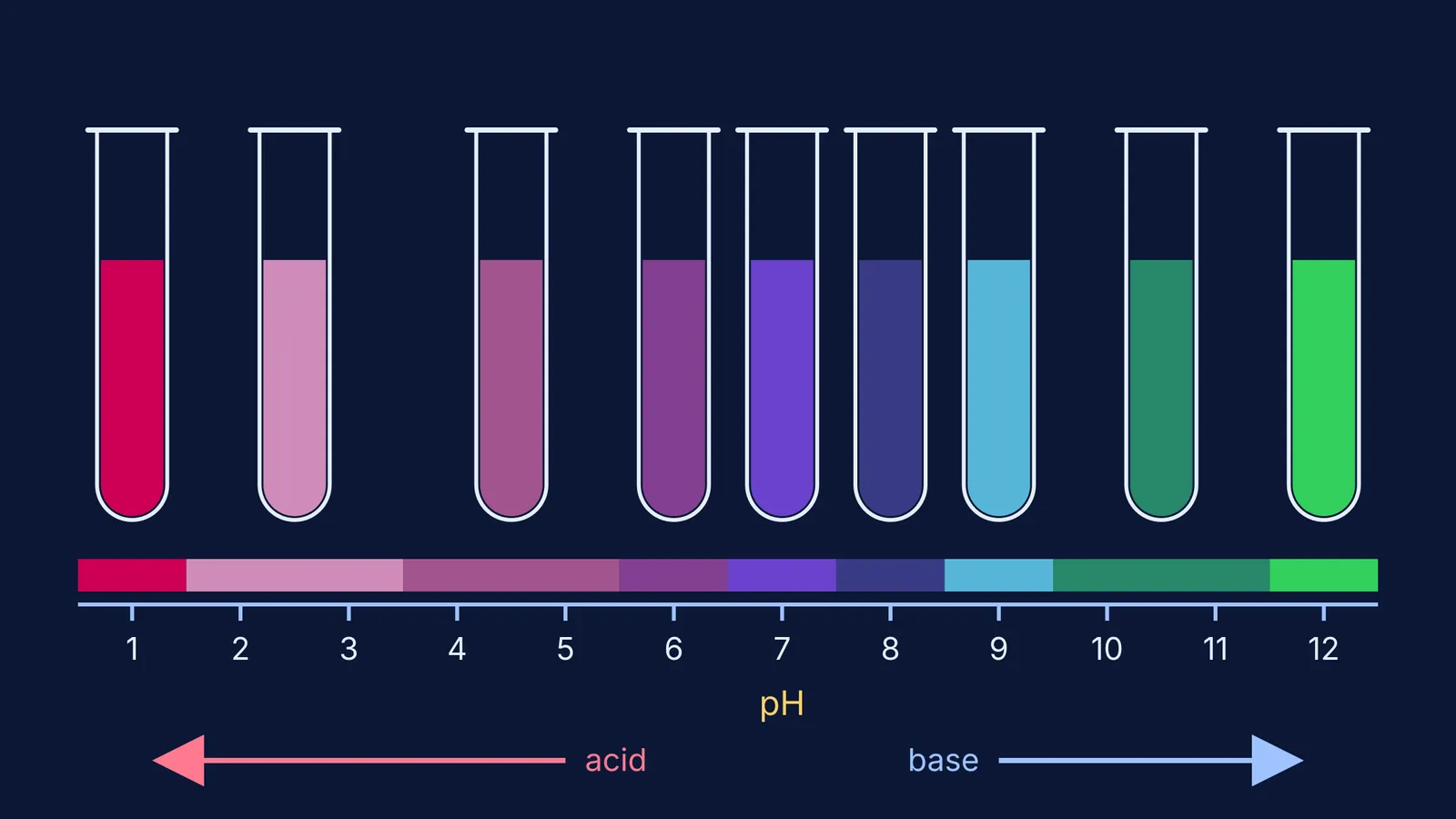
The University of Illinois red cabbage pH indicator activity gives this chart:
pH 2: red
pH 4: purple
pH 6: violet
pH 8: blue
pH 10: blue-green
pH 12: greenish yellow
The Royal Society of Chemistry's red cabbage pH indicator worksheet says the indicator should turn red in very acidic solutions (pH 1 to 3), stay dark blue or purple in neutral solutions (pH 7 to 8) and turn green or yellow in very alkaline solutions (pH 10 to 12). Its colour scale groups some values together, with single swatches for pH 2 to 3, pH 4 to 5 and pH 10 to 11.
The two charts agree on the order of colours but not every shade, a first clue that cabbage colours are a guide, not a measurement.
Why does red cabbage change colour with pH?
Red cabbage gets its colour from anthocyanins, plant pigments whose structure changes with pH (Khoo et al., 2017, Food & Nutrition Research). In acid, the pigment exists as a flavylium cation, which is red. Around neutral pH it loses protons and forms quinonoidal species, which look purple. In more alkaline solution, anionic forms shift the colour towards blue.
The same review gives the anthocyanin cyanidin as red below pH 3, violet at pH 7 to 8 and blue at very high pH, above pH 11 (Khoo et al., 2017).
Cabbage juice is not one pigment, though. A study of seven red cabbage cultivars found that the pigment mix changed with variety and harvest time (Ahmadiani et al., 2014, Journal of Agricultural and Food Chemistry). In that study, some extracts absorbed most strongly at 520 nm at pH 3.5, giving a red like a standard food dye. At pH 7, extracts with more diacylated pigments absorbed near 610 nm, giving a blue. So the juice from your cabbage need not match a chart made from someone else's.
How do you make red cabbage indicator at home?
The Illinois activity sheet uses this method:
Chop half a head of red cabbage into small pieces.
Put it in a large pot and add water to cover.
Boil for 10 minutes so the colour leaches out.
Let it cool for at least 30 minutes.
Strain it and keep the purple water.
Pour 50 to 100 mL into separate clear glasses, one for each test.
Add a little of each household liquid until the colour changes.
To skip boiling, BBC Science Focus blends the leaves with about 400 ml of warm water and sieves the mixture instead. An adult should handle the boiling water. Stick to food and mild cleaning products, never mix cleaners, and keep bleach and drain cleaner out of it. Our guide to safe kitchen chemistry at home has more ground rules for parents.
What should your kitchen test chart show?
Make a five-column table in your notebook: substance, your prediction (acid, neutral or base), predicted colour, observed colour, and pH range read from the chart. Fill in the first three columns before you pour anything.
Here is a worked set, with the results the RSC worksheet and BBC Science Focus say to expect:
Lemon juice: acidic, turns red.
White vinegar: acidic, turns red.
Plain water: neutral, stays purple.
Baking powder in water: weakly alkaline, turns blue or green.
Washing powder in water: alkaline, turns green or yellow.
Your breath, blown through a straw into the juice: carbon dioxide forms weak carbonic acid, and the purple slowly turns pink.
Then predict and test milk and shampoo, also on the Science Focus list. Finally, try the RSC's reversal: turn a glass red with vinegar, then add an alkaline solution such as baking soda a little at a time and watch it pass back through purple. You are watching neutralisation happen.
How accurate is a red cabbage pH test?
It tells you whether something is acidic, neutral or basic, and roughly how strongly. It cannot pin down an exact pH. The RSC scale uses one swatch for pH 2 to 3 and one for pH 10 to 11, and cabbage varieties give different shades (Ahmadiani et al., 2014). For a board practical, use the method in our guide to finding pH with universal indicator. If you want to try another plant, see how to make a China rose indicator.
If the jump from proton loss to colour change still feels like magic, the Fermi Concept Library covers every concept in chemistry, each with its own lesson and its place in the map. That lets you trace indicators back to what an acid is.
Tonight, make one jug of cabbage juice, test six things, and fill in your chart before you check it against the one above.


