

On this page
Dive a few metres into the sea and the world turns blue. Water is eating the red end of sunlight, and a few tens of metres down mostly blue and green light is left. Red algae live in that dim blue-green light because they carry a pigment matched to it. Here is the physics and the biology, with numbers you can check yourself.
Why does water filter out red light first?
Water molecules absorb some wavelengths much more strongly than others. A widely used laboratory measurement of pure water's absorption from 380 to 700 nm comes from Pope and Fry, Applied Optics, 1997, and their data table is published by the Oregon Medical Laser Center.
An absorption coefficient tells you how quickly light is lost per metre of travel. In the Pope and Fry data, pure water absorbs about 0.34 per metre at 650 nm (red) but only about 0.020 per metre at 500 nm (blue-green), roughly seventeen times less (data table).
Light fades exponentially with depth: the fraction left after z metres is e to the power of minus (a times z), where a is the absorption coefficient. A small difference in a therefore becomes a huge difference a hundred metres down.
Real seawater also holds plankton, silt and dissolved material, so light fades faster than in pure water. The pure-water numbers are a best case, but red still goes first.
Worked example: at what depth does each colour fade to 1%?
Set the fraction left equal to 0.01 and solve: z = ln(100) / a, which is about 4.6 / a. Using the absorption coefficients from the Pope and Fry table:
Red, 650 nm: a = 0.34 per metre, so 1% is left at about 14 m.
Orange, 600 nm: a = 0.22 per metre, so about 21 m.
Green, 550 nm: a = 0.057 per metre, so about 82 m.
Blue-green, 500 nm: a = 0.020 per metre, so about 226 m.
Blue, 450 nm: a = 0.0092 per metre, so about 500 m.
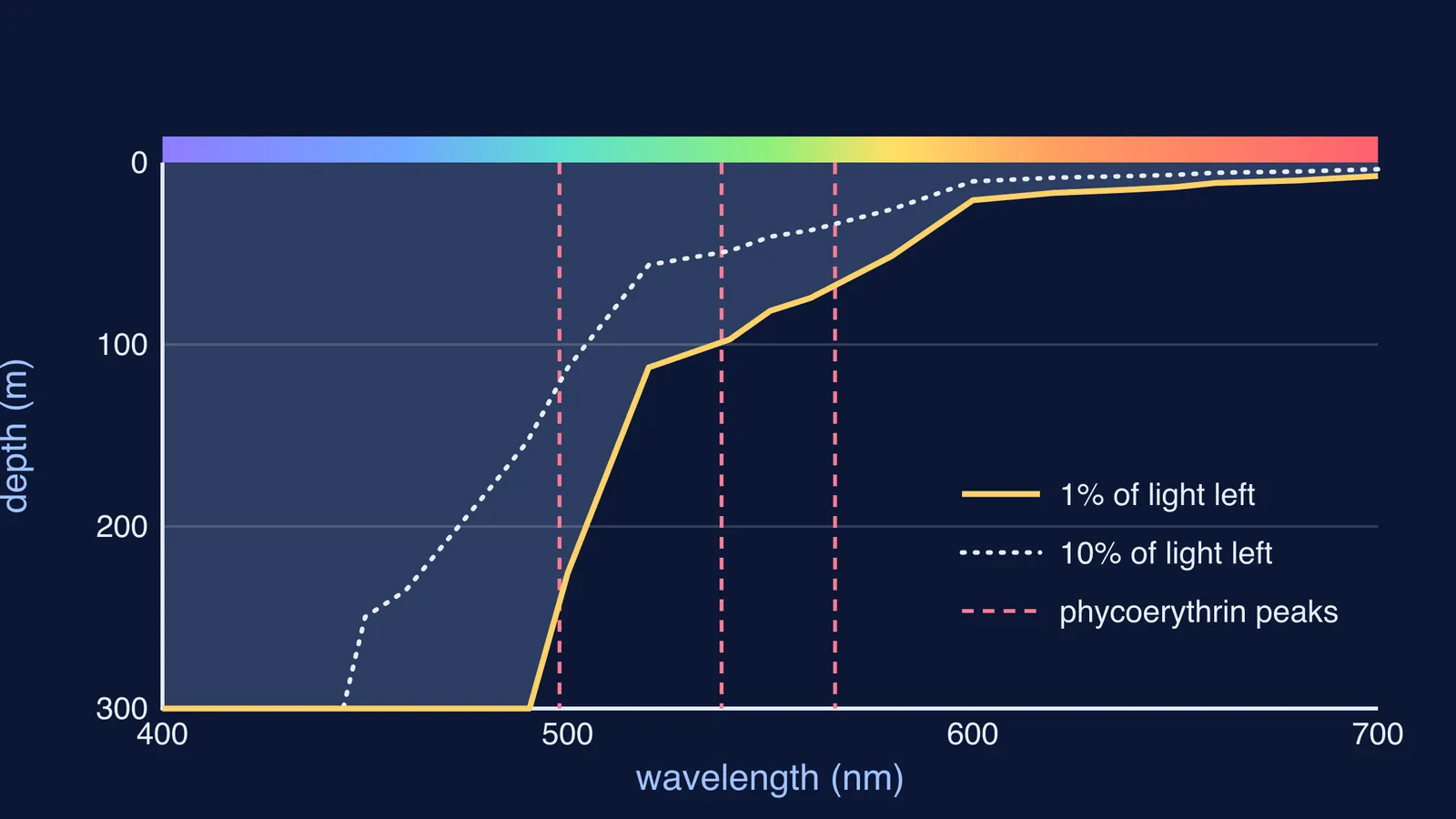
The diagram at the top plots this list as a curve.
What pigment lets red algae use blue-green light?
Red algae carry phycoerythrin, an accessory pigment. A study of R-phycoerythrin purified from the red seaweed Polysiphonia urceolata found absorption peaks at 498, 538 and 566 nm (Wang et al., PLoS ONE, 2015). Those peaks sit in the band that water lets through.
The same paper states that red algae's ability to grow abundantly in deep water depends primarily on their high phycoerythrin content, which absorbs light efficiently from 450 nm to 570 nm (Wang et al., 2015).
This also explains the colour: a pigment that absorbs blue-green light reflects the reds it does not use, so the alga looks red or maroon. To compare what a pigment absorbs with the photosynthesis it drives, read our guide on reading absorption and action spectra. For how carotenoids play a similar helper role in land plants, see what accessory pigments do in photosynthesis.
How deep have red algae actually been found?
In 1985, Mark Littler, Diane Littler and colleagues reported abundant photosynthetic seaweeds living below 200 m on an uncharted seamount, in a paper titled "Deepest known plant life discovered on an uncharted seamount" (Littler et al., Science, 1985).
Guinness World Records lists the deepest alga as an unidentified crustose coralline alga, a type of red alga, found by the Littlers at 295 m off San Salvador, Bahamas, in October 1984, where 99.9995% of sunlight had been filtered out (Guinness World Records).
One honest caveat. The idea that seaweed pigments are matched to the colour of light at each depth is called complementary chromatic adaptation, and it is debated. A 2017 paper on corals notes that some researchers have suggested the depth zones of seaweeds may instead reflect adaptation to how much light arrives rather than its colour (Smith et al., Proceedings of the Royal Society B, 2017). In a school answer, the pigment explanation is the expected one.
How do you write this answer in an exam?
A strong short answer has four parts, in this order:
Water absorbs long wavelengths (red, orange) strongly, so they fade within the top few tens of metres.
Short wavelengths (blue-green) penetrate deepest.
Red algae contain phycoerythrin, which absorbs blue-green light.
So red algae can photosynthesise at depths where algae relying mainly on chlorophyll capture much less of the light that remains.
Add one number, such as red light falling to 1% within about 14 m of pure water (Pope and Fry data). To place red algae alongside the other groups, see our comparison of green, brown and red algae.
If the link between light, pigments and photosynthesis still feels loose, the Fermi Concept Library covers every concept in physics, chemistry, biology, mathematics and computing, each with its own lesson and its place in the map. For practice with exponential-decay calculations like the one above, the Fermi Problem Library has worked problems with a step-by-step solver that explains the reasoning rather than printing an answer.


