On this page
Types-of-motion questions look easy until one example refuses to fit. A swing moves along part of a circle, so is it circular? A bicycle wheel spins and travels down the road, so which is it? Here is a sorting test, examples, and a worked rolling wheel.
What are rectilinear, circular and oscillatory motion?
Rectilinear (straight-line) motion: the object moves along a single straight line. OpenStax's Motion Along a Straight Line/Book:_University_Physics_I_-_Mechanics_Sound_Oscillations_and_Waves_(OpenStax)/03:_Motion_Along_a_Straight_Line) chapter uses a maglev train on its track as the example.
Circular motion: the object stays at a fixed distance from a centre point. OpenStax defines uniform circular motion/Book:_University_Physics_I_-_Mechanics_Sound_Oscillations_and_Waves_(OpenStax)/04:_Motion_in_Two_and_Three_Dimensions/4.05:_Uniform_Circular_Motion) as motion in a circle at constant speed, and gives the hands of a watch and any point on a spinning propeller as examples.
Oscillatory (to-and-fro) motion: the object moves back and forth about a middle position, called the equilibrium position. It is a kind of periodic motion, which OpenStax's section on simple harmonic motion/Book:_University_Physics_I_-_Mechanics_Sound_Oscillations_and_Waves_(OpenStax)/15:_Oscillations/15.02:_Simple_Harmonic_Motion) defines as any motion that repeats itself at regular time intervals, such as a child on a swing.
The same circular-motion section notes that constant speed on a circle still means acceleration, because the direction of velocity keeps changing. If any of these terms feel shaky, the Fermi Concept Library has a lesson on each concept in physics and shows where it sits on the map, so you can fill a gap before it turns into a wrong answer.
How do you decide which type a motion is?
Use this three-question test, in order:
Which part am I describing? Name one point: the wheel's hub, the fan blade's tip, the pendulum bob. Much confusion comes from describing a whole object whose parts move differently.
What shape is its path? A straight line means rectilinear. A full circle, or repeated trips around one, means circular.
Does it turn back and repeat about a middle point? Then it is oscillatory, even when the path is curved.
What are examples of rectilinear, circular and oscillatory motion?
Rectilinear: a metro train on a straight stretch of track, a stone dropped from a terrace, a lift going up, a ball rolled along a straight corridor (its centre).
Circular: the tip of a ceiling-fan blade, the hands of a wall clock, a stone whirled on a string, a point on a spinning top.
Oscillatory: a swing, the pendulum of an old clock, a plucked sitar string, a needle of a sewing machine moving up and down, a child on a see-saw.
Notice the swing: its seat follows an arc of a circle but never goes all the way round, so it is oscillatory. Our earlier post on types of motion in Class 6 has more examples at the school level, and if you are heading towards Class 11, read why every SHM is periodic, but not all periodic motion is SHM.
Why is a rolling wheel more than one type of motion?
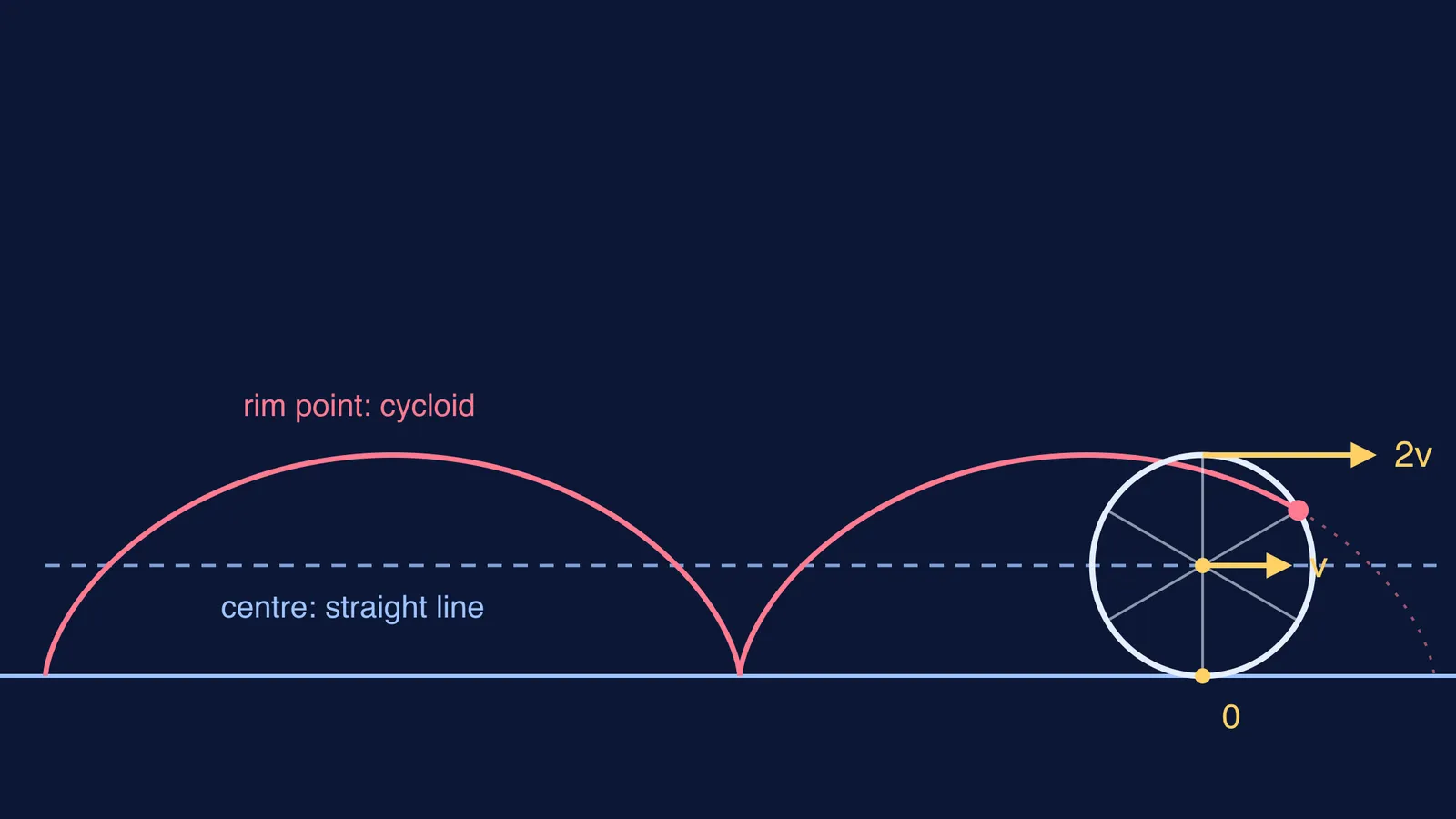
On a wheel rolling without slipping, different points move in different ways. The University of New South Wales physics page on rolling wheels sets out three facts:
The centre moves in a straight line at the speed of the bicycle, v.
The point touching the ground is momentarily at rest.
The top of the wheel moves forward at 2v, and any point on the rim traces a curve called a cycloid.
Worked example. A cyclist rides at a steady 5 m/s. Classify three points on the front wheel and give their speeds.
Centre (the hub): its path is a straight line, so it is rectilinear, at 5 m/s.
A chalk mark on the tyre's outer edge, seen by the rider: it goes round the hub, so it is circular.
The same mark, seen from the roadside: its path is a cycloid, neither a line nor a circle. At the top it moves at 2 × 5 = 10 m/s; at the bottom its speed is 0.
The answer depends on the point and on who is watching, so state both. If you want to see it move, the Fermi Simulation Lab has interactive simulations for ideas that are easier to see than read. For a numerical follow-up, try distance covered by a wheel in revolutions.
Which other mixed cases come up in exams?
Merry-go-round horse: it goes round and also up and down, so it is circular plus oscillatory.
Engine piston and crankshaft: the piston moves to and fro in a line while the crankshaft turns in a circle.
The shadow of circular motion: a peg moving in a circle casts a shadow that moves back and forth. OpenStax shows that this projection of uniform circular motion/Book:_University_Physics_I_-_Mechanics_Sound_Oscillations_and_Waves_(OpenStax)/15:_Oscillations/15.04:_Comparing_Simple_Harmonic_Motion_and_Circular_Motion) is simple harmonic motion, like a block on a spring.
If a numerical on mixed motion keeps going wrong, the Fermi Problem Library has worked problems with a step-by-step solver that explains the reasoning rather than printing an answer.