On this page
When a question puts log_2 3 next to log_3 2, or asks you to add 1/log_2 30 and 1/log_3 30, one identity does most of the work. Here log_a b means the logarithm of b to base a: the power you raise a to in order to get b.
What does log_a b × log_b a = 1 say?
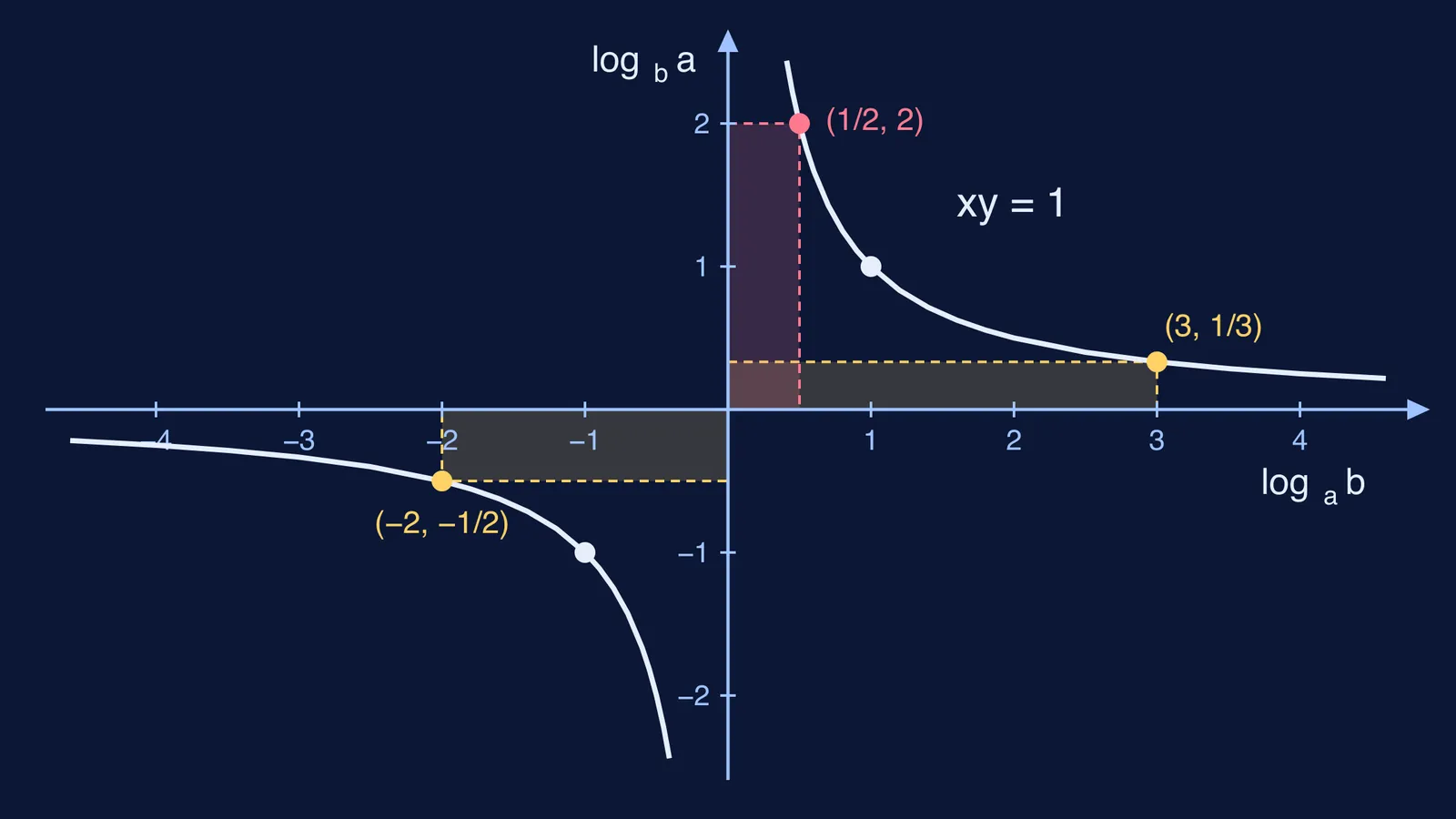
It says the two logs are reciprocals: log_b a = 1 / log_a b, as listed on Wolfram MathWorld's logarithm page. Swap the base and the argument and the value turns upside down. For example, log_2 8 = 3 and log_8 2 = 1/3, because 8^(1/3) = 2.
The identity needs a > 0, b > 0, a ≠ 1 and b ≠ 1. Both numbers act as a base, so both need the base conditions. If b = 1, then log_a 1 = 0 and log_1 a is not defined at all. Our explainer on why a log base must be positive and not equal to 1 goes through these conditions one by one.
How do you prove log a b times log b a equals 1?
The first proof uses the change-of-base formula: log_b M = log_n M / log_n b for positive M, b and n with b ≠ 1 and n ≠ 1, as stated in OpenStax College Algebra 2e, section 6.5. Use natural logs, so n = e:
log_a b = ln b / ln a
log_b a = ln a / ln b
Multiply: (ln b / ln a) × (ln a / ln b) = 1
The cancelling is allowed because ln a and ln b are not zero, since a ≠ 1 and b ≠ 1. For more on the formula itself, see our guide to using change of base to simplify log products.
The second proof uses only the definition of a log.
Let x = log_a b. Then a^x = b.
Let y = log_b a. Then b^y = a.
Put the first into the second: (a^x)^y = a, so a^(xy) = a^1.
Since a > 0 and a ≠ 1, equal powers of a mean equal exponents, so xy = 1.
How does the reciprocal relation simplify mixed bases?
The flip turns an awkward base into a friendly one. Four patterns come up often.
1. A chain of logs collapses. Write each factor as a ratio of natural logs and the neighbours cancel:
log_2 3 × log_3 4 × log_4 5 × log_5 6 × log_6 7 × log_7 8 = ln 8 / ln 2 = log_2 8 = 3
2. Reciprocals with a common argument add up. Flip each term so the shared argument becomes the base, then use the product rule:
1/log_2 30 + 1/log_3 30 + 1/log_5 30 = log_30 2 + log_30 3 + log_30 5 = log_30 (2 × 3 × 5) = log_30 30 = 1
3. Powers in the base come out as a fraction. Since log_(a^m) b = ln b / (m ln a), you get log_(a^m) (b^n) = (n/m) log_a b. So log_8 32 = log_(2^3) (2^5) = 5/3. Check: 8^(5/3) = 2^5 = 32.
4. Equations with log_2 x and log_x 2. Solve log_2 x + log_x 2 = 5/2.
Domain first: x > 0 and x ≠ 1, because x is a base.
Let t = log_2 x. Then log_x 2 = 1/t, so t + 1/t = 5/2.
Multiply by 2t: 2t² − 5t + 2 = 0, so (2t − 1)(t − 2) = 0, giving t = 2 or t = 1/2.
So x = 2² = 4 or x = 2^(1/2) = √2. Both fit the domain.
Check one: log_2 4 + log_4 2 = 2 + 1/2 = 5/2. The same domain-first habit runs through our guide to logarithmic equations and inequalities.
Which mistakes cost marks with this identity?
Treating the sum like the product. log_a b × log_b a = 1, but log_a b + log_b a is never 1; by the range check above it is at least 2 or at most −2.
Confusing 1/log_a b with log_a (1/b). With a = 2 and b = 4, 1/log_2 4 = 1/2, while log_2 (1/4) = −2.
If a mixed-base question still will not come out, the Fermi Problem Library has worked problems with a step-by-step solver that explains the reasoning rather than printing an answer. If logs themselves feel shaky, the Fermi Concept Library gives each mathematics concept its own lesson and its place in the map.
Next time you see two bases that are each other's arguments, write the product as 1 before doing anything else.