

On this page
If you have ever solved log_x(3x − 2) = 2, found two answers and lost marks for keeping both, this is for you. The rules on a logarithm's base and argument are the filter that decides which roots survive.
What are the conditions on the base of a logarithm?
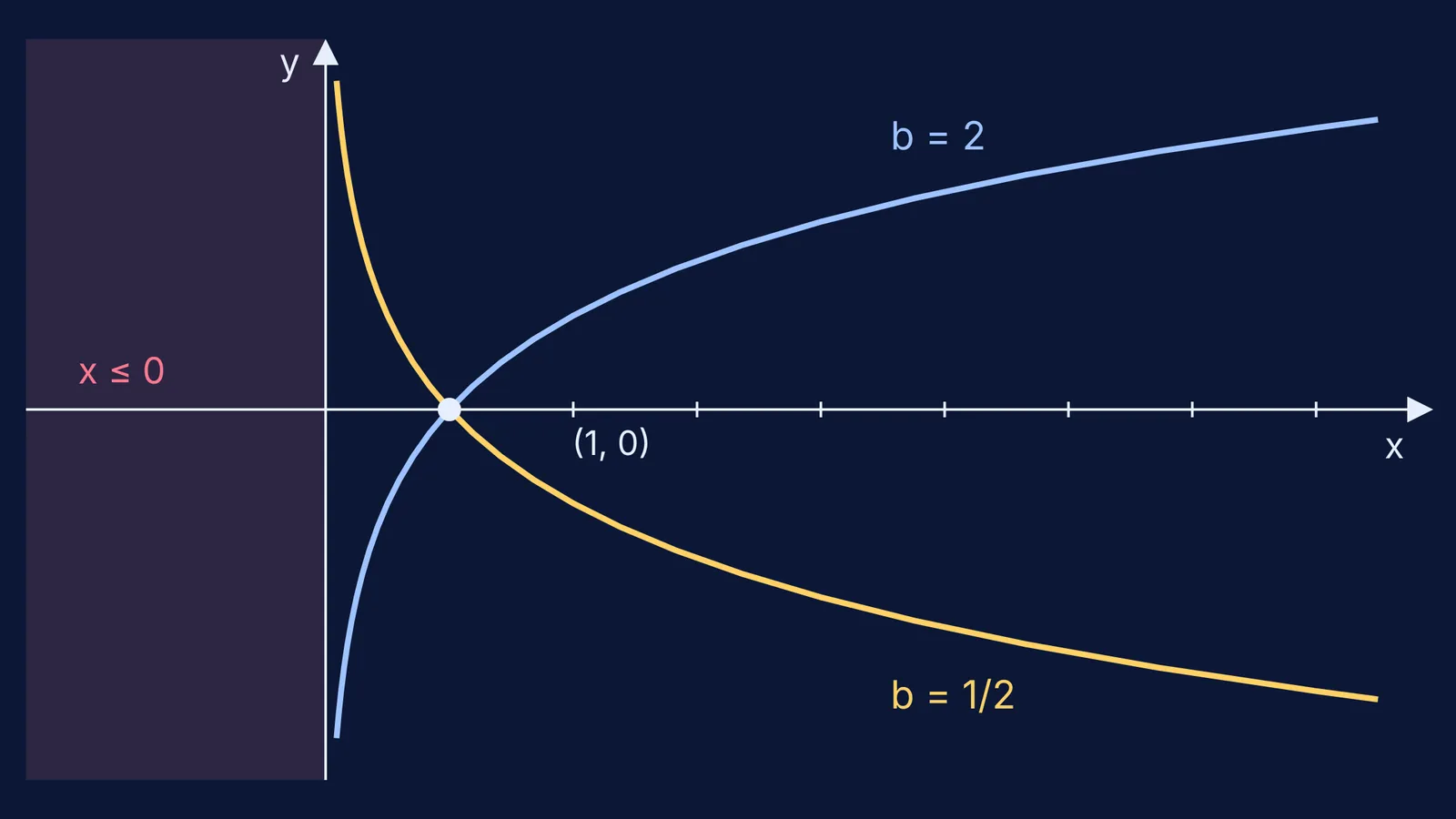
OpenStax College Algebra 2e defines the logarithm like this: for x > 0, b > 0 and b ≠ 1, y = log_b(x) means exactly the same as b^y = x (OpenStax College Algebra 2e, section 6.3). The same section states that the domain of a logarithm function with base b is (0, ∞).
So write down three conditions every time:
The base is positive: b > 0.
The base is not 1: b ≠ 1.
The argument is positive: x > 0.
Notice what is not on the list. The base can be a fraction between 0 and 1: log_(1/2)(8) = −3, because (1/2)^(−3) = 8. And the argument can be 1: log_b(1) = 0 for every allowed base.
Why must the base be positive and not 1?
A logarithm answers one question: what power of b gives x? Without each condition, that question has no single, real answer.
Why b ≠ 1. Every power of 1 is 1. OpenStax makes this point when it defines exponential functions: with b = 1, f(x) = 1^x = 1 for any x (OpenStax College Algebra 2e, section 6.1). So no power of 1 gives 5, and every power of 1 gives 1. A logarithm needs exactly one answer, so base 1 is out.
Why b > 0. Negative bases break down at fractional powers. The same OpenStax section shows that with b = −9, (−9)^(1/2) = √−9, which is not a real number. A base of 0 fails too, because 0 raised to any positive power is 0.
Why must the argument of a log be positive?
Because x is a power of a positive base, and a positive base raised to any real power stays positive. OpenStax puts it this way: the base of an exponential function is always positive, so no power of that base can ever be negative (OpenStax, section 6.3). Zero is never reached either: 2^y gets close to 0 as y becomes very negative, but never equals it. That is why log(0) and log(−4) are undefined, which we unpack in why the logarithm of a negative number is undefined.
How do you solve log equations with a variable base?
When x sits in the base, the conditions do real work. Use this four-step routine:
Write the conditions first: base > 0, base ≠ 1, argument > 0.
Convert to exponential form: log_b(A) = c becomes b^c = A.
Solve the resulting equation.
Test every root against step 1, then check it in the original equation.
Worked example 1: the base-1 trap. Solve log_x(3x − 2) = 2.
Conditions: x > 0, x ≠ 1, and 3x − 2 > 0, so x > 2/3.
Exponential form: x^2 = 3x − 2.
Solve: x^2 − 3x + 2 = 0, so (x − 1)(x − 2) = 0, giving x = 1 or x = 2.
Test: x = 1 makes the base 1, so reject it. x = 2 passes, since log_2(4) = 2.
Answer: x = 2 only. The quadratic was right; the condition removed one root.
Worked example 2: the negative-base trap. Solve log_x(2x + 3) = 2.
Conditions: x > 0, x ≠ 1, and 2x + 3 > 0.
Exponential form: x^2 = 2x + 3.
Solve: x^2 − 2x − 3 = 0, so (x − 3)(x + 1) = 0, giving x = 3 or x = −1.
Test: x = −1 gives a negative base, so reject it, even though (−1)^2 = 1 = 2(−1) + 3 looks fine. x = 3 passes, since log_3(9) = 2.
Answer: x = 3 only.
What should you check before you move on?
Did I write base > 0, base ≠ 1 and argument > 0 before solving?
Did any root make the base 1, 0 or negative?
Did any root make the argument 0 or negative?
Does each surviving root satisfy the original equation, not just the quadratic?
The same habit carries over to domain questions such as finding the domain of log(log x) and nested functions, and to the slips covered in logarithm rules: common mistakes and how to check them.
For more practice, the Fermi Problem Library has worked problems with a step-by-step solver that explains the reasoning rather than printing an answer, so you can follow each step and check the conditions as you go. If the definition itself feels shaky, the Fermi Concept Library gives logarithms their own lesson and their place in the map of mathematics.


