

On this page
Rebels and the Raj is Theme Ten of NCERT's Class 12 book Themes in Indian History Part III, subtitled The Revolt of 1857 and Its Representations (NCERT, reprint 2026-27). Its exercises ask for two skills: building a chain of causes, and reading a source or a picture for its point of view. For the basics, see our Class 8 guide to the causes, leaders and aftermath of 1857.
What was the pattern of the 1857 revolt?
The chapter opens on 10 May 1857, when sepoys at Meerut mutinied; on 11 May they reached the Red Fort in Delhi, and Bahadur Shah, surrounded by sepoys, had to bless the revolt (NCERT). Cantonments across the Gangetic valley then rose in a similar sequence:
A signal, often the evening gun or a bugle.
Sepoys seized the bell of arms (the weapons store) and plundered the treasury.
They attacked the jail, telegraph office, record room and bungalows, burning records.
Proclamations in Hindi, Urdu and Persian called on Hindus and Muslims to unite.
As townspeople joined, moneylenders and the rich became targets in Lucknow, Kanpur and Bareilly.
There is evidence of planning: the 7th Awadh Irregular Cavalry wrote to the 48th Native Infantry that it awaited the 48th's orders, and Charles Ball noted nightly panchayats in the Kanpur sepoy lines. Leaders came from the old courts (Nana Sahib, the Rani of Jhansi, Birjis Qadr) and from villages (Shah Mal of pargana Barout). Rumours of cartridges greased with cow and pig fat, and a prophecy that British rule would end on 23 June 1857, the centenary of Plassey, spread because they matched real fears about British reforms and annexations.
Why was the revolt so widespread in Awadh?
In 1851 Lord Dalhousie described Awadh as "a cherry that will drop into our mouth one day"; in 1856 it was annexed and Nawab Wajid Ali Shah was exiled to Calcutta (NCERT). The chapter's answer is a chain of grievances linking prince, taluqdar, peasant and sepoy.
Prince: the Nawab was widely loved; his removal cost musicians, poets, artisans and officials their livelihood.
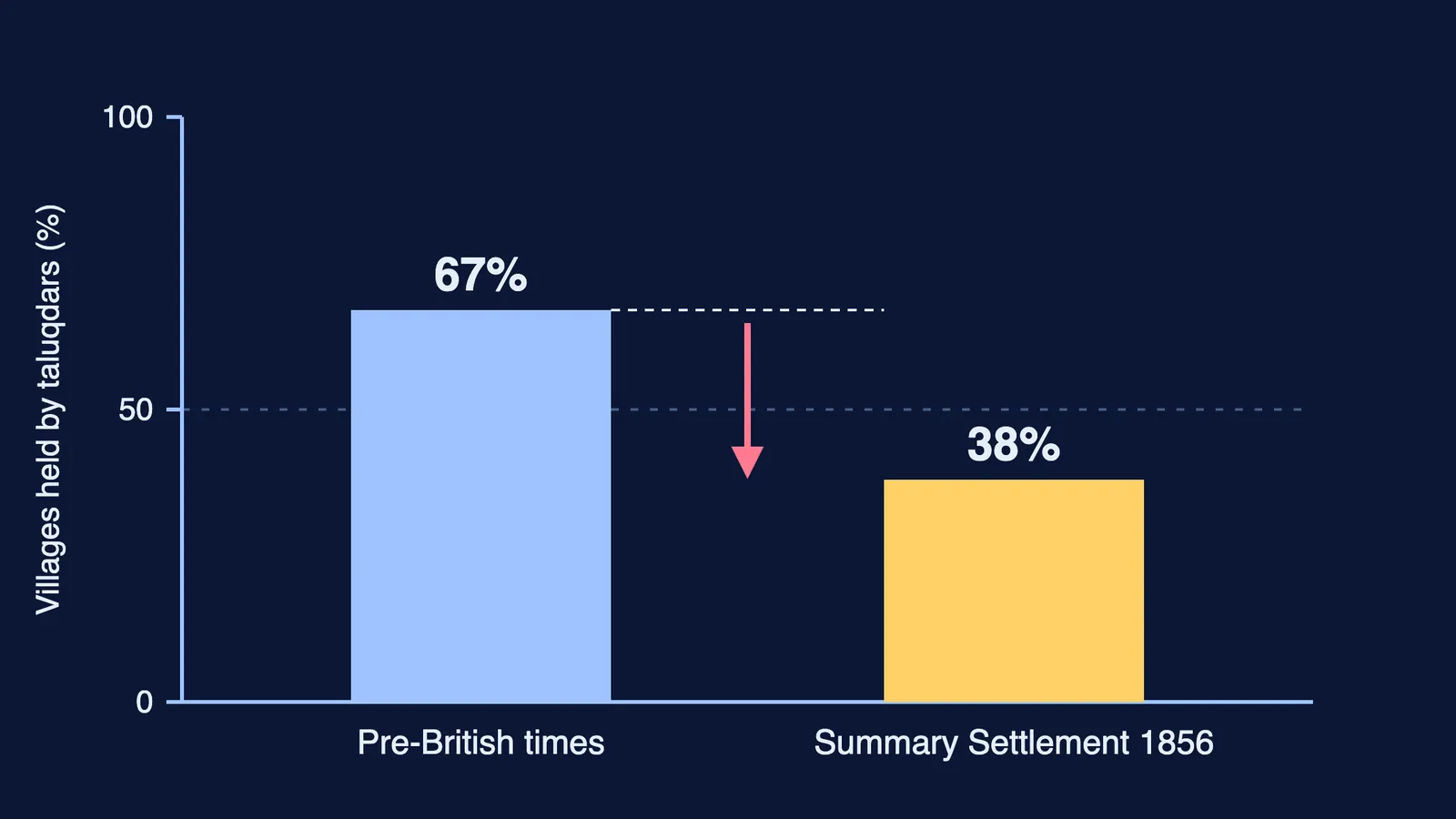
Taluqdars: they were disarmed and their forts destroyed, and under the Summary Settlement of 1856 the share of Awadh villages they held fell from 67 per cent to 38 per cent (NCERT).
Peasants: revenue demand rose by 30 to 70 per cent in some places, and the taluqdar's help in bad years disappeared.
Sepoys: most Bengal Army sepoys came from villages in Awadh and eastern Uttar Pradesh; Awadh was called the nursery of the Bengal Army, so village anger reached the lines.
A British official, Forsyth, estimated that three-fourths of Awadh's adult male population was in rebellion (NCERT).
What did the rebels want?
Few rebels left written records, so the chapter leans on their proclamations (NCERT). The Azamgarh Proclamation of 25 August 1857 has a section for each group: zamindars (lighter revenue demand), merchants (trade opened to Indians), public servants (respect and higher posts), artisans (work with native kings and the rich) and pundits and fakirs (defence of religion). The proclamations stressed Hindu-Muslim unity; in Bareilly in December 1857 the British spent Rs 50,000 trying to set Hindus against Muslims, and failed. In Delhi, Lucknow and Kanpur the rebels set up administrations that looked back to the eighteenth-century Mughal world.
How do you read the images of the revolt?
The chapter treats pictures as sources with a point of view (NCERT). British images celebrated saviours (Thomas Jones Barker's Relief of Lucknow, 1859), showed English women as helpless victims (Joseph Noel Paton's In Memoriam, 1859) or as heroines (Miss Wheeler at Kanpur), and demanded vengeance (Punch's Justice, 12 September 1857). Nationalist images later recast 1857 as the First War of Independence, with the Rani of Jhansi as a warrior on horseback. For any picture, ask:
Who made it, and for which audience?
Who stands at the centre, in the light?
Who is victim, villain or hero, and who is invisible?
What feeling does it provoke, and what did that justify?
How should you plan a long answer on this chapter?
Take NCERT's short-essay question, set for 250 to 300 words: why was the revolt particularly widespread in Awadh, and what prompted peasants, taluqdars and zamindars to join (NCERT)? A plan:
Open with the 1856 annexation and Dalhousie's cherry remark.
Nawab and court: Wajid Ali Shah's exile and lost livelihoods.
Taluqdars: disarmed, and their share of villages cut from 67 to 38 per cent.
Peasants: revenue up 30 to 70 per cent in places, with no relief in bad years.
Sepoys: village anger reached the lines; close with Forsyth's three-fourths estimate to show a popular revolt, not only a mutiny.
To draw that chain on one page, use our guide to making a cause-and-effect chart for a history chapter; to check an AI tool's history dates against NCERT, use this one.
Not sure where to begin revising? Fermi's AI tutor works out what you already know and builds a plan for the session.


