

On this page
Adding 3/(x² − 4) and 2/(x² + x − 2) uses the same idea as adding 1/4 and 1/6: you need a common denominator before you can add the tops. The new step is that you find the LCM of polynomial denominators by factorising, not by listing multiples. Below: the method, a worked example with a numerical check, and common mistakes that cost marks.
What is a rational expression, and why does it need a common denominator?
A rational expression is a fraction whose numerator and denominator are polynomials, with the denominator not equal to zero. The rule for adding them is the same as for number fractions: if p, q and r are polynomials and r ≠ 0, then p/r + q/r = (p + q)/r, as set out in OpenStax Intermediate Algebra 2e, section 7.2.
If the denominators differ, rewrite each fraction so they match. If you want a refresher with plain numbers first, our guide on adding fractions with different denominators using the LCM covers the same logic.
How do you find the LCD of algebraic denominators?
The least common denominator (LCD) is the product of all the factors of the denominators, with common factors included only once. OpenStax sets out the steps: factor each denominator completely, include all factors but not common factors twice, and multiply. In practice:
Factorise every denominator completely: common factors, differences of squares, quadratics.
List each distinct factor once. If a factor appears to a higher power in one denominator, as in (x + 1)² against (x + 1), keep the higher power.
Multiply them. That product is the LCD.
Multiply the top and bottom of each fraction by the LCD factors its denominator is missing.
If x² − 4 or x³ + 27 slows you down, practise with our walkthrough on factorising differences of squares and sums of cubes.
Worked example: 3/(x² − 4) + 2/(x² + x − 2)
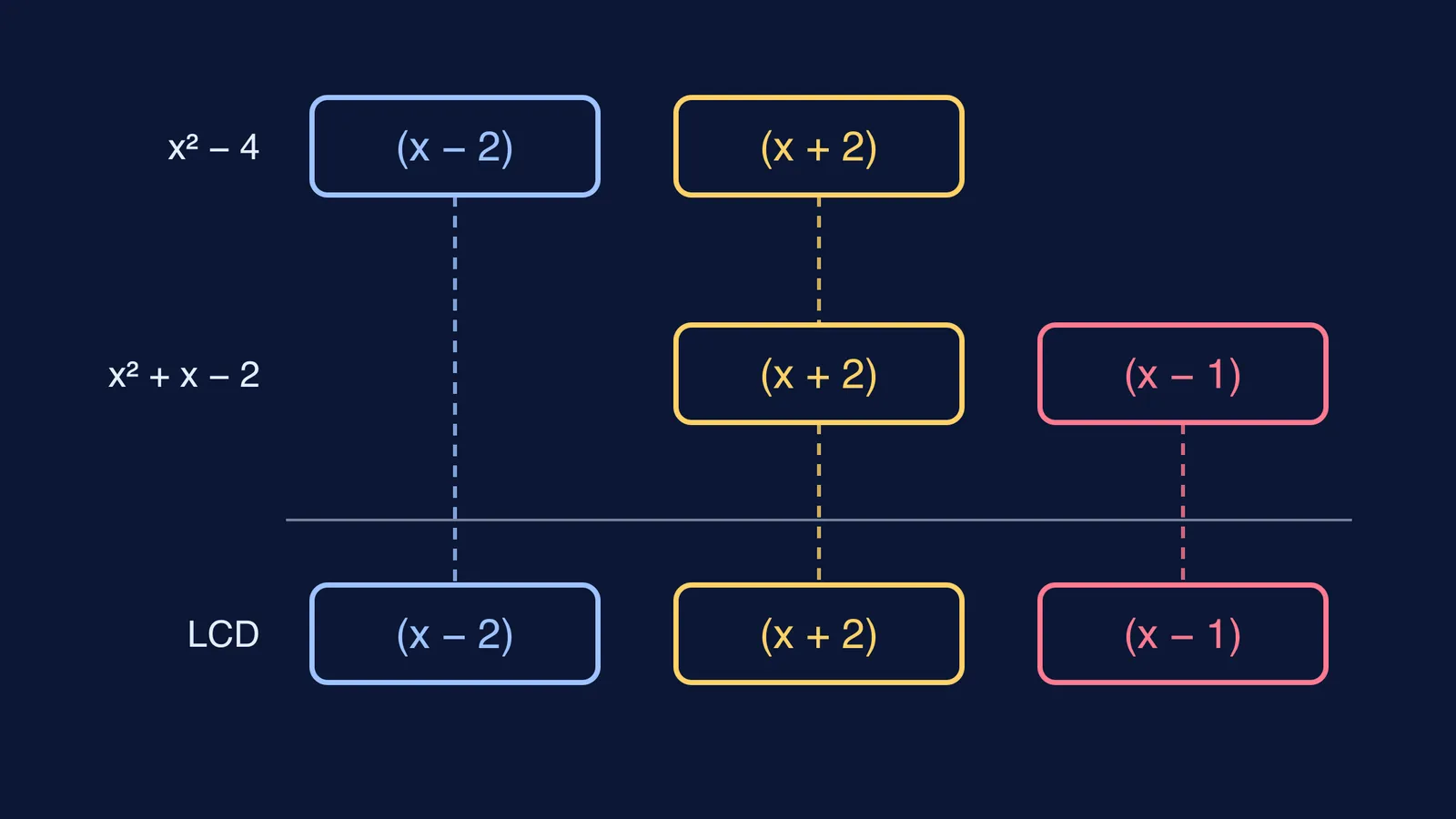
Factorise. x² − 4 = (x − 2)(x + 2), and x² + x − 2 = (x + 2)(x − 1).
Build the LCD. The distinct factors are (x − 2), (x + 2) and (x − 1). The shared factor (x + 2) is used once, so the LCD is (x − 2)(x + 2)(x − 1). Simply multiplying the two denominators would repeat (x + 2) and leave more cancelling later.
Rewrite each fraction. The first fraction is missing (x − 1), so it becomes 3(x − 1)/[(x − 2)(x + 2)(x − 1)]. The second is missing (x − 2), so it becomes 2(x − 2)/[(x − 2)(x + 2)(x − 1)].
Add the numerators. 3(x − 1) + 2(x − 2) = 3x − 3 + 2x − 4 = 5x − 7.
Answer. (5x − 7)/[(x − 2)(x + 2)(x − 1)], for x ≠ 2, −2, 1. The numerator 5x − 7 shares no factor with the denominator, so this is already in simplest form.
Check with a number. Put x = 0 into the original: 3/(−4) + 2/(−2) = −0.75 − 1 = −1.75. Put x = 0 into the answer: −7/[(−2)(2)(−1)] = −7/4 = −1.75. They match. This quick check catches many sign slips.
How do you simplify the result after adding?
Always factorise the final numerator and look for a factor it shares with the LCD. Take 1/(x − 1) − 2/(x² − 1). The LCD is (x − 1)(x + 1), and the numerator is (x + 1) − 2 = x − 1. So the result is (x − 1)/[(x − 1)(x + 1)], which simplifies to 1/(x + 1).
The excluded values still come from the original denominators: x ≠ 1 and x ≠ −1, even though x − 1 no longer appears. OpenStax states that values that would make the denominator zero are not allowed (section 7.2). Only cancel whole factors, never single terms; our post on why (x + 2)/2 is not x + 1 shows why.
Which mistakes cost marks, and how do you avoid them?
Check for these before moving on:
Adding across. 1/(x − 1) + 1/(x + 1) is not 2/(2x). Tops and bottoms are never added separately.
Unfactorised denominators. Missing the shared (x + 2) makes the LCD bigger than needed.
Lost brackets on subtraction. In A/B − (x − 2)/B, the minus applies to the whole numerator: −(x − 2) = −x + 2.
Forgetting restrictions. Write the excluded values next to the answer, taken from the original denominators.
Stopping too early. Factorise the final numerator once more before you call it done.
If a problem goes wrong and you can't see where, the Fermi Problem Library has worked problems with a step-by-step solver that explains the reasoning rather than printing an answer, so you can compare each line with yours. If factorising itself is the weak spot, the Fermi Concept Library gives every mathematics concept its own lesson and its place in the map.
Try it now: add 2/(x² − 9) and 1/(x² + 3x), then check your answer with x = 1.


