

On this page
When simplifying algebra, it is tempting to treat the fraction bar like a visual matching game. If you see a 2 on the top and a 2 on the bottom, your first instinct is often to cross them out.
However, this visual shortcut leads to one of the most common mistakes in high school mathematics: cancelling terms instead of factors. A fraction bar represents division, and division only undoes multiplication, not addition.
Why you cannot cancel terms in fractions?
To understand why crossing out terms is mathematically illegal, you have to look at how algebraic expressions are built.
A 2024 study published in the *JMPM: Jurnal Matematika dan Pendidikan Matematika* (10.26594/jmpm.v9i2.5172) identified seven common algebraic misconceptions. The research found that errors often occur because students incorrectly assimilate new algebraic rules into old arithmetic habits.
When you cancel a number from the top and bottom of a fraction, you are actually dividing both the numerator and the denominator by that number. You can only divide the whole numerator if the number you are cancelling applies to the *entire* top expression. You cannot pick and choose which parts of a sum get divided.
What is the difference between a term and a factor?
The key to simplifying fractions safely is knowing the difference between a term and a factor.
Terms are the building blocks of addition and subtraction. In the expression 3x + 5, both 3x and 5 are terms. They are separated by a plus sign.
Factors are the building blocks of multiplication. In the expression 3x, both 3 and x are factors because they are multiplied together.
The golden rule of algebraic fractions is that you can only cancel global factors—factors that multiply the entire numerator and the entire denominator. You can never cancel a term, because doing so ignores the addition or subtraction holding the expression together.
Why is (x + 2)/2 not equal to x + 1?
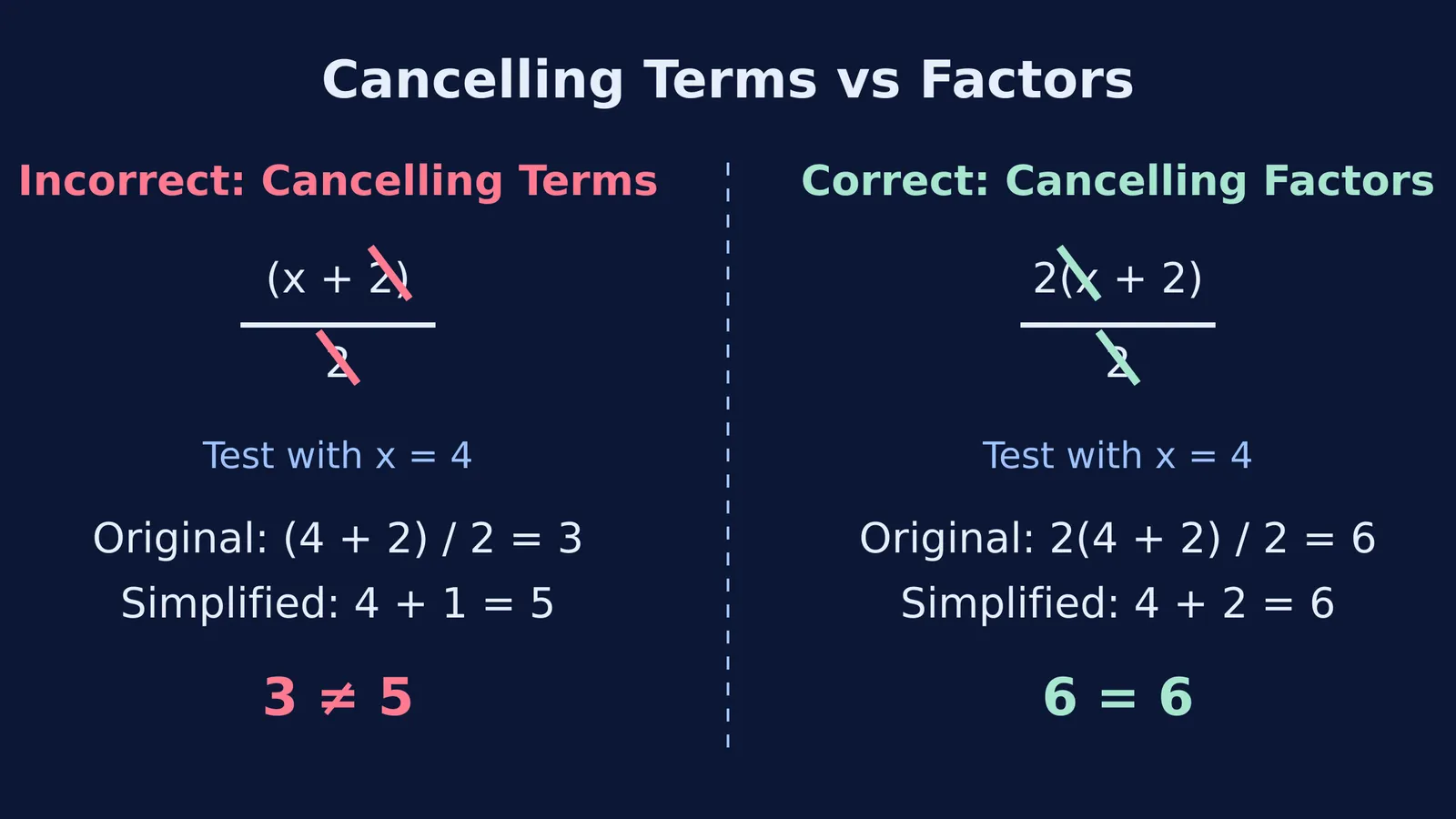
Let's look at the classic example: simplifying the fraction (x + 2) / 2.
Many students will cross out the 2 in the numerator and the 2 in the denominator. Because 2 divided by 2 is 1, they write the final answer as x + 1.
This is incorrect because the 2 in the numerator is a term. It is being added to x, not multiplied by x. The fraction bar means that the entire numerator (x + 2) is being divided by 2.
To divide correctly, the denominator must apply to every term in the numerator. The expanded form of the fraction is: x/2 + 2/2
This simplifies to: x/2 + 1
This result is entirely different from x + 1. The visual trick of scratching out matching numbers ignores the addition sign binding the numerator together.
How to check if your algebra is right?
The most powerful habit you can build in algebra is the numerical substitution test. If you are unsure whether a simplification step is legal, plug a simple number into both your starting expression and your final answer. If the two results do not match, your rule is wrong.
Let's test our previous example by substituting x = 4.
First, evaluate the original expression, (x + 2) / 2:
Substitute 4 for x: (4 + 2) / 2
Add the numerator: 6 / 2
Divide: The true value is 3.
Next, evaluate the incorrect simplified expression, x + 1:
Substitute 4 for x: 4 + 1
Add: The value is 5.
Since 3 does not equal 5, the cancellation was illegal.
If you find yourself repeatedly making these structural errors when evaluating limits at infinity of rational functions or determining when a quadratic is always positive, a targeted intervention can help. The Fermi Problem Library provides worked problems with a step-by-step solver that explains the reasoning rather than just printing an answer. Fermi's AI tutor works out what you already know and builds a plan for the session, catching foundational gaps like illegal cancellations before they cost you marks.
A practical framework for simplifying fractions
To permanently stop cancelling terms, use the "Factor First" checklist every time you see an algebraic fraction.
Look for plus or minus signs. If there is addition or subtraction anywhere in the numerator or denominator, put brackets around the entire expression. This reminds you that the expression is a single packaged unit.
Factor out the greatest common divisor. Check if every single term in the numerator shares a common factor. For example, in the expression (2x + 4) / 2, you can factor out a 2 from the top to get 2(x + 2).
Cancel only identical multipliers. Now that the 2 is multiplying the entire bracketed group, it is a global factor. You can safely divide the top and bottom of 2(x + 2) / 2 by 2, leaving you with x + 2.
Run the number test. If you simplified (2x + 4) / 2 to x + 2, plug in x = 3 to check. The original gives (6 + 4) / 2 = 5. The new expression gives 3 + 2 = 5. The match proves your logic is sound.
By shifting your focus from visual matching to factoring, you will eliminate one of the most stubborn calculation errors in mathematics.


