

On this page
Every point on the x-axis has a y-coordinate of 0. That one fact turns "in what ratio does the x-axis divide AB?" into a one-line equation. The NCERT Class 10 coordinate geometry chapter writes the ratio as k:1 and gives the point dividing A(x₁, y₁) and B(x₂, y₂) in that ratio as ((kx₂ + x₁)/(k + 1), (ky₂ + y₁)/(k + 1)).
Using k:1 leaves one unknown and one equation, and the sign of k tells you whether the axis cuts the segment at all.
How do you find the ratio in which the x-axis divides a line segment?
Let the ratio be k:1.
Write only the y-coordinate of the dividing point: (ky₂ + y₁)/(k + 1).
Set it equal to 0 and solve: ky₂ + y₁ = 0, so k = −y₁/y₂.
Put k back into the x-coordinate to get the point of division.
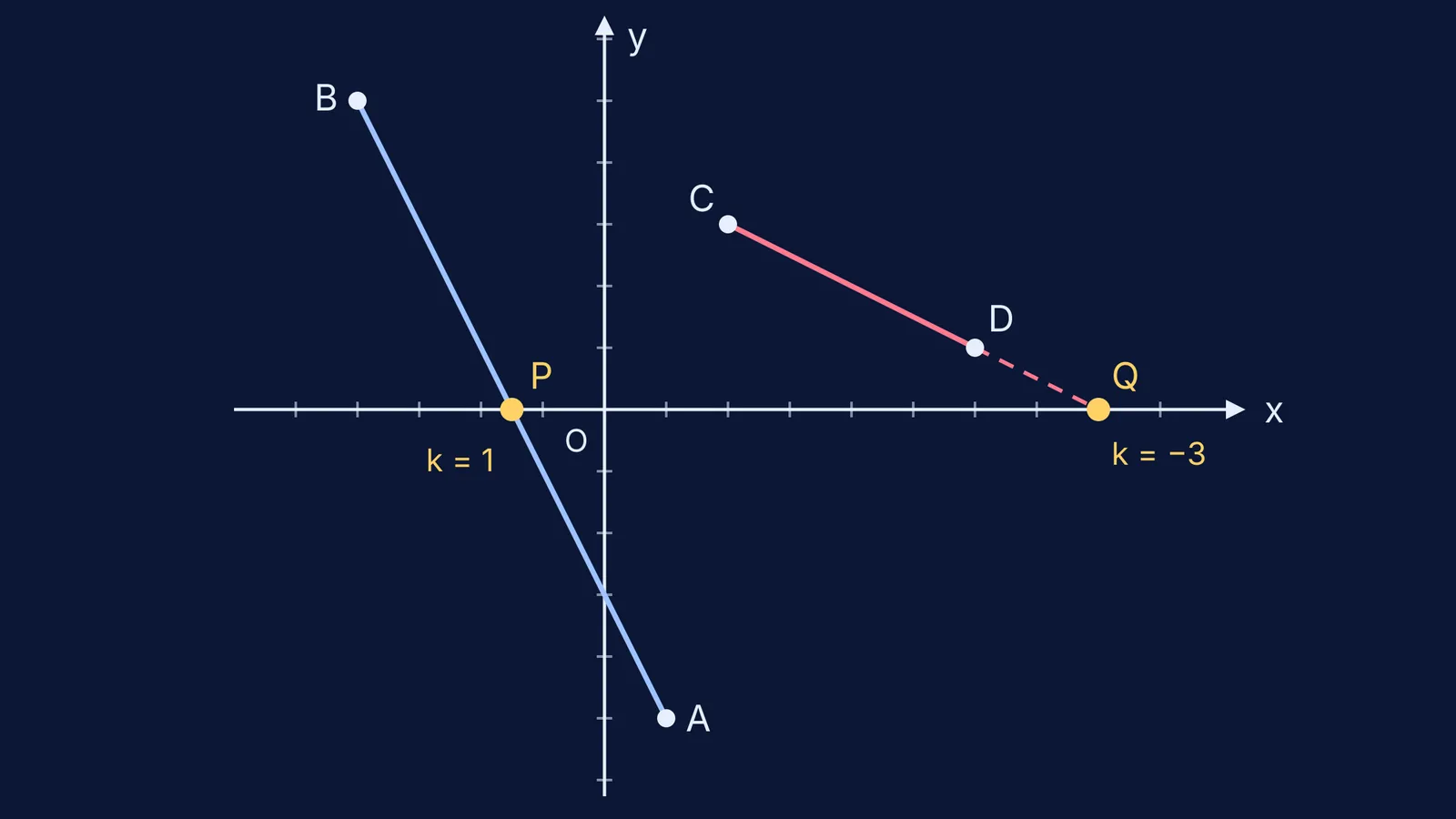
Try it on Exercise 7.2, Question 5 of the same NCERT chapter: A(1, −5) and B(−4, 5). Here k = −(−5)/5 = 1, so the ratio is 1:1. The x-coordinate is (1 × (−4) + 1)/(1 + 1) = −3/2, so the x-axis cuts AB at (−3/2, 0), which is its midpoint.
A shortcut falls out of k = −y₁/y₂: the size of the ratio is |y₁| : |y₂|, the distances of A and B from the x-axis. Both points here are 5 units away, so 1:1 is no surprise.
Why does the sign of k tell you internal or external division?
The Class 10 formula is for internal division, where the point lies between A and B. The NCERT Class 12 vector algebra chapter gives the external case in Section 10.5.3: the point dividing PQ externally in the ratio m:n has position vector (mb − na)/(m − n). Put m = |k| and n = 1 with k negative, and that is the k:1 formula with a negative k. You do not need a second formula; the sign does the work.
k > 0: y₁ and y₂ have opposite signs, so A and B are on opposite sides and the axis cuts the segment. Internal division, ratio k:1.
k < 0: y₁ and y₂ have the same sign, so the axis meets line AB only when extended. External division, ratio |k|:1.
k = 0: A is already on the x-axis.
y₂ = 0 with y₁ ≠ 0: no k works, because B is on the axis.
y₁ = y₂ ≠ 0: k = −1 makes k + 1 = 0. AB is parallel to the x-axis and never meets it.
What does a negative k look like in a worked example?
Find the ratio in which the x-axis divides the segment joining C(2, 3) and D(6, 1).
k = −3/1 = −3.
k is negative, as the signs predicted: both points are above the axis.
x = (−3 × 6 + 2)/(−3 + 1) = (−16)/(−2) = 8, so the point is Q(8, 0).
Check with distances: QC = √(36 + 9) = 3√5 and QD = √(4 + 1) = √5, so QC:QD = 3:1.
Answer: the x-axis divides CD externally in the ratio 3:1, at (8, 0). Write "externally in the ratio 3:1", not "−3:1"; a ratio of lengths is positive. The diagram at the top shows both cases to scale.
How do you find the ratio in which the y-axis divides a segment?
Swap the roles. Every point on the y-axis has x = 0, so set (kx₂ + x₁)/(k + 1) = 0, which gives k = −x₁/x₂, then put k into the y-coordinate. Example 9 in the NCERT Class 10 chapter does exactly this for (5, −6) and (−1, −4): k = 5, so the y-axis divides the segment in the ratio 5:1, at (0, −13/3).
The sign rule carries over, now read from x₁ and x₂. Here 5 and −1 have opposite signs, so the division is internal, which matches k = 5.
What mistakes cost marks on this question?
Run this checklist before you move on:
Did you set the correct coordinate to zero (y for the x-axis, x for the y-axis)?
Did you write a fraction k as a whole-number ratio? NCERT's Example 7 turns k = 2/7 into 2:7.
If k is negative, did you write "externally |k|:1" instead of a negative ratio?
Did you find the point of division if the question asked for it?
Did you substitute k into the other coordinate to check it gives a sensible point?
For more practice, see our guide to the section formula in Class 10, the interactive post on internal and external division, and classifying a triangle using coordinates.
If you keep losing the sign or setting the wrong coordinate to zero, the Fermi Problem Library has worked problems with a step-by-step solver that explains the reasoning rather than printing an answer. If the section formula itself feels shaky, the Fermi Concept Library gives each concept its own lesson and its place in the map.


