

On this page
The section formula is a fundamental tool in coordinate geometry. It allows you to find the exact coordinates of a point that cuts a line segment into a specific ratio, such as 2:1 or 3:4.
While learning the algebraic expressions is necessary, simply memorizing them can leave you confused when an exam question twists the phrasing. This is why manipulating the points on a screen builds a much stronger intuition than reading them in a textbook.
What is the section formula for internal division?
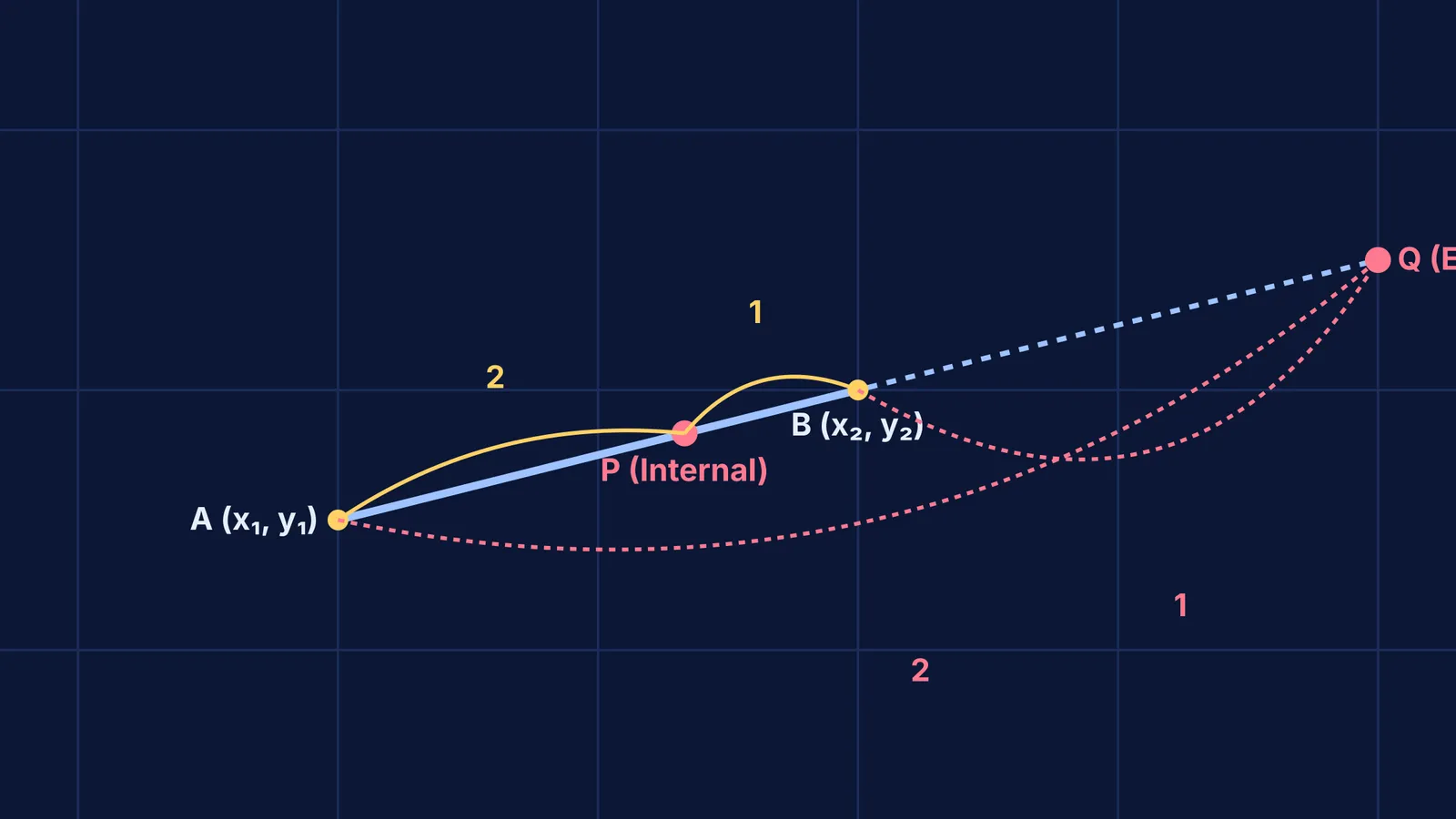
Internal division occurs when a point P(x, y) lies somewhere strictly between the two endpoints of a line segment, A(x₁, y₁) and B(x₂, y₂). If point P divides the segment AB in the ratio m:n, its coordinates are found by adding the weighted coordinates of the endpoints.
The internal section formula is: x = (mx₂ + nx₁) / (m + n) y = (my₂ + ny₁) / (m + n)
In the Indian syllabus, the National Council of Educational Research and Training (NCERT) introduces this internal division formula in Class 10 mathematics. It acts as the stepping stone for almost all coordinate geometry problems that follow.
How do you calculate external division with the section formula?
External division happens when the point P(x, y) lies on the extension of the line segment AB, outside the endpoints. It still divides the distance from A and the distance from B in a ratio m:n, but the point is further along the line. Class 11 mathematics introduces this concept, often alongside Section formula in 3D: dividing a segment internally and externally.
To calculate external division, the formula changes its signs from addition to subtraction: x = (mx₂ − nx₁) / (m − n) y = (my₂ − ny₁) / (m − n)
Because the formula uses a minus sign, calculating external division algebraically is more prone to careless errors. A negative result for the ratio m/n simply means the division is external rather than internal. For instance, an internal division with a ratio of -2:1 is equivalent to an external division in the ratio 2:1.
Why does learning with interactive geometry help?
When you plot an internal division of 2:1 on a static piece of paper, you get one fixed answer. But what happens if you gradually increase the ratio to 5:1, or shift to a 2:1 external division?
A 2010 study on mathematics achievement found that students who learned coordinate geometry through dynamic, interactive software significantly outperformed those who learned through traditional chalkboard methods, especially those with lower visual-spatial ability (Saha et al., 2010).
This is because interactive tools let you manipulate the variables directly. If you predict where a point dividing a segment externally in 2:1 lies, you can drag the ratio slider and watch the point move along the extended line to verify your guess. As the ratio changes, the point shifts in response, allowing you to instantly see the geometric effect of altering the values. If you struggle to picture these shifts in your head, you can experiment with the geometry in the Fermi Simulation Lab. Interacting with the shapes makes the invariant relationships—the rules that never change regardless of where you drag the points—obvious to the eye.
A worked example: dividing externally in 2:1
Let us put the formula to work. Suppose you have a line segment joining A(1, 2) and B(4, 6) on a Cartesian plane. You need to find the exact coordinates of point Q(x, y) which divides AB externally in the ratio 2:1.
Here, x₁ = 1, y₁ = 2 and x₂ = 4, y₂ = 6. The ratio is m = 2 and n = 1.
Write out the external x-coordinate formula: x = (mx₂ − nx₁) / (m − n)
Substitute your values: x = ((2 × 4) − (1 × 1)) / (2 − 1)
Simplify the numerator and denominator: x = (8 − 1) / 1 = 7
Write out the external y-coordinate formula: y = (my₂ − ny₁) / (m − n)
Substitute your values: y = ((2 × 6) − (1 × 2)) / (2 − 1)
Simplify: y = (12 − 2) / 1 = 10
The point Q lies exactly at (7, 10). This means the point sits beyond B along the extended line segment, twice as far from A as it is from B.
How to avoid sign errors in exams?
When switching between internal and external calculations under time pressure, sign errors are the most common mistake students make. Use this quick checklist to catch them:
Check the denominator: For internal division, the denominator (m + n) must be larger than either part of the ratio. For external division (m − n), it will be smaller.
Draw a rough sketch: Before applying the formula, sketch the coordinates on a scrap axis. If you are calculating an external division and your final point lands between A and B, you have accidentally used the internal formula.
Watch out for negative coordinates: If x₁ or x₂ is negative, wrap it in brackets during substitution to prevent a double negative from silently turning your subtraction into addition.
Because external division problems often involve checking if points line up on the same extended path, they connect closely to vector proofs, such as testing Collinear points with vectors: the position vector test. Mastering this simple formula gives you the spatial foundation you need for more complex physics applications, including Motion in a plane from r(t): velocity and acceleration vectors.


