

On this page
A question gives you one measured rate and a balanced equation, then asks for the rate of a different species. It is easy to lose the mark here by multiplying when you should divide, or by dropping a minus sign. Once you see where the numbers come from, the fix fits on one line.
Why do reactants and products change at different rates?
The coefficients fix how many moles of each species react or form. The NCERT Class 12 Chemistry textbook, Unit 3 (Chemical Kinetics) uses 2HI → H₂ + I₂: two moles of HI are used up for every mole of H₂ formed, so HI is consumed twice as fast as H₂ appears. To make the terms equal, NCERT divides the change in [HI] by 2.
Without a rule, every species would give a different value for the rate. The rule is to divide by the coefficient.
The square brackets mean molar concentration, as NCERT states in the same section. If that notation still trips you up, our explainer on what square brackets mean in chemistry covers it.
Why is there a minus sign for reactants?
A reactant's concentration falls, so d[A]/dt is a negative number. According to Chemistry LibreTexts/Kinetics/02%3A_Reaction_Rates/2.05%3A_Reaction_Rate), rates written in terms of a reactant always carry a minus sign so that the rate comes out positive. NCERT gives the same reason when it multiplies Δ[R] by −1.
That gives you two things that look alike but differ in sign:
The rate of disappearance of A is −d[A]/dt, a positive number.
d[A]/dt on its own is negative.
Read the question's wording carefully. If it asks for d[NO₂]/dt or d[Br⁻]/dt, give the signed value. If it asks for the rate of disappearance or formation, give a positive number.
How do you convert the rate of one species into another?
This three-step method works for any balanced equation:
Divide the given rate (taken as positive) by that species' coefficient. This gives the rate of reaction.
Multiply by the coefficient of the species you want.
Put the sign back: negative for d[ ]/dt of a reactant, positive everywhere else.
As a shortcut, the rate of X divided by the rate of Y equals the coefficient of X divided by the coefficient of Y. As a sanity check, the species with the larger coefficient always changes faster.
Worked example 1: decomposition of N₂O₅
In NCERT Example 3.2 (Unit 3 PDF), the reaction is 2N₂O₅ → 4NO₂ + O₂, and [N₂O₅] falls from 2.33 to 2.08 mol L⁻¹ in 184 minutes.
Rate of disappearance of N₂O₅ = 0.25 ÷ 184 = 1.36 × 10⁻³ mol L⁻¹ min⁻¹.
Rate of reaction = 1.36 × 10⁻³ ÷ 2 = 6.79 × 10⁻⁴ mol L⁻¹ min⁻¹, which is NCERT's answer.
Rate of formation of NO₂ = 4 × 6.79 × 10⁻⁴ = 2.72 × 10⁻³ mol L⁻¹ min⁻¹, which also matches NCERT.
Rate of formation of O₂ = 1 × 6.79 × 10⁻⁴ mol L⁻¹ min⁻¹. This step is our own extension of the example.
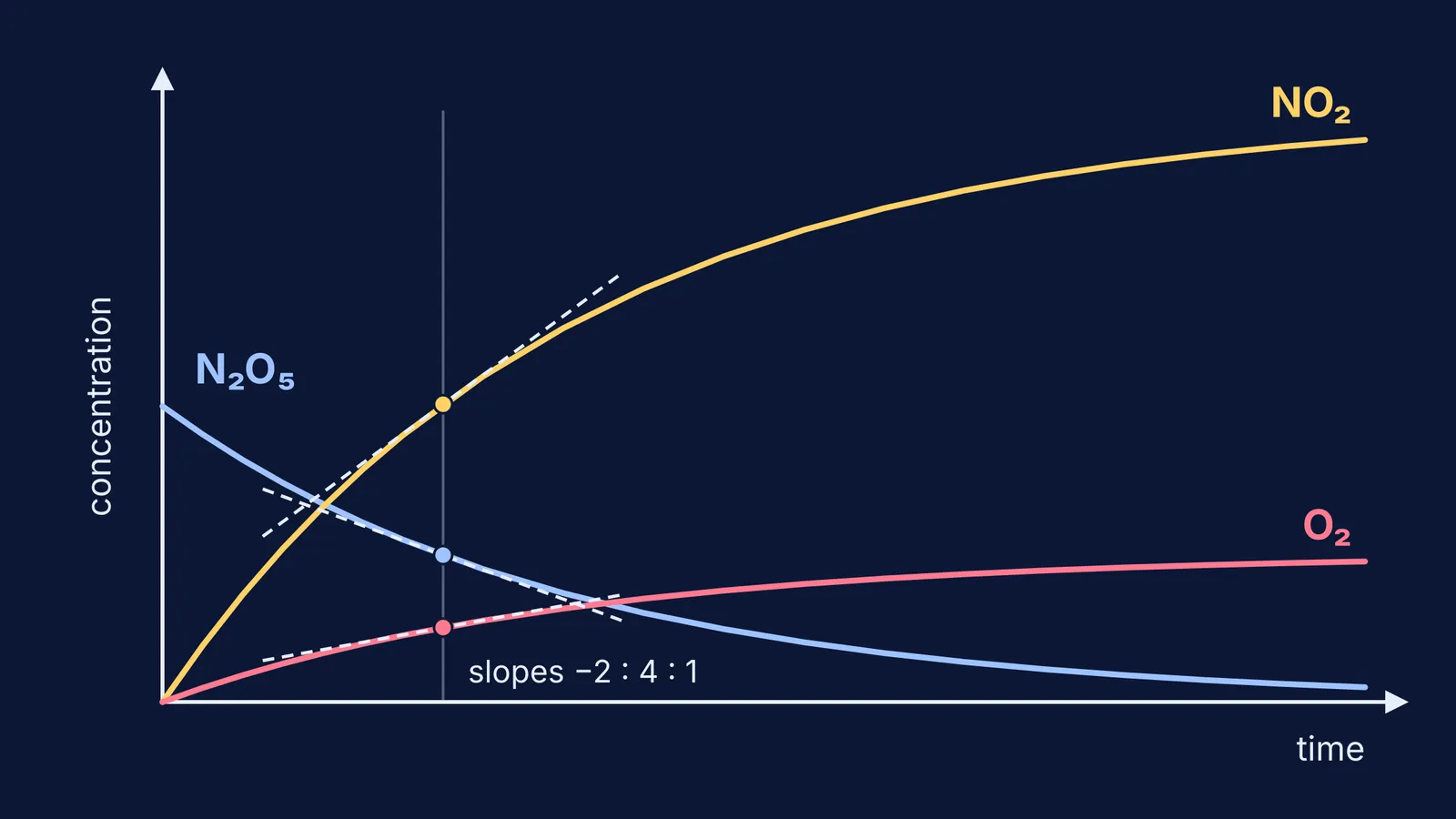
Check: 1.36 : 2.72 : 0.679 (all × 10⁻³) is 2 : 4 : 1, the same as the coefficients.
Worked example 2: the bromate reaction
NCERT writes the rate expression for 5Br⁻ + BrO₃⁻ + 6H⁺ → 3Br₂ + 3H₂O. Suppose, as an example with our own number, that Br⁻ disappears at 0.010 mol L⁻¹ s⁻¹.
Rate of reaction = 0.010 ÷ 5 = 0.0020 mol L⁻¹ s⁻¹.
BrO₃⁻ disappears at 0.0020 mol L⁻¹ s⁻¹, so d[BrO₃⁻]/dt = −0.0020 mol L⁻¹ s⁻¹.
H⁺ disappears at 6 × 0.0020 = 0.012 mol L⁻¹ s⁻¹.
Br₂ forms at 3 × 0.0020 = 0.0060 mol L⁻¹ s⁻¹.
If you keep flipping the ratio, practise a few in the Fermi Problem Library, where the step-by-step solver explains the reasoning rather than just printing an answer.
What mistakes cost marks on these questions?
Flipped ratio. Multiplying by a reactant's coefficient where you should divide. Use the sanity check: the bigger coefficient means the faster change.
Lost sign. Writing +0.0020 when the question asked for d[BrO₃⁻]/dt.
Rewritten equation. If you halve every coefficient (N₂O₅ → 2NO₂ + ½O₂), each species still changes at the same speed, but the rate of reaction doubles. Always use the equation exactly as the question writes it.
Rate mixed up with rate constant. The coefficient rule is about rate, not k. Here is how rate and rate constant differ.
These ratios also hold for instantaneous rates, which are slopes of the concentration–time curves. Those slopes shrink as reactants are used up, which is why reaction rate falls with time.
To see where this sits in kinetics as a whole, from rate laws to order and half-life, open chemical kinetics in the Fermi Concept Library and work through the next idea.


