

On this page
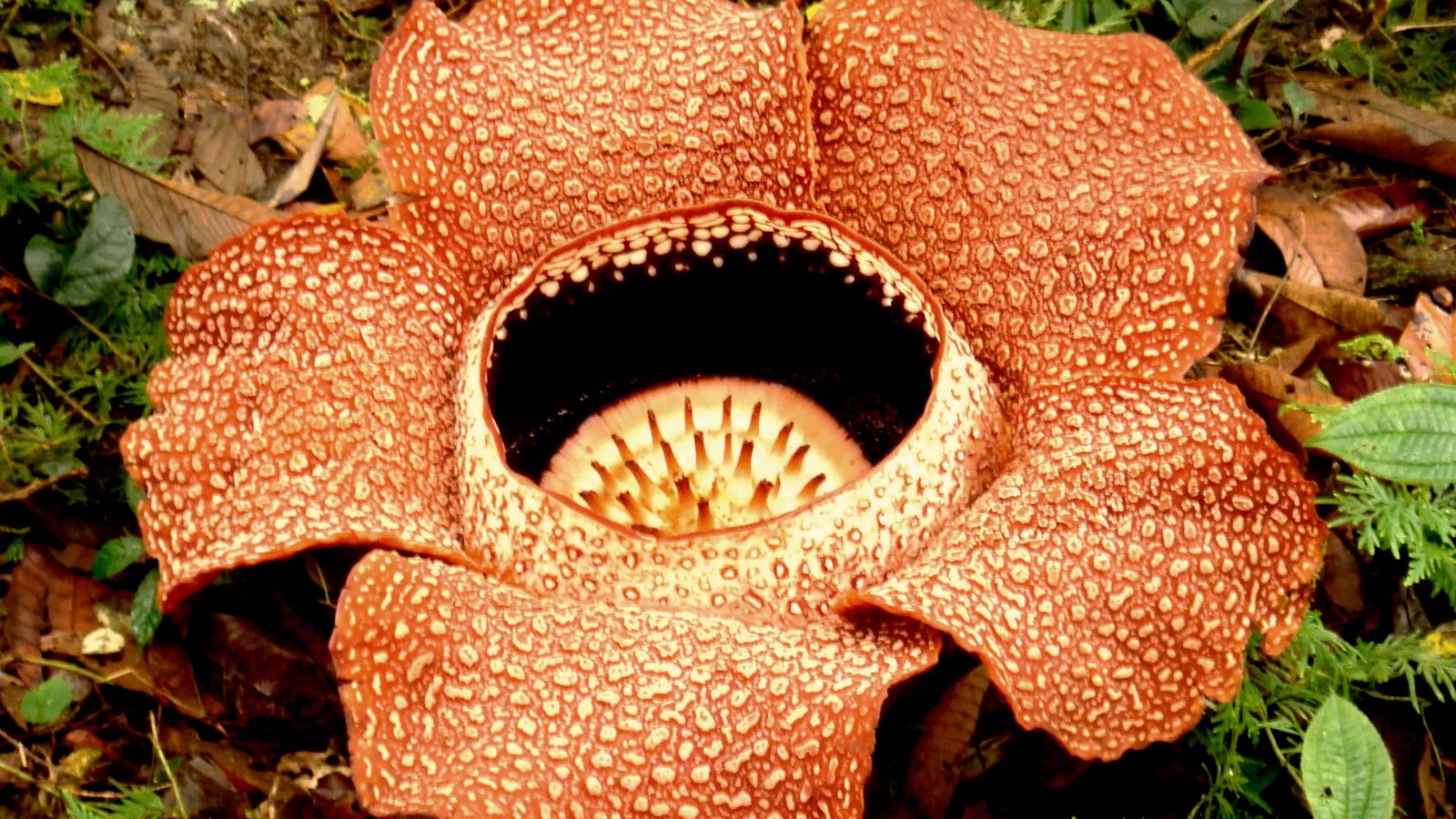
Picture a flower up to a metre across, sitting on the forest floor with no leaves or stem attached to it. That is what you see when *Rafflesia* blooms in the rainforests of Southeast Asia. The flower is the only part of the plant that ever shows itself. Everything else lives hidden inside another plant.
For a biology student, *Rafflesia* is a gift. One plant brings together parasitism, pollination, evolution and even genetics. Here is what is known, with the sources, and a way to turn it into a strong exam answer.
How big is the Rafflesia flower?
Flowers in the Rafflesiaceae family reach up to one metre in diameter, according to a 2007 study in Science by Charles Davis and colleagues. The same study found something surprising: the family is derived from within the Euphorbiaceae, the spurge family, where most species have minute flowers. The authors estimated a roughly 79-fold increase in flower diameter on the lineage leading to Rafflesiaceae, which they called one of the most dramatic cases of size evolution reported for eukaryotes.
The bloom does not last. Harvard Magazine's profile of Davis's work reports that each flower lasts little more than a week.
How can a plant have no leaves, stem or roots?
*Rafflesia* has no roots, shoots, stems or leaves, as Harvard Magazine describes it. It lives as a thin chain of cells winding through the tissues of its host, *Tetrastigma*, a woody vine in the grape family. With no leaves there is no photosynthesis, so its food comes from the vine.
The plant stays invisible until it is ready to flower. Then a cabbage-like bud breaks through the bark of the host vine, as a 2023 University of Oxford press release describes.
Its DNA tells the same story. A 2014 study in Molecular Biology and Evolution by Jeanmaire Molina and colleagues found no recognisable chloroplast (plastid) genome in *Rafflesia lagascae*. They found only small scraps of plastid DNA, about 11.5 kilobases in all, and none of the plastid genes they identified had an intact reading frame. About a third of the remnant genes grouped with those of the host vine, hinting that they may have been picked up from it. The authors suggested *Rafflesia* may be the first plant group known to have no recognisable plastid genome.
This is why *Rafflesia* is called a total (holo) parasite: it depends on the host for everything. Compare it with partial parasites in our explainer on epiphytes, parasites and saprophytes, and with the green, photosynthesising sandalwood root parasite.
Why does Rafflesia smell like rotting meat?
The smell is a pollination trick. Its scent of rotting meat earned it the names corpse lily and carrion flower, and it draws carrion flies, which seek out carcasses, reports Harvard Magazine. The same article says the smell reportedly peaks around noon on the third or fourth day of the bloom.
The flies get fooled: there is no carcass. But the pollen, produced as a sticky fluid, dries on their backs and is carried to the next flower. Many flowers reward pollinators with nectar; *Rafflesia* pays with a lie. Our post on insect pollination and floral rewards shows how unusual that is.
Is Rafflesia endangered?
Most species are. A 2023 study in Plants, People, Planet reviewed all 42 known *Rafflesia* species, which grow across Brunei, Indonesia, Malaysia, the Philippines and Thailand. The University of Oxford press release gives the breakdown: the researchers classed 25 species as Critically Endangered, 15 as Endangered and 2 as Vulnerable. Only one species was listed on the IUCN Red List, and 67% of known habitats were unprotected.
A parasite this specialised cannot survive without its host vine, and the vine cannot survive without its forest.
How do you write Rafflesia in an exam answer?
Examiners reward structure. Use this four-part frame for a 3-mark or 5-mark answer:
Define: Rafflesia is a total parasite that produces the largest flowers known, up to one metre across (Davis and colleagues, 2007).
Body plan: no leaves, stem or roots; lives as threads of cells inside the host vine Tetrastigma.
Nutrition: takes its food from the host, so it is a holoparasite, not a partial parasite.
Pollination: a rotting-meat smell attracts carrion flies, which carry its sticky pollen between flowers.
Before you write, run this quick check:
Did I name the host?
Did I say total parasite, not just parasite?
Did I link the smell to the pollinator?
Could I draw a labelled sketch: vine, bud on bark, open flower?
If the gap is in the ideas underneath, like how parasitism differs from saprophytism, the Fermi Concept Library covers every concept in biology, each with its own lesson and its place in the map. When you want to test yourself on mixed questions, the Fermi Problem Library has worked problems with a step-by-step solver that explains the reasoning.
Next time someone asks for the largest flower, you can tell them the better story: it belongs to a plant you will never see.


