

On this page
Many students assume that parasitic plants must lack chlorophyll, like the completely dependent *Cuscuta* (Amarbel). However, Indian sandalwood (*Santalum album* and related species) challenges this idea by living a double life. It is classified as a partial root parasite because it only relies on its host for specific resources.
What is a partial root parasite?
A partial root parasite is a plant that produces its own food through photosynthesis but must tap into another plant's root system to obtain water and inorganic minerals.
Unlike total parasites, sandalwood has functional green leaves. It is fully capable of independent carbon fixation. Yet, it cannot independently extract enough water and minerals from the soil to thrive. To solve this, it attaches to the roots of neighbouring plants.
How do haustoria work?
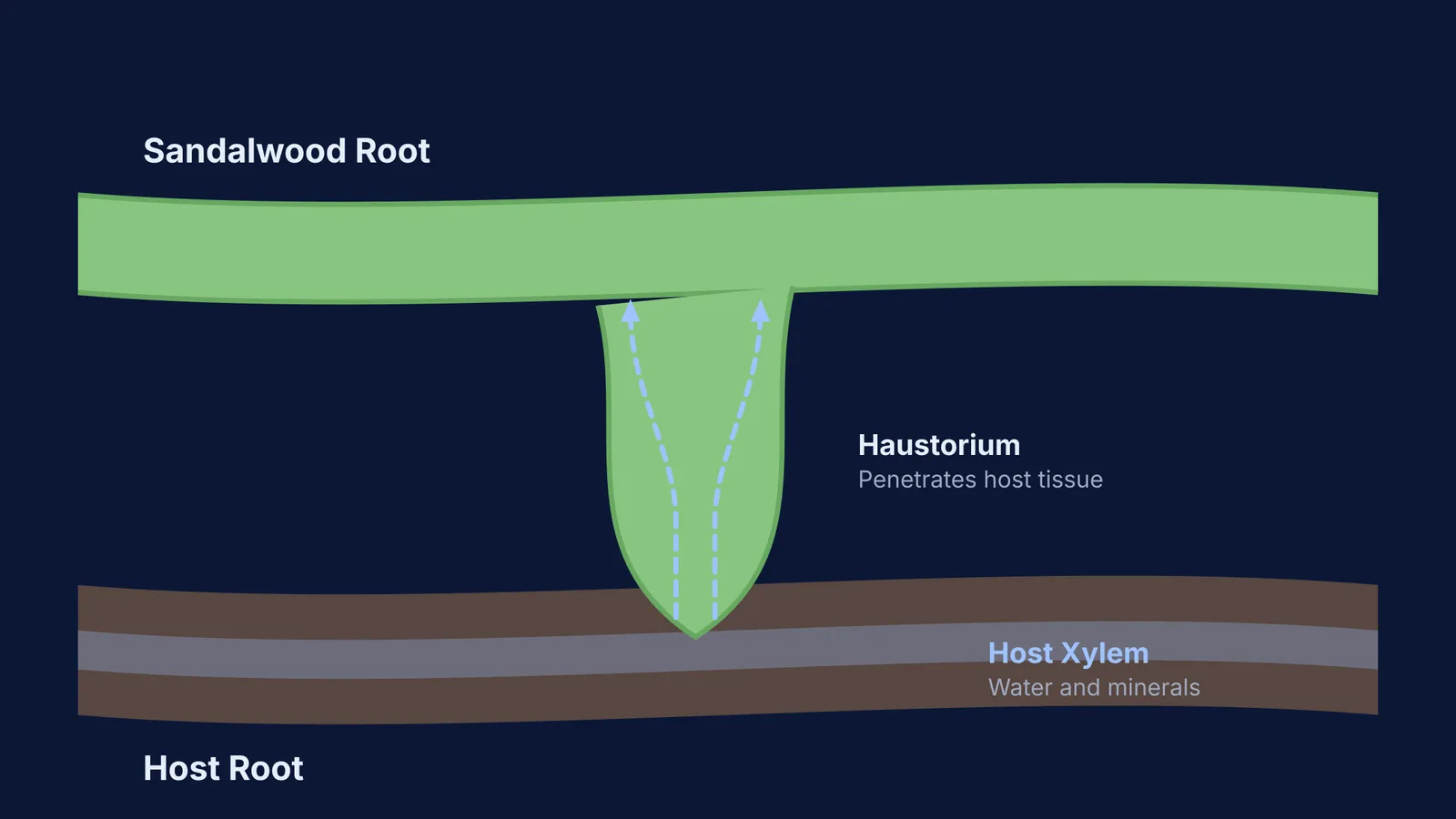
The secret to sandalwood's survival lies in the haustorium (plural: haustoria). A haustorium is a specialised, multicellular organ that acts as a physiological bridge between the parasite and its host.
Research shows that haustoria develop on sandalwood roots and absorb water and nutrients from the host (Meng et al., 2025). Once connected, the sandalwood essentially siphons off the sap flowing through the host's tissue.
What triggers the haustorium to form?
The process of forming a haustorium is not spontaneous; it requires precise chemical signalling. Recent transcriptomic research has shed light on exactly how this happens at a genetic level.
The small GTPase gene *SaRac1* is specifically expressed in the developing haustorium. Mechanistically, the protein produced by *SaRac1* interacts with another protein, *SaRbohA*, to enhance the production of reactive oxygen species (ROS) (Meng et al., 2025). These reactive oxygen species, particularly hydrogen peroxide (H₂O₂), act as vital signals that upregulate key genes responsible for haustorium formation. When researchers applied external H₂O₂ to the plants, they observed a significant increase in the expression of these developmental genes.
Conversely, when scientists used an inhibitor to block the production of these reactive oxygen species, the expression of crucial genes like *SaYUCCA* and *SaSBT* was suppressed, which significantly reduced haustorium formation (Meng et al., 2025). This demonstrates that sandalwood actively senses and biochemically responds to its host's presence.
Does sandalwood always need a host?
While sandalwood seeds can germinate on their own, a host is essential for long-term establishment and growth.
Sandalwood can attach to a variety of plant species, but it thrives with specific hosts. Trees such as *Acacia* are commonly used in sandalwood plantations to establish the trees and support their growth (Brand et al., 2003). This relationship helps the tree to eventually develop the fragrant heartwood for which it is famous.
Mastering plant biology for exams?
For exams like NEET and Class 12 biology, distinguishing between different plant adaptations—such as stem modifications and root parasites—requires active recall. Simply reading textbook definitions often leaves concept gaps.
When you are unsure how these biological structures fit together, Fermi's AI tutor can work out what you already know and build a plan for the session, so you sit down to a clear next step. If you need a deeper dive into plant anatomy or the mechanics of xylem transport, you can explore the full map in the Fermi Concept Library.
A quick study checklist for parasites
Total stem parasite: *Cuscuta* (lacks chlorophyll, attaches to stems).
Total root parasite: *Rafflesia* (lacks chlorophyll, attaches to roots).
Partial stem parasite: Mistletoe (has chlorophyll, attaches to stems).
Partial root parasite: Sandalwood (has chlorophyll, attaches to roots).
By categorising these examples clearly, you can avoid mixing them up in multiple-choice questions.


