

On this page
When you turn the dial of an old transistor radio, you are usually turning a variable capacitor. The NCERT Class 12 Physics chapter on Alternating Current puts it plainly: "In tuning, we vary the capacitance of a capacitor in the tuning circuit such that the resonant frequency of the circuit becomes nearly equal to the frequency of the radio signal received." So the exam question "what range of capacitance tunes this band?" is really asking: which C values put the resonant frequency at each end of the band?
What formula links capacitance to the tuned frequency?
The resonant angular frequency of an LC or series LCR circuit is ω₀ = 1/√(LC), Eq. 7.28 in the NCERT Alternating Current chapter. Dividing by 2π gives the frequency in hertz: f = 1/(2π√(LC)). Square both sides and rearrange, and you get the form you actually need:
C = 1/(4π²f²L)
Three things follow from that one line:
C depends on 1/f², so the lowest frequency in the band needs the largest capacitance, and the highest frequency needs the smallest.
With the coil fixed, C_max/C_min = (f_max/f_min)². The inductance cancels out of the ratio.
The inductance sets the scale. A bigger coil shifts the whole capacitor range down, but the ratio stays the same.
If you want to see where the formula comes from, our post on how LCR resonance is used in radio tuning walks through it.
What is the medium-wave (AM) band in India?
For Europe, Africa and Asia, medium-wave broadcast channels run from 531 to 1602 kHz, spaced 9 kHz apart, according to the medium wave allocation summary. All India Radio uses both ends: Prasar Bharati's North Zone frequency list shows Jodhpur 'A' on 531 kHz and Pauri, Pithoragarh and Uttarkashi on 1602 kHz. For comparison, TRAI's 2023 consultation paper on FM radio describes the FM spectrum band as 88 to 108 MHz.
How do you find the capacitance range for the medium-wave band?
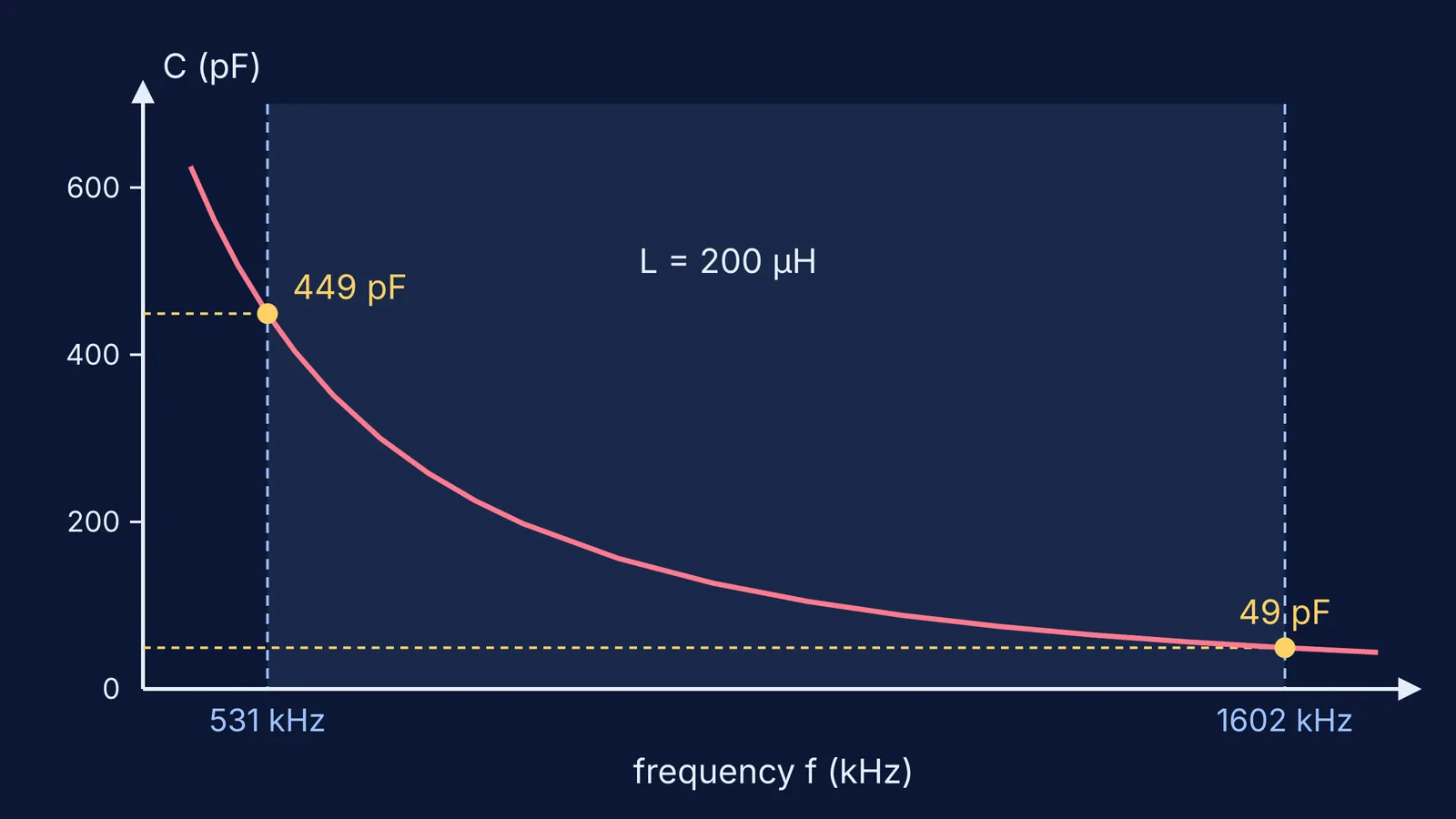
Here is a full worked example. Take a tuning coil of L = 200 µH and the 531 to 1602 kHz band, whose two ends both carry stations on Prasar Bharati's list.
Write the working formula: C = 1/(4π²f²L), with 4π² ≈ 39.48 and L = 2 × 10⁻⁴ H.
Lowest frequency gives C_max. At f = 531 × 10³ Hz, f² ≈ 2.820 × 10¹¹, so 4π²f²L ≈ 39.48 × 2.820 × 10¹¹ × 2 × 10⁻⁴ ≈ 2.226 × 10⁹. C_max ≈ 4.49 × 10⁻¹⁰ F, about 449 pF.
Highest frequency gives C_min. At f = 1602 × 10³ Hz, f² ≈ 2.566 × 10¹², so 4π²f²L ≈ 2.026 × 10¹⁰. C_min ≈ 4.94 × 10⁻¹¹ F, about 49 pF.
Check with the ratio rule: (1602/531)² ≈ (3.017)² ≈ 9.10, and 449/49.4 ≈ 9.1. The two methods agree.
Find one station in the middle. AIR Shimla is listed on 774 kHz, so C ≈ 449 × (531/774)² ≈ 211 pF, safely between the two ends.
Answer: the variable capacitor must cover roughly 49 pF to 449 pF.
Why does FM need a much smaller capacitor swing?
The FM band of 88 to 108 MHz quoted by TRAI has a frequency ratio of only about 1.23, so the capacitance ratio is (108/88)² ≈ 1.51. With an illustrative 0.1 µH coil, C runs from about 32.7 pF at 88 MHz down to about 21.7 pF at 108 MHz. Compare that with the ninefold swing for medium wave: a narrow band in relative terms needs only a small turn of the capacitor. Our post on the wavelength of FM and AM radio waves shows the same bands from the wavelength side.
What mistakes cost marks in tuning-range questions?
Before you write the final answer, run this checklist:
Units: kHz and MHz to Hz, µH to H, then F to pF at the end (1 pF = 10⁻¹² F).
The 2π: ω₀ = 1/√(LC) from NCERT is in rad/s. If the question gives frequency in kHz, use f = ω₀/2π.
Square the ratio: the capacitance ratio is (f_max/f_min)², not f_max/f_min.
Reverse questions: if you are given the capacitor range and asked for the band, use f ∝ 1/√C. A 9:1 capacitor gives roughly a 3:1 frequency range.
Plausibility: tuning capacitors for medium wave come out in tens to hundreds of picofarads. An answer in microfarads usually means a lost power of ten.
It also helps to picture what the circuit is doing at resonance. Our LC oscillation simulation post lets you watch energy move between the capacitor and the coil, and see the period change as C changes.
If you get the wrong answer and cannot see why, the Fermi Problem Library has worked problems with a step-by-step solver that explains the reasoning rather than printing an answer. If the gap is the idea of resonance itself, the Fermi Concept Library gives each concept in physics its own lesson.
Try it yourself next: redo the worked example with a 300 µH coil, then check that the ratio still comes out near 9.1.


