

On this page
Connect a charged capacitor to an inductor and nothing seems to happen on paper. In a simulation, though, you can watch the energy move: out of the capacitor, into the inductor's magnetic field, back into the capacitor with the plates' signs reversed, and around again. Here is what to look for, and how to predict the period before you press play.
What happens to energy in an LC circuit?
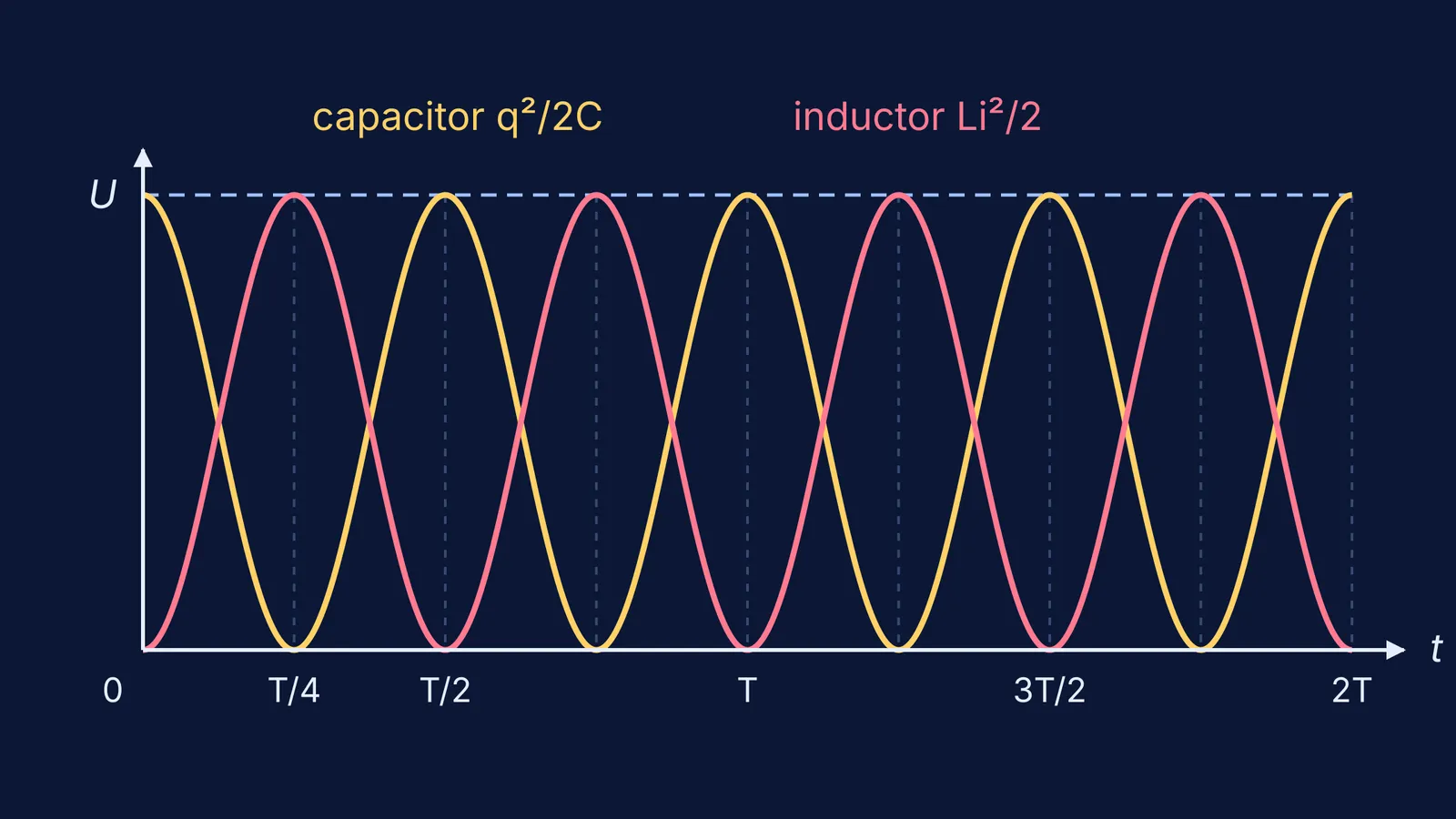
An ideal LC circuit has no resistance, so energy only changes form. According to OpenStax University Physics Volume 2, section 14.5, the total energy is U = q²/2C + Li²/2, and this sum stays constant as charge and current change.
Here is one cycle, starting with a fully charged capacitor:
At t = 0, all the energy sits in the capacitor's electric field and the current is zero.
Current starts to flow. The capacitor loses charge and the inductor's magnetic field grows.
At T/4 the capacitor is completely discharged, the same OpenStax section notes, and all the energy is in the inductor as Li²/2, with the current at its maximum.
The inductor keeps the current going, so the capacitor charges up again with opposite polarity by T/2.
The second half runs in reverse; at T everything is back to the start.
How do you predict the period of an LC circuit?
The charge oscillates with angular frequency ω = 1/√(LC), as derived in OpenStax University Physics Volume 2. Since T = 2π/ω, the period of an LC circuit is T = 2π√(LC).
A worked example using the values from that OpenStax section, L = 2.0 × 10⁻² H and C = 8.0 × 10⁻⁶ F:
LC = 1.6 × 10⁻⁷ s², so √(LC) = 4.0 × 10⁻⁴ s.
ω = 1/√(LC) = 2.5 × 10³ rad/s, which matches the textbook's answer.
T = 2π × 4.0 × 10⁻⁴ s ≈ 2.5 × 10⁻³ s, or about 2.5 ms. That is roughly 400 oscillations every second.
The capacitor first empties at T/4 ≈ 6.3 × 10⁻⁴ s, the same time OpenStax gets.
Write these numbers down first. Then set the same L and C in a simulation, time two capacitor-full moments of the same polarity, and compare.
How is an LC circuit like a mass on a spring?
For a block on a spring, OpenStax University Physics Volume 1 gives the period as T = 2π√(m/k), and notes that the period does not depend on the amplitude. The LC circuit follows the same equation, and the OpenStax LC section lists the swaps:
Mass m becomes inductance L (both resist change: one in velocity, one in current).
Spring constant k becomes 1/C (a small capacitance is like a stiff spring).
Position x becomes charge q.
Velocity v becomes current i.
So the capacitor's energy q²/2C plays the role of the spring's stored energy kx²/2, and the inductor's Li²/2 plays the block's kinetic energy mv²/2. An empty capacitor is the block passing equilibrium at top speed. Our post on energy, compression and maximum speed in spring-block systems works through the mechanical side.
Six predictions to test in an LC simulation
Each prediction follows from T = 2π√(LC) and the energy formula U = q²/2C in OpenStax section 14.5. Commit to an answer, then run it.
At T/8, how is the energy split? Equally. The capacitor's share is cos²(ωt), and cos²(π/4) = 1/2.
Make C four times larger. The period doubles, because T depends on √C.
Make L four times larger and C four times smaller. The period does not change, since LC is the same.
Double the starting charge. The period stays the same, just as a spring's period ignores amplitude, but the total energy becomes four times larger, because U depends on q².
Watch the moment the capacitor is empty. The current should be at its largest, in either direction.
Compare the charge graph and the energy graph. Count how many energy peaks fit into one charge period. You should see two.
For why this helps, see what PhET research says interactive physics simulations are good for; for the full derivation, see LC oscillations and energy swapping between capacitor and inductor.
Where can you try an LC simulation?
Any LC simulation that lets you set L, C and the starting charge will do. Our Fermi Simulation Lab has interactive simulations for ideas that are easier to see than to read, so you can run the six predictions above and compare your numbers with the screen. If the spring analogy still feels shaky afterwards, Fermi's AI tutor can work out what you already know, run the simulation with you and check your understanding as it goes.
Start with prediction 1: write down the energy split at T/8, then press play.


