On this page
In The Language of Chemistry, the first ICSE Class 9 chemistry chapter, you meet sodium, ammonium and sulphate described as "radicals". Later, in organic chemistry or a news story about free radicals, the same word means something else. Here is the ICSE meaning, a valency table, and how to turn two radicals into a correct formula.
What are radicals in ICSE chemistry?
The CISCE Class IX chemistry syllabus lists "Radicals – definition; formulae and valencies" under The Language of Chemistry (CISCE Class IX chemistry syllabus, copy hosted by CollegeDekho). Always check the syllabus for your own exam year, because CISCE revises it.
In ICSE usage, a radical is an atom or a group of atoms that carries a charge and behaves as a single unit in a reaction. In other words, it is an ion, such as Na⁺ or SO₄²⁻.
The Selina textbook answers put the two types simply: a positively charged radical is called a basic radical, and a negatively charged radical is called an acidic radical (Selina Class 9 Chapter 1 solutions on BYJU'S).
In a salt, the names usually match where each part came from. In NaOH + HCl → NaCl + H₂O, the Na⁺ came from the base, so it is the basic radical; the Cl⁻ came from the acid, so it is the acidic radical.
Which radicals are basic and which are acidic? A valency table
The valency of a radical is the number of charges it carries, so Al³⁺ has valency 3 and SO₄²⁻ has valency 2. Learn them by valency group.
Basic radicals (cations):
Valency 1: sodium Na⁺, potassium K⁺, silver Ag⁺, hydrogen H⁺, ammonium NH₄⁺, cuprous Cu⁺
Valency 2: magnesium Mg²⁺, calcium Ca²⁺, zinc Zn²⁺, lead Pb²⁺, ferrous Fe²⁺, cupric Cu²⁺
Valency 3: aluminium Al³⁺, ferric Fe³⁺
Acidic radicals (anions):
Valency 1: chloride Cl⁻, bromide Br⁻, hydroxide OH⁻, nitrate NO₃⁻, nitrite NO₂⁻, bicarbonate HCO₃⁻, bisulphate HSO₄⁻
Valency 2: oxide O²⁻, sulphide S²⁻, sulphate SO₄²⁻, sulphite SO₃²⁻, carbonate CO₃²⁻
Valency 3: phosphate PO₄³⁻, nitride N³⁻
Two patterns save effort. Ammonium is the only polyatomic basic radical in this list; every other polyatomic radical here is acidic. And for iron and copper, which show variable valency, "-ous" is the lower valency and "-ic" the higher. To see where single-atom valencies come from, our post on finding valency from electron configuration walks through it.
How do you write a formula from radicals?
Use this six-step routine every time:
Write the basic radical first and the acidic radical second.
Write each radical's valency above its symbol.
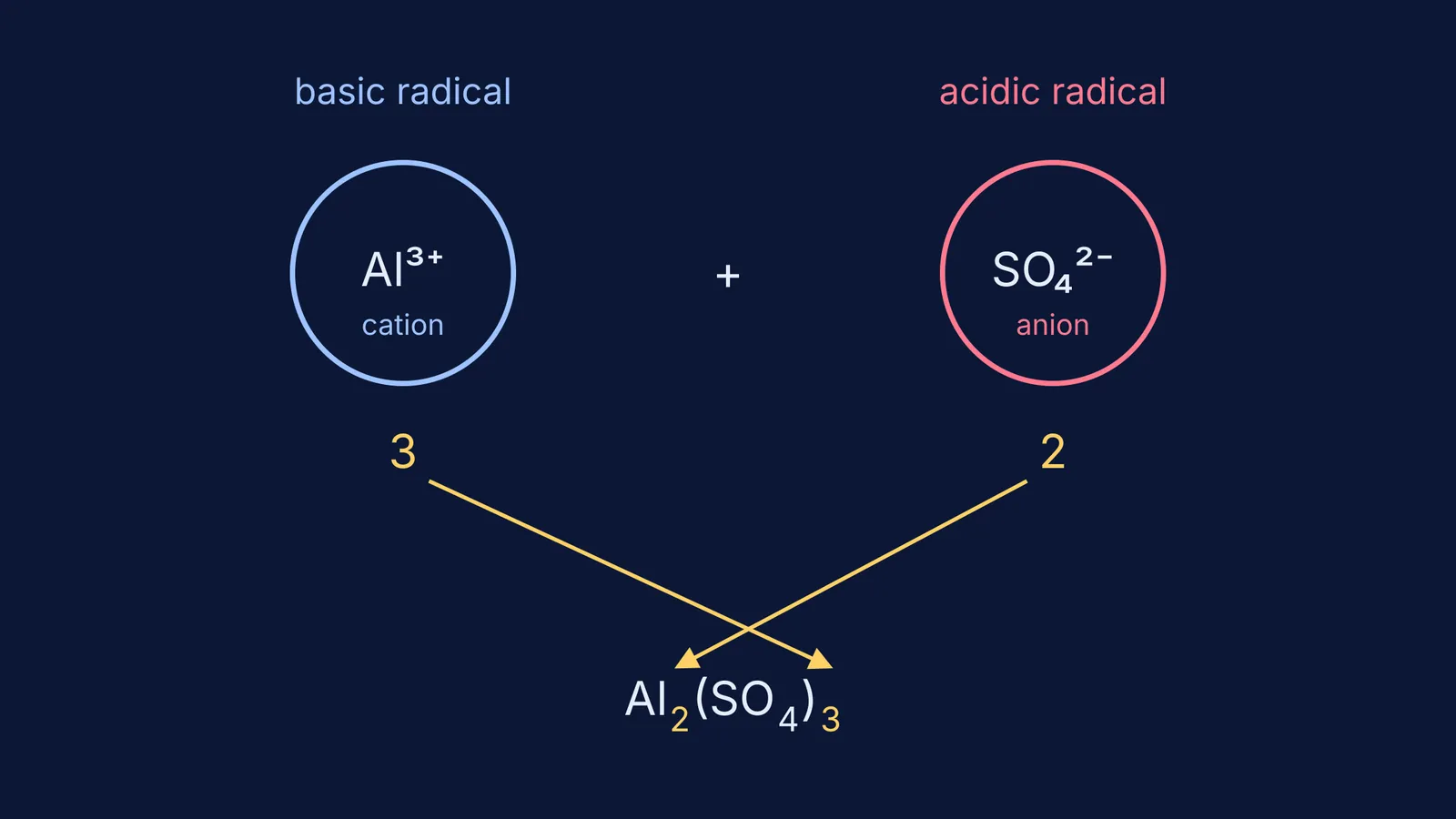
Criss-cross: the valency of one becomes the subscript of the other.
Divide both subscripts by their common factor if they share one.
Put a polyatomic radical in brackets if its subscript is more than 1.
Check that total positive charge equals total negative charge.
Worked example, aluminium sulphate: Al³⁺ and SO₄²⁻. Crossing gives Al₂(SO₄)₃. Check: 2 × 3 = 6 positive charges and 3 × 2 = 6 negative charges, so it balances.
Three more to try, with answers: calcium carbonate is Ca₂(CO₃)₂ after crossing, which simplifies to CaCO₃; ferric hydroxide is Fe(OH)₃; ammonium phosphate is (NH₄)₃PO₄. For more practice on the criss-cross step itself, see how to write chemical formulas using valency in Class 9.
If you keep getting the brackets or the simplifying step wrong, the Fermi Problem Library has worked problems with a step-by-step solver that explains the reasoning rather than printing an answer.
Is an ICSE radical the same as a free radical?
No. In current chemistry, a radical (or free radical) is a species with an unpaired electron, as defined in the IUPAC Gold Book entry for radical.
The ICSE meaning is the older one. Until late in the 20th century, chemists used "radical" for any connected group of atoms, and the term goes back to Louis-Bernard Guyton de Morveau in 1785 and Antoine Lavoisier in 1789, from the Latin radix, meaning root (Wikipedia: Radical (chemistry))).
So the chloride ion, Cl⁻, is an ICSE acidic radical, but it is not a free radical: it has eight valence electrons, all paired. A lone chlorine atom, Cl·, with seven valence electrons, is a free radical. Our explainer on homolytic and heterolytic fission shows how bond breaking makes each kind. In an ICSE answer, writing the formula with its charge beside the name, such as "sulphate radical (SO₄²⁻)", makes clear which meaning you intend.
How can you learn the valency table quickly?
Try a short daily drill for a week:
Days 1 to 3: cover one valency group at a time and write it out from memory, then check.
Days 4 to 6: write ten random pairs (say, ammonium + sulphate) and the formula for each.
Day 7: name ten formulae back into words, such as Fe₂(SO₄)₃ to ferric sulphate.
If an idea behind the table keeps slipping, the Fermi Concept Library gives every concept in chemistry its own lesson.
Once that feels easy, keep it fresh by writing five new formulae a day from your textbook's exercise.