

On this page
To understand how elements react and form compounds, you must first understand their electron configuration. According to the NCERT Class 9 Science textbook (Chapter 4), the chemical behavior of an atom is defined by its outermost shell.
By looking at the distribution of electrons in an atom, you can quickly calculate its valency—the combining capacity of the element. This simple number predicts how atoms will bond with one another to form molecules.
What are valence electrons?
Electrons in an atom revolve around the nucleus in specific orbits or shells. The electrons present in the outermost shell of an atom are known as valence electrons.
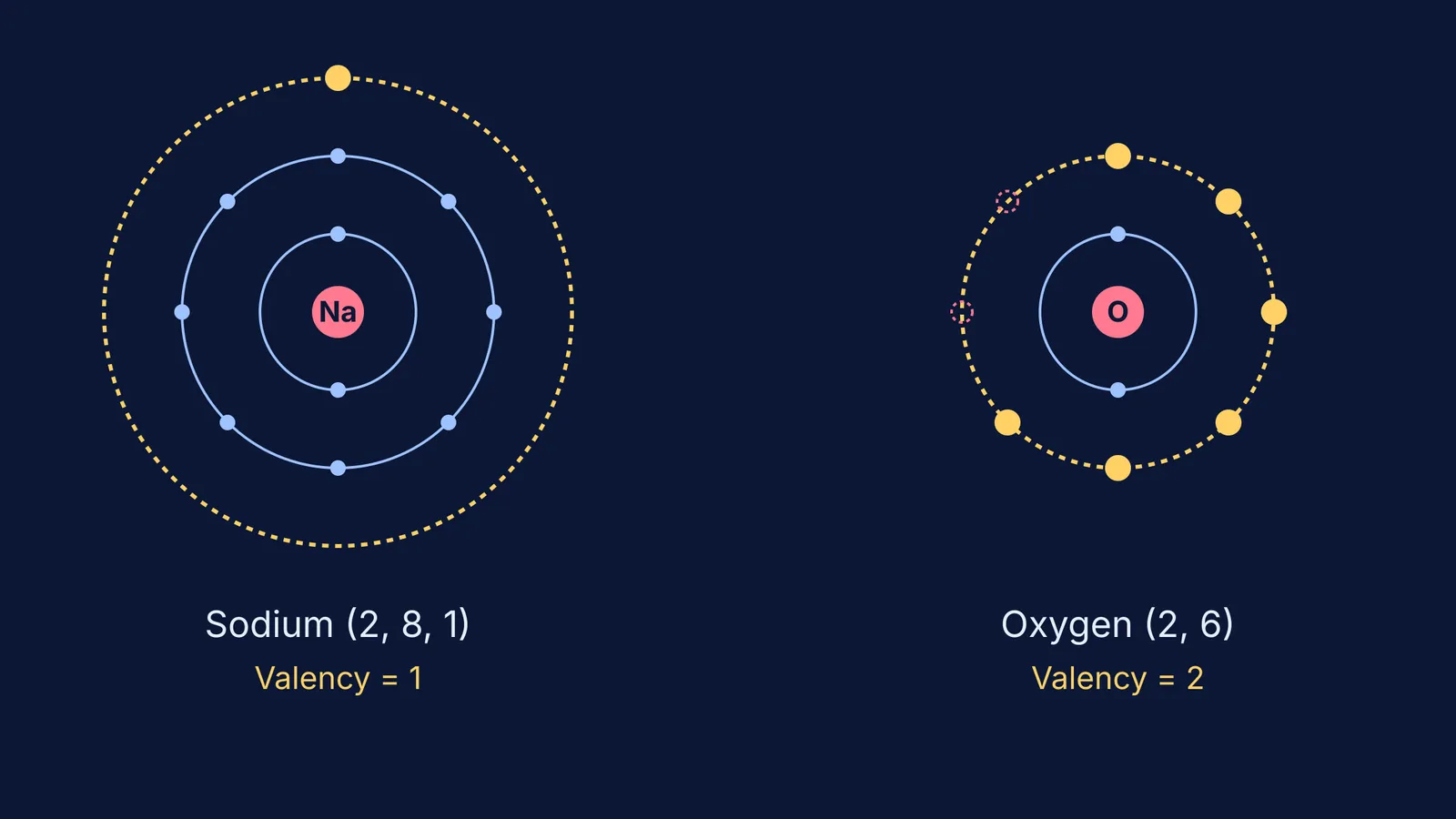
These are the only electrons involved in chemical reactions. Because the inner shells are tightly bound to the nucleus, they do not participate in sharing or transferring electrons. For example, sodium has an atomic number of 11 and an electronic configuration of 2, 8, 1. Its outermost shell (the M shell) contains 1 electron, meaning sodium has 1 valence electron.
The Bohr-Bury scheme states that the outermost shell of an atom can accommodate a maximum of 8 electrons. Elements with fewer than 8 electrons in their outermost shell are chemically active, meaning they are unstable and will try to react with other elements. When atoms react, they either share, gain, or lose electrons from this outermost shell to reach a stable state.
To determine the configuration of any element, you need to follow the Bohr-Bury Rules for the Distribution of Electrons in Shells. Once you have the arrangement, finding the valence electrons is as simple as looking at the last number.
How do you find valency from electronic configuration?
Valency is the combining capacity of an atom, representing the number of electrons it must gain, lose, or share to achieve a stable octet (8 electrons) in its outermost shell.
You can find the valency directly from the number of valence electrons using two straightforward rules:
If the valence electrons are 1, 2, 3, or 4: The valency is equal to the number of valence electrons. For instance, magnesium (2, 8, 2) has 2 valence electrons, so its valency is 2.
If the valence electrons are 5, 6, or 7: The valency is calculated by subtracting the number of valence electrons from 8. For instance, oxygen (2, 6) has 6 valence electrons, so its valency is 8 − 6 = 2.
If the outermost shell is completely filled with 8 electrons, the atom is chemically stable and has a valency of 0.
While most elements follow the octet rule, the lightest elements—hydrogen, helium, and lithium—follow the duplet rule. Their outermost shell is the K shell, which can only hold a maximum of 2 electrons. Helium already has 2 electrons in its K shell, making it stable with a valency of 0. Hydrogen has 1 electron, so its valency is 1 because it needs 1 more electron to complete its duplet.
If you want to review the foundational definitions of atomic structure or any other topic, the Fermi Concept Library has every concept in physics, chemistry, biology, mathematics and computing, each with its own lesson and its place in the map.
Valency table for the first 18 elements
For Class 9 students, memorising the atomic numbers and valencies of the first 18 elements is highly recommended. Here is how their electron configurations translate into valency:
Hydrogen (1): 1 (Valency 1)
Helium (2): 2 (Valency 0)
Lithium (3): 2, 1 (Valency 1)
Beryllium (4): 2, 2 (Valency 2)
Boron (5): 2, 3 (Valency 3)
Carbon (6): 2, 4 (Valency 4)
Nitrogen (7): 2, 5 (Valency 8 − 5 = 3)
Oxygen (8): 2, 6 (Valency 8 − 6 = 2)
Fluorine (9): 2, 7 (Valency 8 − 7 = 1)
Neon (10): 2, 8 (Valency 0)
Sodium (11): 2, 8, 1 (Valency 1)
Magnesium (12): 2, 8, 2 (Valency 2)
Aluminium (13): 2, 8, 3 (Valency 3)
Silicon (14): 2, 8, 4 (Valency 4)
Phosphorus (15): 2, 8, 5 (Valency 8 − 5 = 3)
Sulphur (16): 2, 8, 6 (Valency 8 − 6 = 2)
Chlorine (17): 2, 8, 7 (Valency 8 − 7 = 1)
Argon (18): 2, 8, 8 (Valency 0)
*Note: Phosphorus (2, 8, 5) frequently shows a valency of 3 or 5 depending on the compound it forms, but the standard Class 9 rule gives its primary valency as 3.*
Once you know the valencies of these elements, you can predict how they will combine. You can learn How to write chemical formulas using valency in Class 9 to master writing equations for your board exams.
Why do atoms want 8 valence electrons?
Noble gases like neon and argon are found in nature as single, unreactive atoms. Their lack of reactivity is due to their electron configuration: their outermost shells are completely full.
Every other element on the periodic table tries to reach this same state of stability. Metals, which typically have 1, 2, or 3 valence electrons, find it easier to lose those few electrons to reveal the full shell underneath. Non-metals, with 5, 6, or 7 valence electrons, find it easier to gain the few electrons they are missing to reach 8.
For example, consider table salt (sodium chloride, NaCl). Sodium has 1 valence electron (2, 8, 1), and chlorine has 7 valence electrons (2, 8, 7). Sodium can achieve a stable octet by losing its 1 valence electron, exposing the full shell underneath (2, 8). Chlorine, on the other hand, needs exactly 1 electron to complete its outermost shell to 8 (2, 8, 8). When they react, sodium transfers its electron to chlorine. Both atoms achieve a stable octet, forming a strong chemical bond. This drive to complete the octet is the fundamental reason why chemical reactions happen.


