

On this page
Structure of Atom shows you two kinds of graph that look alike but answer different questions. One plots ψ² against r. The other plots 4πr²ψ² against r. Mix them up and you will say the electron in hydrogen is most likely to be found inside the nucleus.
What is the difference between ψ² and 4πr²ψ²?
According to the NCERT Class 11 Chemistry chapter on Structure of Atom, ψ² at a point gives the probability density of the electron at that point. The same chapter notes that for the 1s orbital this density is highest at the nucleus and falls sharply as you move away.
To ask how likely the electron is at distance r, in any direction, you need the volume at that distance. A thin spherical shell of radius r and thickness dr has volume 4πr² dr. So the probability in that shell is 4πr²ψ² dr, which is the radial distribution function derived in Paul Percival's SFU lecture notes on the hydrogen atom.
Think of a dartboard. The bullseye has the most darts per square centimetre, but it is tiny. A wider ring further out holds more darts in total. Likewise, ψ² is largest at the centre, but the r² factor pulls the radial curve to zero at r = 0.
How do you count peaks and nodes on a radial curve?
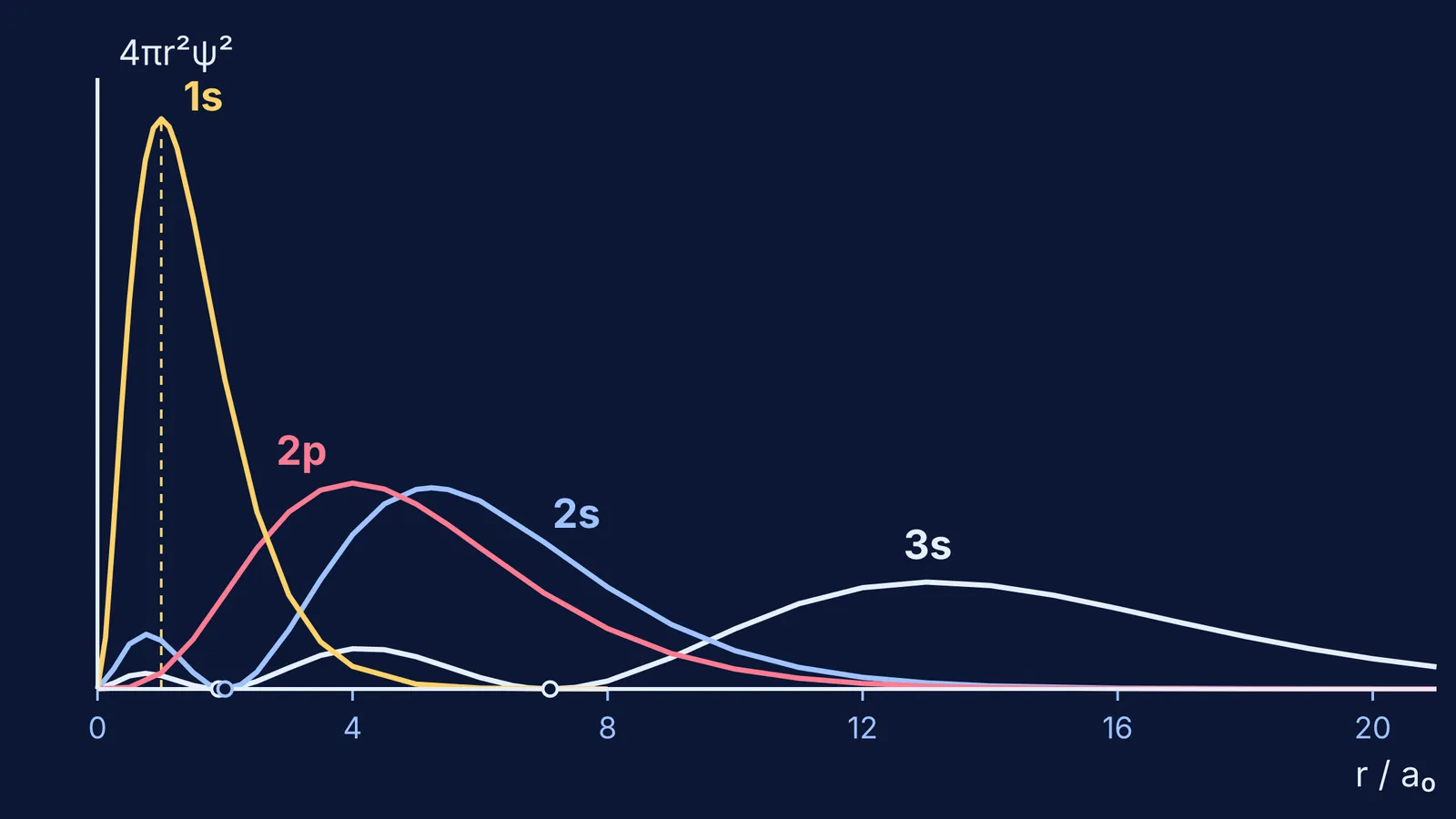
NCERT gives the rule: an orbital has n − 1 nodes in total, made up of l angular nodes and n − l − 1 radial nodes (NCERT, section 2.6.2). A radial node is a distance where the curve touches zero between its humps, so the number of peaks is one more than the number of radial nodes: n − l. The zero at r = 0 and the tail at large r do not count as nodes.
1s (n = 1, l = 0): 0 radial nodes, 1 peak.
2s (n = 2, l = 0): 1 radial node, 2 peaks, a small inner one and a larger outer one.
2p (n = 2, l = 1): 0 radial nodes, 1 peak. Its one node is a plane, as the University of Sheffield Orbitron 2p page notes for all p orbitals.
3s (n = 3, l = 0): 2 radial nodes (Orbitron 3s page) and 3 peaks, with the outermost peak tallest.
Our post on s, p and d orbital shapes and their nodes in 3D shows where these nodes sit in space.
Where does the most probable radius lie?
The most probable radius is the r at the top of the tallest peak. For hydrogen's 1s orbital the radial function is P(r) = (4/a₀³) r² e^(−2r/a₀), and setting dP/dr = 0 gives r = a₀ (SFU lecture notes). The Orbitron site puts this maximum at 52.9 pm (Orbitron 1s page), the same as the first Bohr radius in our post on radius and speed in the nth Bohr orbit.
The same notes put the average distance at 1.5a₀, larger than a₀, because of the long tail on the right.
Worked example: the 2p peak
For n = 2, l = 1, the general hydrogen radial function in the SFU notes reduces to R ∝ r e^(−r/2a₀).
Square it and multiply by r²: P ∝ r⁴ e^(−r/a₀).
Differentiate: dP/dr ∝ (4r³ − r⁴/a₀) e^(−r/a₀).
Set it to zero: r = 4a₀, about 212 pm.
The same functions give the 2s node at r = 2a₀ and its outer peak near 5.2a₀. For 3s, the two nodes fall near 1.9a₀ and 7.1a₀, with the main peak near 13a₀. 2s has a small hump near the nucleus that 2p lacks. For multi-electron atoms, NCERT notes that an s electron spends more time near the nucleus than a p electron of the same shell, so it is held more tightly. In hydrogen the two still have equal energy, as our post on why 2s and 2p have the same energy in hydrogen explains.
How do you identify an orbital from its radial curve?
On any exam graph:
Read the y-axis label: ψ, ψ² or 4πr²ψ² (sometimes written r²R²).
For an s orbital, ψ and ψ² are not zero at r = 0; 4πr²ψ² always starts at zero.
Count the humps. That number is n − l.
Count the touch-downs between the humps. That number is n − l − 1.
Use the l value given in the question to find n.
Read the most probable radius off the tallest peak.
A trap to watch for: two peaks with one node fits both 2s and 3p, since n − l = 2 for each. If l is not given, look for clues such as "spherical" or "nodal plane".
To check your node counting, the Fermi Concept Library has a lesson for each chemistry concept, and the Fermi Problem Library has a step-by-step solver that explains the reasoning. Sketch the 3p curve from the rules above first, then compare.


