

On this page
Most of us first meet orbitals as flat drawings in a Class 11 textbook. Turn those shapes around in 3D and many of the rules about nodes stop being things to memorise: you can see them. Here is how to predict the nodes of any orbital from n and l, and what the shape actually means.
What do the s, p and d orbital shapes actually show?
An orbital is a wavefunction, written Ψ, and Ψ² gives the probability of finding an electron in a given volume of space. The solid shape in a textbook or a 3D viewer is a contour surface, and by convention it encloses 90% of the electron probability. So a lobe is not a track the electron runs along; it is where you would find the electron most of the time.
The shapes themselves:
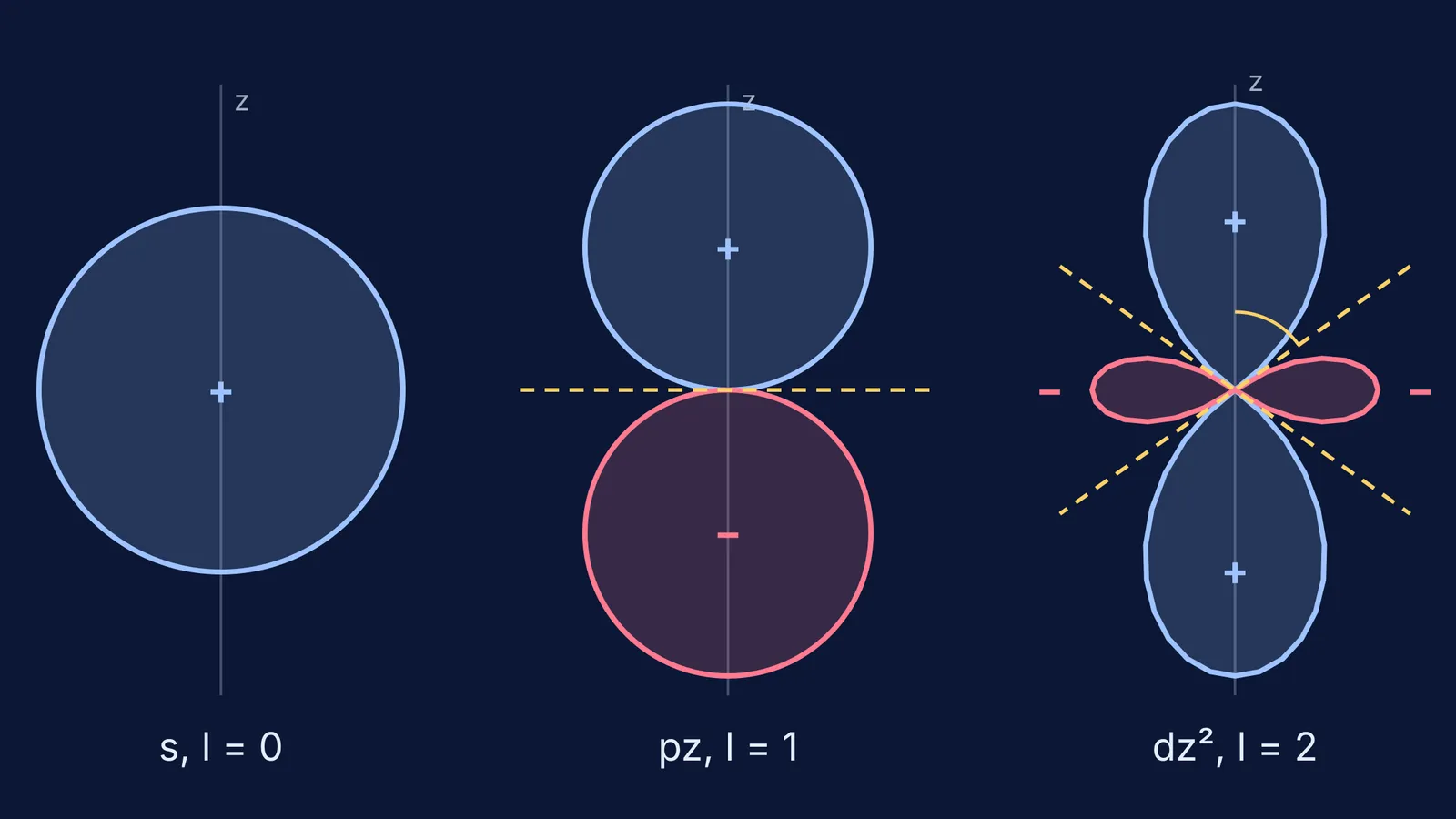
s orbitals are spheres centred on the nucleus.
p orbitals have two lobes along one axis, with a flat nodal plane through the nucleus between them.
d orbitals come in five: dxy, dyz, dxz, dx²−y² and dz²/Quantum_Mechanics/09._The_Hydrogen_Atom/Atomic_Orbitals/d_Atomic_Orbitals). Four look like a four-leaf clover; dz² has a lobe above and below with a doughnut around the middle.
The two colours on a 3D orbital are the sign of Ψ, not electric charge. In the University of Sheffield's Orbitron, made by Mark Winter, red shows positive values of the wavefunction and white shows negative ones. The probability depends on Ψ², so a positive lobe and a negative lobe of the same size are equally likely places to find the electron.
How do you work out radial and angular nodes from n and l?
A node is where the probability is zero; at a node you will never find the electron/Quantum_Mechanics/09._The_Hydrogen_Atom/Radial_Nodes). There are two kinds, and three rules cover them, all set out on the same LibreTexts page on nodes/Quantum_Mechanics/09._The_Hydrogen_Atom/Radial_Nodes):
Angular nodes = l. They are flat planes or cones through the nucleus.
Radial nodes = n − l − 1. They are spheres around the nucleus.
Total nodes = n − 1.
How many nodes do 2s, 3p, 3d, 4d and 4f have?
Predict first, then rotate:
2s: n = 2, l = 0. No angular nodes, one radial node.
3p: n = 3, l = 1. One angular node (a plane), one radial node.
3d: n = 3, l = 2. Two angular nodes, no radial nodes.
4d: n = 4, l = 2. Two angular nodes, one radial node, three in total.
4f: n = 4, l = 3. Three angular nodes, no radial nodes.
The first three match the worked values on LibreTexts/Quantum_Mechanics/09._The_Hydrogen_Atom/Radial_Nodes). For a step-by-step version with more practice, see our guide to counting radial and angular nodes, and if n and l themselves feel shaky, start with what the four quantum numbers mean.
dz² catches people out: l = 2 means two angular nodes, but there are no planes. Its angular nodes are cones/Quantum_Mechanics/09._The_Hydrogen_Atom/Atomic_Orbitals/d_Atomic_Orbitals). NPTEL's atomic structure notes give the cone angles as the roots of (1/2)(3cos²θ − 1), measured from the z-axis. Set it to zero: cos θ = ±1/√3, so θ is about 54.7° and 125.3°. That gives two cones, which is two angular nodes, just as l predicts.
What should you check when you rotate an orbital in 3D?
Use this five-point check in any 3D viewer:
Count the flat nodes edge-on. Rotate until a nodal plane becomes a line.
Look inside for spheres. A 90% surface hides radial nodes, so you need a slice or a density control. The Orbitron lets you change the density level that is drawn.
Check the colours flip. The sign of Ψ changes as you cross a node, so neighbouring lobes across a node should be different colours.
Match your prediction. If the count does not equal n − 1, recheck n and l before you blame the picture.
Ask where the electron is most likely. Radial probability adds up the probability over thin spherical shells at each distance. For hydrogen's 1s orbital it peaks at 52.9 pm, the same radius Bohr calculated for n = 1.
The answer: 4p has n = 4 and l = 1, so one angular node and 4 − 1 − 1 = 2 radial nodes.
Where can you practise turning orbitals in 3D?
Our piece on simulations versus static diagrams looks at when a picture you can move helps more than a printed figure. If picturing 3D shapes from flat pages is where you get stuck, the Fermi Simulation Lab has interactive simulations for ideas that are easier to see than to read. If the gap is the idea behind n and l, each concept in the Fermi Concept Library has its own lesson and its place in the map.
Pick one orbital tonight, predict its nodes on paper, then rotate it and check.


