On this page
"Find all m for which both roots are greater than 1" is a staple quadratic-equations question. Most students remember three conditions; fewer can say why each is there, which is how wrong values of m slip through. Here are all three on one graph, plus a full example.
What are the conditions for both roots to be greater than k?
Take f(x) = ax² + bx + c with roots α and β. Both roots are greater than k when three conditions hold at the same time, as listed in Careers360's location-of-roots notes for JEE Main (the Cracku quadratic equations notes give the same test for a > 0):
D = b² − 4ac ≥ 0, so the roots are real (they may be equal).
a·f(k) > 0, so k lies outside the interval between the roots.
−b/2a > k, so the axis of symmetry lies to the right of k.
The a·f(k) form works whether the parabola opens up or down; when a > 0 it is just f(k) > 0.
Why does each condition matter on the graph?
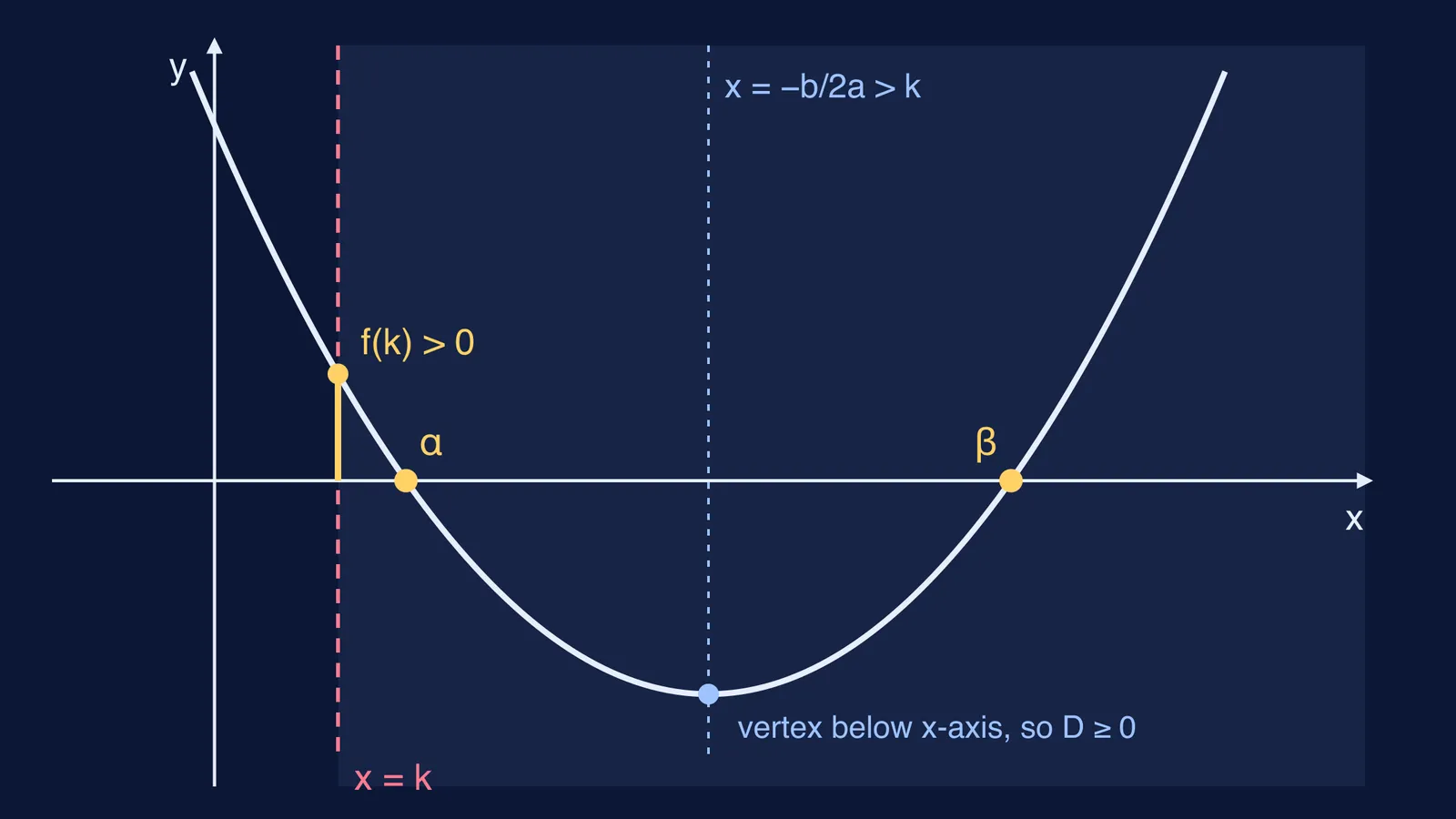
Look at the upward parabola in the graph above (a > 0).
D ≥ 0: the vertex sits on or below the x-axis, so the curve meets the axis.
a·f(k) > 0: the curve is above the axis at x = k. Between the roots an upward parabola is below the axis, so k is not between them. It could still be left of both roots or right of both.
−b/2a > k: this settles which side. The vertex lies midway between the roots, so if it is right of k and k is outside the roots, both roots are right of k.
Each condition rules out a case the others allow. For x² + 6x + 3 and k = 1, D = 24 > 0 and f(1) = 10 > 0, yet both roots, −3 ± √6, are negative: the vertex is at x = −3, left of 1. For x² − 4x + 8, f(1) = 5 > 0 and the vertex x = 2 is right of 1, but D = −16, so there are no real roots.
How do you find the parameter range? A worked example
Find all real m for which both roots of x² − 2mx + m + 6 = 0 are greater than 1. Here a = 1, b = −2m, c = m + 6 and k = 1.
Discriminant: D = 4m² − 4(m + 6) ≥ 0 gives (m − 3)(m + 2) ≥ 0, so m ≤ −2 or m ≥ 3.
Sign at k: f(1) = 7 − m. With a = 1, we need 7 − m > 0, so m < 7.
Vertex: −b/2a = m, and we need m > 1.
Intersect all three, do not take the union: m ≥ 3 and m < 7. The answer is 3 ≤ m < 7.
Check the edges:
m = 3 gives (x − 3)², a double root at 3 > 1, so m = 3 is included.
m = 7 gives x² − 14x + 13 = (x − 1)(x − 13). One root equals 1, so m = 7 is excluded. That is why condition 2 is strict.
m = 4 gives x² − 8x + 10, with roots 4 ± √6, about 1.55 and 6.45: the curve in the graph above.
What mistakes cost marks on these questions?
Writing a·f(k) ≥ 0. That lets a root equal k, which "greater than" does not allow.
Using D > 0 when equal roots are allowed. Use D > 0 only if the question says "distinct" or "unequal".
Testing f(k) > 0 when a is negative or depends on the parameter. Keep a·f(k), and check separately any value making a = 0.
Taking the union of the three ranges instead of the intersection.
Skipping the edge check.
If your answer keeps coming out wrong, the Fermi Problem Library has worked problems with a step-by-step solver that explains the reasoning rather than printing an answer, so you can compare your steps line by line.
How does this connect to other root-location questions?
The Careers360 notes use the same three ideas for the whole family:
Both roots less than k: D ≥ 0, a·f(k) > 0, −b/2a < k.
k between the roots: a·f(k) < 0 is enough on its own. See why one sign test settles whether k lies between the roots.
Both roots between k₁ and k₂: D ≥ 0, a·f(k₁) > 0, a·f(k₂) > 0 and k₁ < −b/2a < k₂.
If the sketch is the weak step, revisit how to sketch a parabola from its equation and turning "real roots" in a word problem into a discriminant condition. For the vertex and the discriminant, the Fermi Concept Library has a lesson for every concept in mathematics.
Practice: for which m are both roots of x² − 2mx + m + 6 = 0 less than 4? Same three steps.