

On this page
When a mathematics question asks you whether a physical situation is possible—like designing a park with a specific perimeter and area—it is usually testing your understanding of quadratic word problems. In real life, dimensions like length and breadth must be real, measurable numbers. By setting up a mathematical equation for the physical situation and finding its discriminant, you can prove mathematically whether the proposed design can actually exist in the real world or if it is physically impossible. This method saves you from trying to solve an equation that has no real solution.
A classic example of this type of problem, which is often found in the Class 10 NCERT Mathematics textbook, goes exactly like this: "Is it possible to design a rectangular park of perimeter 80 m and area 400 m²? If so, find its length and breadth."
Here is how you translate the words into an equation, and why the discriminant holds the answer.
How do you formulate the equations?
First, turn the constraints into algebraic expressions. Let the length of the rectangular park be l and its breadth be b. It helps to write down everything you know before you start combining equations.
We are given two facts:
The perimeter is 80 m:
The formula for the perimeter of a rectangle is 2(l + b). 2(l + b) = 80 Dividing both sides of the equation by 2 gives: l + b = 40 From this, we can express the length of the park in terms of the breadth: l = 40 − b
The area is 400 m²:
The standard formula for the area of a rectangle is length multiplied by breadth (l × b). l × b = 400
Now, substitute the expression for l into the area equation to eliminate one of the variables: (40 − b) × b = 400 40b − b² = 400
Rearranging this into the standard quadratic form (ax² + bx + c = 0) gives us the final equation to test: b² − 40b + 400 = 0
Is it possible to design the rectangular park?
To find out if this park can actually exist, we do not need to solve the whole equation immediately. Instead, we use the discriminant (D), which tells us the nature of the roots of a quadratic equation.
The discriminant of a standard quadratic equation is calculated as D = B² − 4AC.
For our equation (b² − 40b + 400 = 0), we can identify the coefficients:
A = 1
B = −40
C = 400
Plugging these values into the discriminant formula: D = (−40)² − 4(1)(400) D = 1600 − 1600 = 0
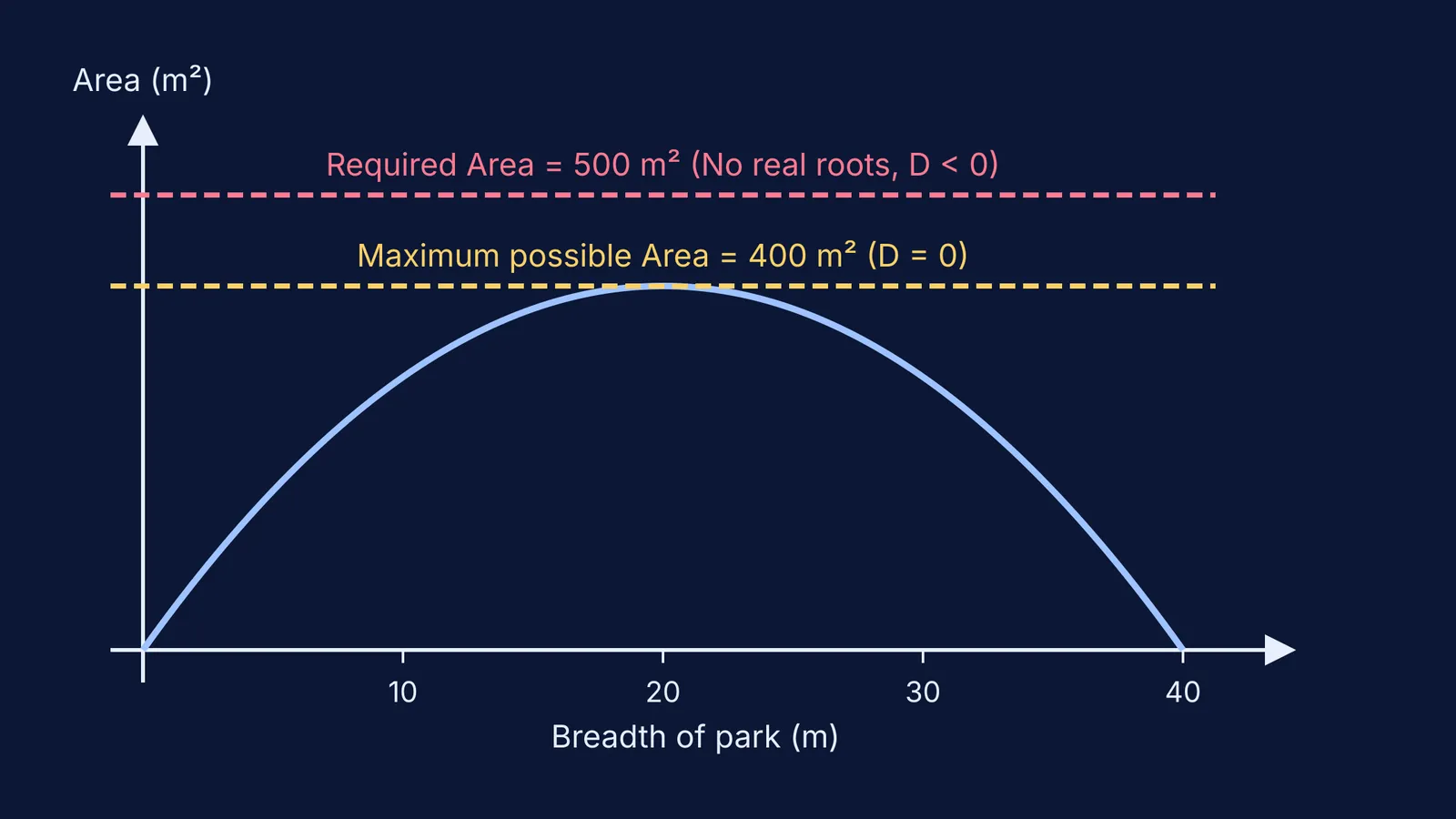
Because the discriminant is exactly 0, the equation has real and equal roots. This means yes, it is mathematically possible to design the park.
To find the dimensions, we use the quadratic formula to solve for the breadth: b = [−B ± √D] / 2A b = [−(−40) ± √0] / 2(1) b = 40 / 2 = 20 m
Since the breadth is 20 m, the length is l = 40 − 20 = 20 m. The park is a 20 m by 20 m square, which is a special type of rectangle that maximises the area for a given perimeter.
What if the discriminant is negative?
What would happen if the local council asked you to design a rectangular park with the same 80 m perimeter, but a larger area of 500 m²?
The new equation based on these constraints would be: b² − 40b + 500 = 0
Calculating the discriminant for this new constraint gives a completely different result: D = (−40)² − 4(1)(500) D = 1600 − 2000 = −400
Since D < 0, the equation has no real roots. In the physical world, length and breadth must be real numbers; you cannot measure an imaginary distance with a tape measure. Therefore, it is impossible to enclose 500 square metres of area with only 80 metres of fencing. As explained in our guide to when a quadratic is always positive, the discriminant test is a powerful tool for finding the absolute boundaries of mathematical functions and physical constraints.
How can you check your reasoning?
If you get stuck trying to translate these word problems into equations, or if you need to practice more scenarios, the Fermi Problem Library can help you build the skill. Instead of just printing the final roots, Fermi's step-by-step solver explains the logical reasoning behind setting up the algebraic expressions and interpreting the discriminant, ensuring you truly understand the geometry hidden inside the algebra. This approach helps you tackle not just area problems, but any physical constraint problem.


