

On this page
The distance formula turns a geometry question into arithmetic. For points (x₁, y₁) and (x₂, y₂), the distance is √[(x₂ − x₁)² + (y₂ − y₁)²], which NCERT's Class 10 textbook derives from Pythagoras theorem in Chapter 7, Coordinate Geometry.
How do you prove four points form a square using the distance formula?
Compute all six distances between the four points: four sides and two diagonals. A quadrilateral is a square when all four sides are equal and both diagonals are equal; this is the property NCERT's Example 2 uses to show that (1, 7), (4, 2), (−1, −1) and (−4, 4) are the vertices of a square (NCERT Class 10, Chapter 7).
Compare squared distances; square roots add nothing and invite slips.
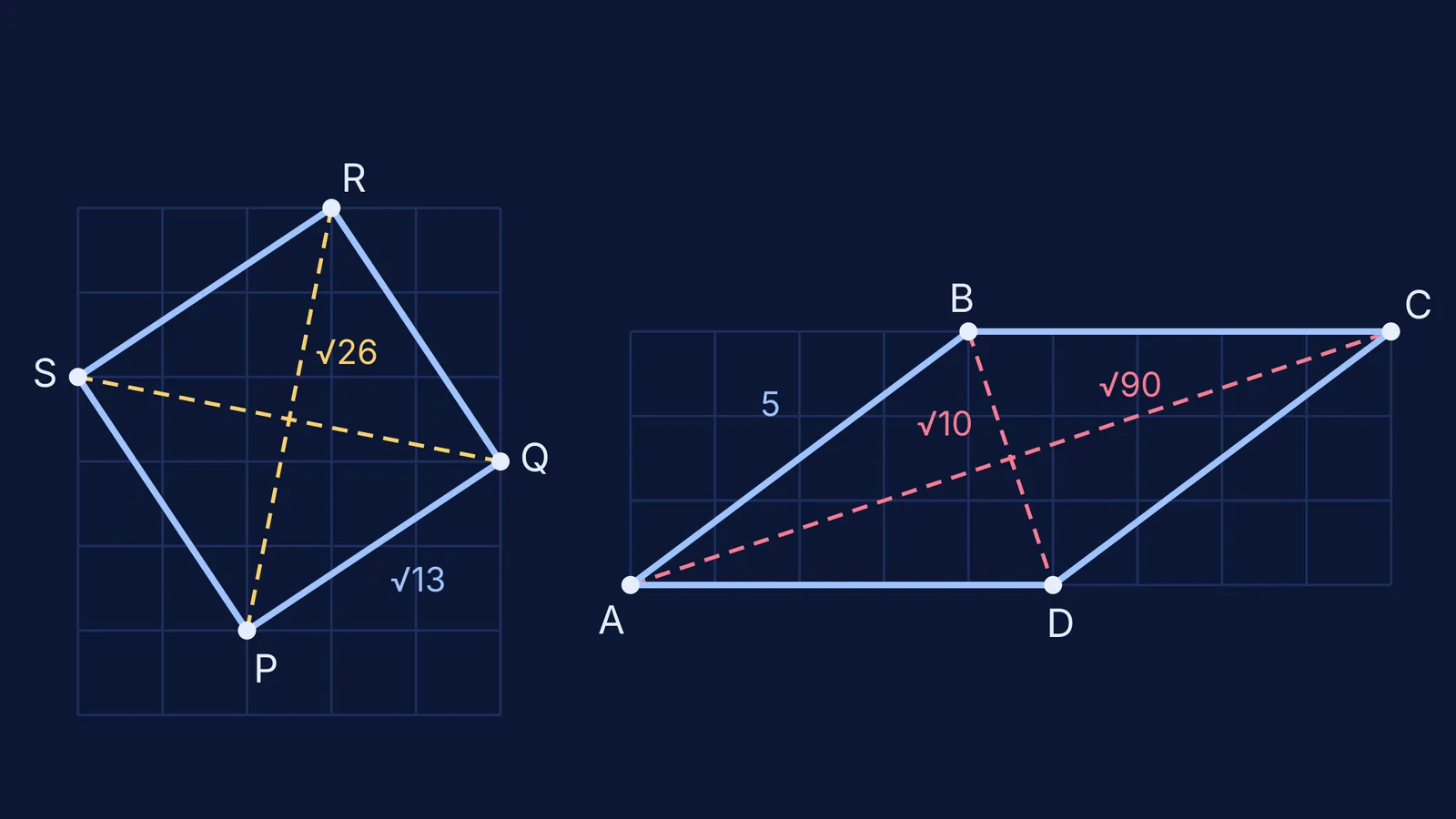
Worked example: take P(2, 1), Q(5, 3), R(3, 6) and S(0, 4).
PQ² = (5 − 2)² + (3 − 1)² = 9 + 4 = 13
QR² = (3 − 5)² + (6 − 3)² = 4 + 9 = 13
RS² = (0 − 3)² + (4 − 6)² = 9 + 4 = 13
SP² = (2 − 0)² + (1 − 4)² = 4 + 9 = 13
PR² = (3 − 2)² + (6 − 1)² = 1 + 25 = 26
QS² = (0 − 5)² + (4 − 3)² = 25 + 1 = 26
Four sides are equal (√13 each) and the two diagonals are equal (√26 each), so PQRS is a square. In any square, diagonal² = 2 × side² (here 26 = 2 × 13), a free check on your arithmetic.
Why do four equal sides only prove a rhombus?
A rhombus is a quadrilateral with all sides the same length, an equilateral parallelogram in Wolfram MathWorld's definition. Equal sides fix the lengths but not the angles, so the shape can lean over like a pushed door frame.
Try A(0, 0), B(4, 3), C(9, 3), D(5, 0). Every side squared is 25, so every side is 5. But AC² = 81 + 9 = 90 and BD² = 1 + 9 = 10. The diagonals are √90 and √10, nowhere near equal, so ABCD is a rhombus and not a square.
MathWorld also gives the rhombus diagonal rule p² + q² = 4a², where p and q are the diagonals and a is the side (MathWorld: Rhombus). Here 90 + 10 = 100 = 4 × 25. If the diagonals are also equal, then p² = q² = 2a², which is exactly the square condition above. That is why equal sides plus equal diagonals is enough.
NCERT also shows an alternative: four equal sides plus one right angle, checked with the converse of Pythagoras theorem (AD² + DC² = AC²). Either works; the diagonal check is usually quicker. For why a rhombus's diagonals cross at right angles, see our post on how to prove the diagonals of a rhombus are perpendicular.
How do you test for a parallelogram or a rectangle?
Many school questions ask you to name the quadrilateral formed by four points, as question 6 of NCERT Exercise 7.1 does. Use this order:
Parallelogram: the diagonals bisect each other (MathWorld: Parallelogram), so the midpoints of AC and BD are the same point.
Rectangle: a parallelogram whose diagonals are equal.
Rhombus: a quadrilateral with four equal sides.
Square: a rhombus with equal diagonals, or a rectangle with equal adjacent sides.
Example: A(0, 0), B(4, 2), C(3, 4), D(−1, 2). The midpoint of AC is (1.5, 2) and the midpoint of BD is (1.5, 2), so it is a parallelogram. AC² = 9 + 16 = 25 and BD² = 25 + 0 = 25, so the diagonals are equal and it is a rectangle. But AB² = 20 and BC² = 5, so it is not a square.
Why does that work? Equal diagonals that bisect each other put all four vertices on one circle, with each diagonal a diameter, so every corner is an angle in a semicircle: 90°.
If a question gives you three vertices and asks for the missing one, see how to find the fourth vertex of a parallelogram from three points.
What mistakes cost marks on these questions?
Wrong vertex order. If the points are listed out of order, AB, BC, CD and DA may include a diagonal. Sketch first, or use the six-distance sort.
Stopping at four equal sides. That proves only a rhombus. Show the diagonals too.
Collinear points. If three of the points lie on one line, there is no proper quadrilateral; the "if any" in the NCERT question allows for that answer.
No conclusion. End with the property and the name: all sides equal and diagonals equal, so ABCD is a square.
The same habit of comparing squared distances helps you classify a triangle as isosceles or right-angled using coordinates. For more practice, the Fermi Problem Library has worked problems with a step-by-step solver that explains the reasoning rather than printing an answer.


